




Here's how it works
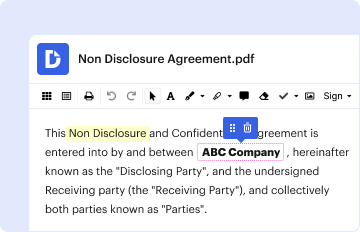
01. Edit your form online
Type text, add images, blackout confidential details, add comments, highlights and more.
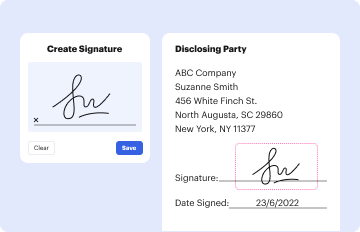
02. Sign it in a few clicks
Draw your signature, type it, upload its image, or use your mobile device as a signature pad.

03. Share your form with others
Send it via email, link, or fax. You can also download it, export it or print it out.
How to use or fill out Annuity 1035 Exchange and Transfer Rollover Form with our platform

- Click ‘Get Form’ to open the Annuity 1035 Exchange and Transfer Rollover Form in the editor.
- Begin by entering the name of the receiving company and their business address. Ensure that you provide accurate contact information for any follow-up.
- In Section 1, fill out the surrendering company’s details, including policy/account number, type of plan, and estimated transfer amount. This information is crucial for processing your request.
- Proceed to Section 2 to specify whether you are requesting a full or partial exchange. Indicate the amount you wish to transfer if it’s a partial exchange.
- Review Section 3 for disclosures and acknowledgments. It’s important to understand your rights and responsibilities regarding this transaction.
- Complete the taxpayer identification number certification in Section 4, ensuring all information is accurate to avoid any issues with tax reporting.
- Finally, sign and date the form in Section 5. If applicable, ensure that all required signatures are obtained from joint owners or beneficiaries.
Start filling out your Annuity 1035 Exchange and Transfer Rollover Form online for free today!
Fill out Annuity 1035 Exchange and Transfer Rollover Form online
It's free
It's free
Got questions?
We have answers to the most popular questions from our customers. If you can't find an answer to your question, please contact us.
Contact us
What are the disadvantages of a 1035 exchange?
The legislative history of 1035 states that exchange treatment is appropriate for individuals who have merely exchanged one insurance policy for another better suited to their needs and who have not actually realized gain. H.R. Rep. No. 1337, 83d Cong., 2d Sess.
What is the disadvantage of a 1035 exchange?
What Are Possible Disadvantages of a 1035 Exchange? These are some disadvantages of a 1035 exchange: Exchanging policies may trigger surrender charges, which reduce the value transferred to the new contract. The new policy often starts a new surrender charge schedule, so carefully read the terms of your contract.
What is considered a 1035 exchange?
A 1035 exchange, also known as a like-kind exchange, is a legal way to swap one insurance policy, annuity, endowment or long-term care product of like kind without triggering tax on any investment gains associated with the original contract.
How do I report a 1035 exchange on my tax return?
with a code 6 in Box 7, it is indicating a tax-free exchange of life insurance, annuity, or endowment contracts under Section 1035. Generally, this form has no impact on your Federal tax return; however, it may impact your state tax return. See the IRS Instructions for Forms 1099-R and 5498 for details.
What is the difference between a 1035 exchange and a transfer?
The term annuity transfer is sometimes used interchangeably with a 1035 exchange. Its named after the tax code, IRS Section 1035, which refers to a tax-free exchange of one nonqualified annuity for another nonqualified annuity.
Security and compliance
At DocHub, your data security is our priority. We follow HIPAA, SOC2, GDPR, and other standards, so you can work on your documents with confidence.
Learn more


People also ask
Is a 1035 exchange a rollover or transfer?
A 1035 Exchange allows you to directly transfer an existing account to a brand new account without triggering a taxable event.
Will the 1035 rollover transfer form be used?
You should use the 1035 Exchange Form when you want to transfer or exchange life insurance or annuity contracts without incurring tax penalties. This form is applicable for full or partial exchanges and is necessary to comply with IRS regulations.