






Understanding Federal Supporting Statements
Federal supporting statements are critical documents that provide detailed financial information to the IRS. They serve to clarify the financial conditions of a business or organization when filing tax returns or when specific income levels are reported. These statements are essential for ensuring compliance with federal tax regulations and for providing transparency to both the IRS and stakeholders.
Definition and Purpose of Federal Supporting Statements
Federal supporting statements include detailed narratives that accompany financial statements, explaining significant items or transactions that affect financial performance. Their primary purpose is to provide transparent reporting for the IRS and other stakeholders regarding revenue sources, expenses, liabilities, and overall financial health.
- Detailed explanation of revenues: This includes income generated from various sources, such as operational activities and investments.
- Clarification of expenses: Organizations must detail allowable expenses that affect taxable income, such as operational costs, salaries, and overhead.
- Insights into assets and liabilities: It provides a snapshot of what the organization owns versus what it owes, essential for stakeholders assessing financial stability.
Key Components of a Federal Supporting Statement
A complete federal supporting statement typically includes several standard components that must be fulfilled to ensure comprehensiveness.
- Income and Revenue Breakdown: Detailed categorization of all revenue streams, including net operating income and provisions regarding revenues.
- Expense Reporting: Categories must include cost of goods sold, administrative expenses, and any other operational costs that impact financial outcomes.
- Assets and Liabilities Listing: An itemized overview of current and long-term assets and liabilities, ensuring full disclosure of financial status.
- Notes on Accounting Methods: Details about the accounting methods used (e.g., accrual vs. cash basis) can provide context around financial reporting.
Filing Deadlines and Important Dates
Understanding the timeline for filing federal supporting statements is critical for compliance:
- Annual Filing Deadline: Organizations typically need to submit the federal supporting statements alongside their tax returns, often due on April fifteenth.
- Extensions: If additional time is needed, businesses can file for an extension, usually providing six extra months.
- Quarterly Filings: Certain businesses may also need to prepare interim statements if required by stakeholders or under specific regulations.
Required Documents and Submission Methods
Preparation of federal supporting statements involves gathering various documents to support the information being reported.
- Supporting Documentation: This can include invoices, bank statements, receipts, and prior year tax returns.
- Digital Submission: Many tax forms, including federal supporting statements, can now be submitted electronically via IRS e-file.
- Paper Submission: There remains an option to submit physical copies of forms via mail, requiring adherence to USPS delivery guidelines for compliance.
Compliance and Penalties for Non-Compliance
Failing to accurately complete and submit federal supporting statements can incur significant penalties.
- Financial Penalties: Organizations could face fines based on the duration and severity of the non-compliance.
- Audit Risks: Inaccurate or poorly substantiated statements may trigger IRS audits, leading to further scrutiny of financial practices.
- Rectification Options: Organizations that discover errors post-filing can submit amended returns alongside corrected federal supporting statements to rectify any discrepancies.
Variants and Alternative Forms
Within the realm of federal supporting statements, there may be various forms and versions.
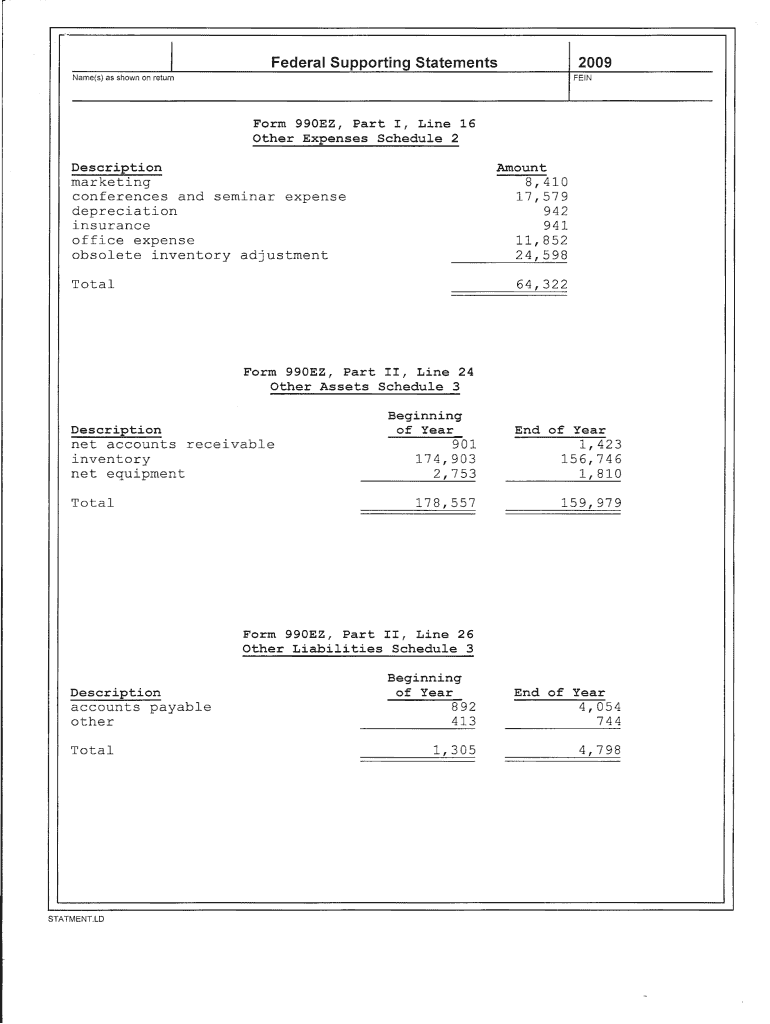
- IRS Forms: Some specific IRS forms require information akin to what’s reported in supporting statements, such as Form 990 for nonprofits, which requires detailed financial reporting.
- Templates and Examples: Utilizing federal supporting statements templates can streamline the preparation process, ensuring that all essential elements are included comprehensively.
Digital Tools and Software Compatibility
Adopting modern technology to facilitate the preparation and submission of federal supporting statements can enhance accuracy and ease.
- Tax Preparation Software: Programs like TurboTax or QuickBooks may offer built-in functionalities to support the generation of federal supporting statements.
- PDF Creation Tools: Digital platforms can help users convert their documented statements into PDF formats, ensuring compatibility when submitting federal forms.
Real-World Examples and Scenarios
Providing context through real-world examples can help demystify the preparation of federal supporting statements.
- Nonprofit Organizations: An example might include a nonprofit that receives funding from multiple grants; their supporting statements must clarify income sources, ensure transparency, and justify expenditures.
- Corporations Reporting Taxable Income: A corporation that engages in international sales may face unique challenges in reporting revenues and expenses, necessitating detailed narratives in their federal supporting statements to address specific accounting practices.
These components create a robust foundation for understanding and completing federal supporting statements, ensuring compliance and clarity when dealing with the IRS and other stakeholders.