




01. Edit your form online
Type text, add images, blackout confidential details, add comments, highlights and more.

Type text, add images, blackout confidential details, add comments, highlights and more.

Draw your signature, type it, upload its image, or use your mobile device as a signature pad.

Send it via email, link, or fax. You can also download it, export it or print it out.
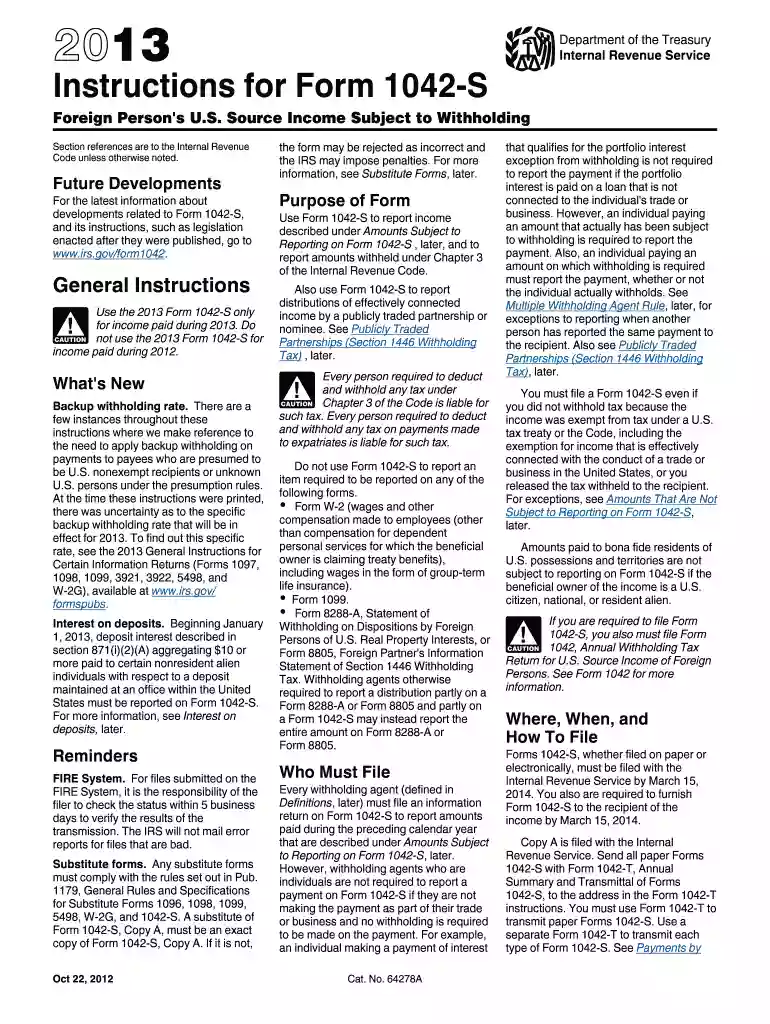
Form 1042-S is a critical tax document used to report U.S. source income paid to foreign persons subject to withholding under IRS regulations. This form serves as a report to both the recipient and the IRS, detailing the amount of income, the type of income, and the amount withheld. Designed to ensure compliance with U.S. tax laws, it encompasses a broad range of income types, such as dividends, royalties, and income from services performed in the United States. Understanding this form is essential for foreign individuals and entities earning income within the U.S. Individuals and institutions dealing with international income streams must accurately report to avoid non-compliance issues.
Understanding specific terminology related to Form 1042-S is crucial for accurate reporting. Terms such as "withholding agent," "recipient," and "U.S. source income" often appear. A withholding agent refers to an individual or entity responsible for ensuring the correct withholding from payments to foreign persons. The "recipient" is the individual or entity receiving the income. Lastly, "U.S. source income" includes any income earned from U.S.-based operations or investments. Familiarity with these terms helps streamline the reporting process, ensuring clarity and reducing errors in form completion and submission.
To acquire Form 1042-S, visit the IRS website, which provides downloadable, printable versions of the form. Alternatively, tax software like TurboTax or QuickBooks often feature these forms within their systems for electronic completion and submission. Tax professionals may also supply these forms as part of their services. Obtaining the form through official IRS channels or certified tax preparation software ensures the latest version, aligning with current tax regulations and avoiding potential discrepancies during filing.
Completing Form 1042-S involves several precise steps. Start by entering the withholding agent's information, including name and taxpayer identification number (TIN). Next, detail the recipient's information—name, address, and foreign taxpayer identification. Specify the type and amount of U.S. source income paid and the related withholding tax. Indicate the appropriate income codes and exemption codes, ensuring each detail matches IRS standards. Review and validate all entered data before submission to ensure compliance and accuracy.
Adhering to the filing deadlines for Form 1042-S is critical to avoid late penalties. Typically, withholding agents must file this form with the IRS and provide a copy to the recipient by March 15 following the year of income payment. Electronic filing is encouraged and may offer an extended deadline. Keeping track of these dates aids in timely compliance, assisting in accurate record-keeping for both income and withholding taxes.
Failing to file Form 1042-S correctly or on time can result in significant penalties. The IRS may impose fines for late filings, incorrect information, or failure to provide recipient copies. Typically, fines escalate based on the duration of the delay. Avoid penalties by ensuring thorough preparation and understanding of the form's requirements, consulting tax professionals and IRS publications as necessary.
Form 1042-S is commonly used by withholding agents who manage income for foreign persons. These agents include universities, large corporations, financial institutions, and investment entities handling dividends, scholarships, and professional service fees. Foreign individuals and businesses receiving income from U.S. sources also engage with this form. This demographic ensures proper tax handling according to U.S. tax laws, highlighting the importance of their role in international financial transactions.


The IRS provides comprehensive guidelines on completing and submitting Form 1042-S. These guidelines cover eligibility criteria, income types subject to reporting, and step-by-step instructions for accurately identifying withholding amounts. With frequent updates to tax laws and regulations, these IRS guidelines are vital resources. They help with understanding amendments, recent tax treaty benefits, and any changes in reporting standards, aiding in compliance and reducing audit risk.
Form 1042-S offers multiple submission methods to accommodate varying filer preferences and capabilities. Paper filing is available, though electronic filing is encouraged for efficiency. Participating in the IRS E-File program enables streamlined data entry, quicker processing times, and reduced errors. Additionally, partnering with tax software programs supports digital filing, catering to modern technological preferences and offering simplified record management across platforms.
We've got more versions of the 1042 s 2012 form form. Select the right 1042 s 2012 form version from the list and start editing it straight away!
| Versions | Form popularity | Fillable & printable |
|---|---|---|
| 2025 | 4.3 Satisfied (22 Votes) | |
| 2024 | 4.7 Satisfied (37 Votes) | |
| 2023 | 4.6 Satisfied (41 Votes) | |
| 2022 | 4.8 Satisfied (155 Votes) | |
| 2020 | 4.4 Satisfied (187 Votes) | |
| 2019 | 4.3 Satisfied (88 Votes) | |
| 2018 | 4.2 Satisfied (88 Votes) | |
| 2017 | 4.2 Satisfied (72 Votes) | |
| 2016 | 4.4 Satisfied (545 Votes) | |
| 2015 | 4.3 Satisfied (67 Votes) | |
| 2013 | 4 Satisfied (29 Votes) | |
| 2012 | 4 Satisfied (25 Votes) |
At DocHub, your data security is our priority. We follow HIPAA, SOC2, GDPR, and other standards, so you can work on your documents with confidence.
If you are a Foreign National employee who is or has been employed during tax year 2012, you may NOW receive your 1042-S tax form electronically. If you wish to
Sep 16, 2013 Publication 4810 for Form 8955SSA will be available by September 30,. 2013. Publication 1187 for Form 1042S will be available byRead more


