




01. Edit your form online
Type text, add images, blackout confidential details, add comments, highlights and more.

Type text, add images, blackout confidential details, add comments, highlights and more.

Draw your signature, type it, upload its image, or use your mobile device as a signature pad.

Send it via email, link, or fax. You can also download it, export it or print it out.
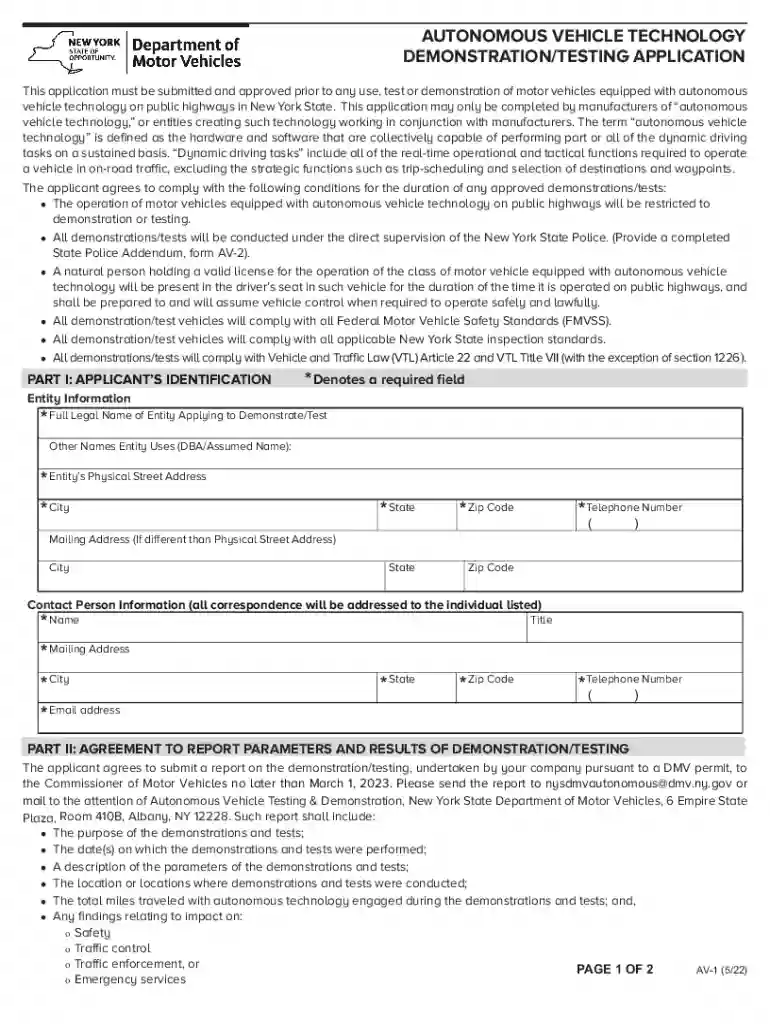
The Autonomous Vehicle Technology Demonstration Testing Application is a specialized form used by manufacturers and entities looking to demonstrate or test autonomous vehicle technology on public highways in specific regions, such as New York State. This application ensures that all testing activities are conducted safely and in compliance with state regulations. The goal is to assess the safety, efficacy, and operational parameters of autonomous vehicles, while also safeguarding public road users.
The application aids in outlining the procedural and compliance requirements for conducting tests. Users must accurately fill out and submit the form to the appropriate regulatory body.
To secure the Autonomous Vehicle Technology Demonstration Testing Application, applicants have several acquisition routes.
Completing the Autonomous Vehicle Technology Demonstration Testing Application involves a structured approach to ensure accuracy and compliance.
The application is primarily utilized by vehicle manufacturers, technology developers, and research institutions engaged in autonomous technology innovation.



Using the Autonomous Vehicle Technology Demonstration Testing Application entails adherence to legal protocols that govern vehicle testing operations.
Understanding the essential components of the application aids in effective preparation and submission.
State-specific requirements can significantly affect the completion and approval of the application.
Real-world instances highlight how the application is used in autonomous vehicle testing scenarios.
Failing to comply with application requirements can result in significant consequences.
We've got more versions of the AUTONOMOUS VEHICLE TECHNOLOGY DEMONSTRATION TESTING APPLICATION form. Select the right AUTONOMOUS VEHICLE TECHNOLOGY DEMONSTRATION TESTING APPLICATION version from the list and start editing it straight away!
At DocHub, your data security is our priority. We follow HIPAA, SOC2, GDPR, and other standards, so you can work on your documents with confidence.
AV-1: Autonomous Vehicle Technology Demonstration/Testing Application (PDF). English. Use this form to apply to test or demonstrate motor vehicles equipped withRead more
This technology develops an augmented reality environment for connected and automated vehicle (CAV) testing and evaluation.Read more
by W Kempton 2008 Cited by 505 This report documents a practical demonstration of Vehicle-to-Grid power, providing real-time frequency regulation from an electric car. Vehicle-to-Grid (V2G)Read more


