Schedule R (Forms 941 and Form 940) - IRS 2026

Get Form
2023 schedule b form 941 Preview on Page 1

Here's how it works

01. Edit your 2023 schedule b form 941 online
Type text, add images, blackout confidential details, add comments, highlights and more.

02. Sign it in a few clicks
Draw your signature, type it, upload its image, or use your mobile device as a signature pad.

03. Share your form with others
Send 2023 schedule 941 via email, link, or fax. You can also download it, export it or print it out.

Definition & Purpose of Schedule R (Forms 941 and Form 940) - IRS

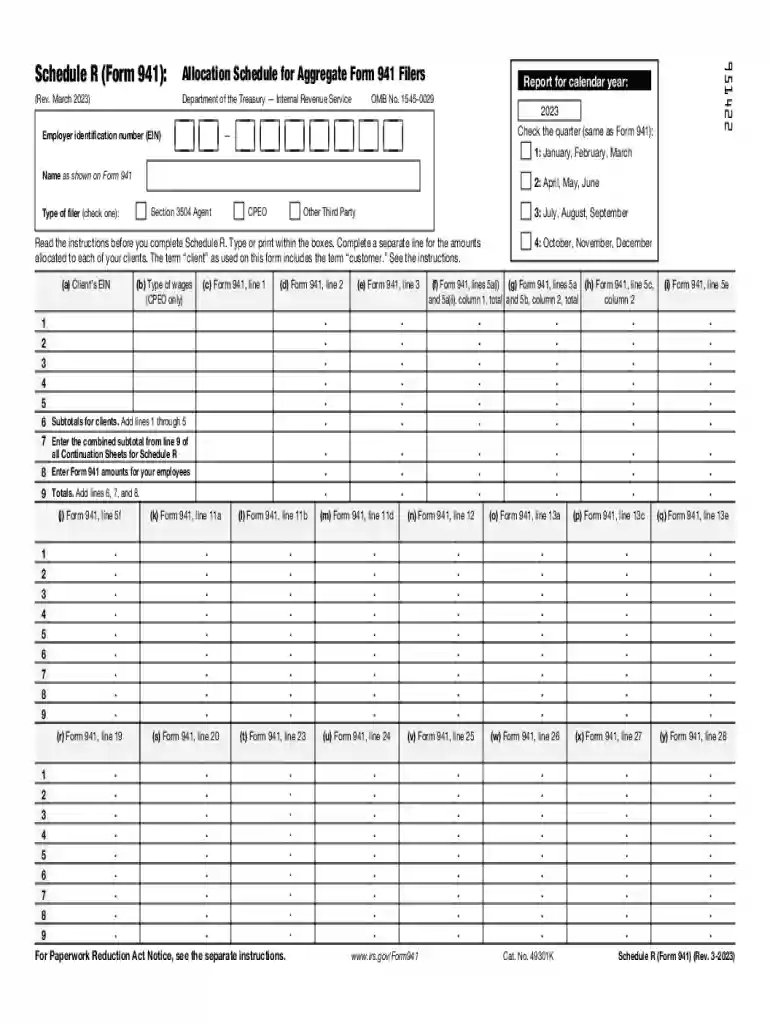
Schedule R, specifically designed for Forms 941 and 940, plays a crucial role in the payroll tax process by allowing employers to allocate employment tax liability. This allocation is essential for third-party payers, such as section 3504 agents and certified professional employer organizations (CPEOs), to document client-specific taxes accurately. Employers and agents use Schedule R to differentiate and allocate wages and taxes among various clients, ensuring compliance with IRS requirements.

  • Form 941: Focuses on reporting income, Social Security, and Medicare taxes withheld by employers.
  • Form 940: Concentrates on federal unemployment taxes (FUTA) and is filed annually.

Understanding these distinctions is critical for correctly utilizing Schedule R, as misallocation can lead to compliance issues and potential penalties.

Steps to Complete Schedule R (Forms 941 and 940)

Completing Schedule R requires careful attention to detail and a thorough understanding of each section of the form. Here's a step-by-step guide to assist filers:

  1. Gather Necessary Information: Collect employer identification numbers (EINs), client information, and wage details for each entity represented on the form.
  2. Complete Client Information Section: Insert the name, EIN, and wage details for each client.
  3. Accurate Tax Allocation: Ensure precise recording of Social Security, Medicare, and FUTA taxes for each client.
  4. Verify Totals: Include summation of all wages and taxes to match reported figures on aggregate forms 940 and 941.
  5. Review and Submit: Double-check all entries for accuracy before submitting to the IRS, adhering to specified deadlines.

Key Elements of Schedule R

Schedule R comprises several integral parts essential for accurate reporting:

  • Client Name and EIN: This ensures that each client's tax liability is correctly assigned.
  • Types of Wages: Detailed entry of different wage types subject to taxation.
  • Tax Totals: Summary of taxes to reflect accurate allocations across clients.
  • Certification Statement: Accountability section requiring the signature of the responsible party to affirm accuracy.

By understanding these elements, filers can ensure the precision and compliance of their tax submissions.

Who Typically Uses Schedule R

Schedule R is predominantly utilized by third-party payroll processors and related entities. These include:

  • Section 3504 Agents: Responsible for workforce management and payroll activities on behalf of clients.
  • Certified Professional Employer Organizations (CPEOs): Manage payroll for multiple businesses and require Schedule R for reporting and compliance.
  • Businesses with Complex Employee Structures: Those with multiple subsidiaries or complex payroll needs also benefit from using Schedule R for proper tax breakdowns.

Required Documents for Filing

Having essential documents is necessary for completing Schedule R efficiently. Typical documents include:

  • Employee and Client Wage Records: For allocation of wages and taxes.
  • EIN Documentation: To verify all employer identifications applied in the form.
  • Prior Filings: References such as past 940 or 941 submissions for consistency checks.

Organizing these documents prior to form completion helps streamline the filing process and prevents errors.

Filing Deadlines for Schedule R

Adhering to filing deadlines is critical to avoid penalties and ensure timely compliance. Important dates include:

  • Quarterly Filing for Form 941: Typically due by the last day of the month following the end of each calendar quarter.
  • Annual Filing for Form 940: Due January 31 for the preceding tax year.

Knowing these deadlines allows businesses to plan accordingly and allocate sufficient time for the completion of Schedule R.

Penalties for Non-Compliance

Non-compliance with Schedule R requirements can lead to substantial penalties from the IRS. Potential consequences include:

  • Fines and Penalties: Errors or omissions may result in financial penalties.
  • Increased Scrutiny: Repeated non-compliance could lead to more frequent audits and reviews.
  • Interest on Unpaid Taxes: Accrual of interest due to misallocated or unpaid taxes affecting overall tax obligations.

To mitigate these risks, businesses and third-party filers must ensure accuracy and adherence to all IRS guidelines related to Schedule R.

Digital vs. Paper Version of Schedule R

Choosing between digital and paper submissions impacts the ease and efficiency of filing Schedule R:

  • Digital Submissions: Often faster and integrates easily with existing accounting software, reducing the risk of manual errors.
  • Paper Filings: Useful for those without digital access but may involve longer processing times and potential for handling mistakes.

Weighing these options allows filers to select the method that best suits their operational capabilities and compliance needs.

See more Schedule R (Forms 941 and Form 940) - IRS versions

We've got more versions of the Schedule R (Forms 941 and Form 940) - IRS form. Select the right Schedule R (Forms 941 and Form 940) - IRS version from the list and start editing it straight away!
Versions Form popularity Fillable & printable
2024 4.3 Satisfied (20 Votes)
2023 4.5 Satisfied (59 Votes)
2022 4.3 Satisfied (25 Votes)
2021 4.8 Satisfied (182 Votes)
2020 4.4 Satisfied (283 Votes)
2018 4.3 Satisfied (133 Votes)
2011 4.4 Satisfied (51 Votes)
be ready to get more

Complete this form in 5 minutes or less

Get form

Got questions?

We have answers to the most popular questions from our customers. If you can't find an answer to your question, please contact us.
Contact us
Form 940 is used to report FUTA taxes, while Form 941 is used to report federal income tax withheld, Social Security, and Medicare tax withholding.
Schedule R to claim a nonrefundable credit for the elderly or disabled. Taxpayers age 65 or older, or under age 65 and receiving disability income due to permanent and total disability, may be eligible for the credit.
Each year, every business with employees must file Form 940 to compute the amount of unemployment tax that must be paid on the federal level. This payroll tax is based on the first $7,000 of each employees wages (including owners of S corporations who receive a salary for work performed for their businesses).
The Schedule R (Form 941) will provide the IRS with client-specific information to support the totals reported on an aggregate Form 941. It includes an allocation line for each client showing a breakdown of their wages and employment tax liability for the tax period.
Although Form 940 covers a calendar year, you may have to deposit your FUTA tax before you file your return. If your FUTA tax liability is more than $500 for the calendar year, you must deposit at least one quarterly payment. If your FUTA tax liability is $500 or less in a quarter, carry it forward to the next quarter.

Security and compliance

At DocHub, your data security is our priority. We follow HIPAA, SOC2, GDPR, and other standards, so you can work on your documents with confidence.

Learn more
ccpa2
pci-dss
gdpr-compliance
hipaa
soc-compliance

People also ask

Employers use Form 941 to: Report federal income, social security, and Medicare taxes withheld from employees paychecks, and. Report the employers share of social security and Medicare taxes.
Use Form 940 to report your annual Federal Unemployment Tax Act (FUTA) tax. Together with state unemployment tax systems, the FUTA tax provides funds for paying unemployment compensation to workers who have lost their jobs. Most employers pay both a federal and a state unemployment tax. Only employers pay FUTA tax.

941 r