







Definition and Meaning of the Combined Insurance Form
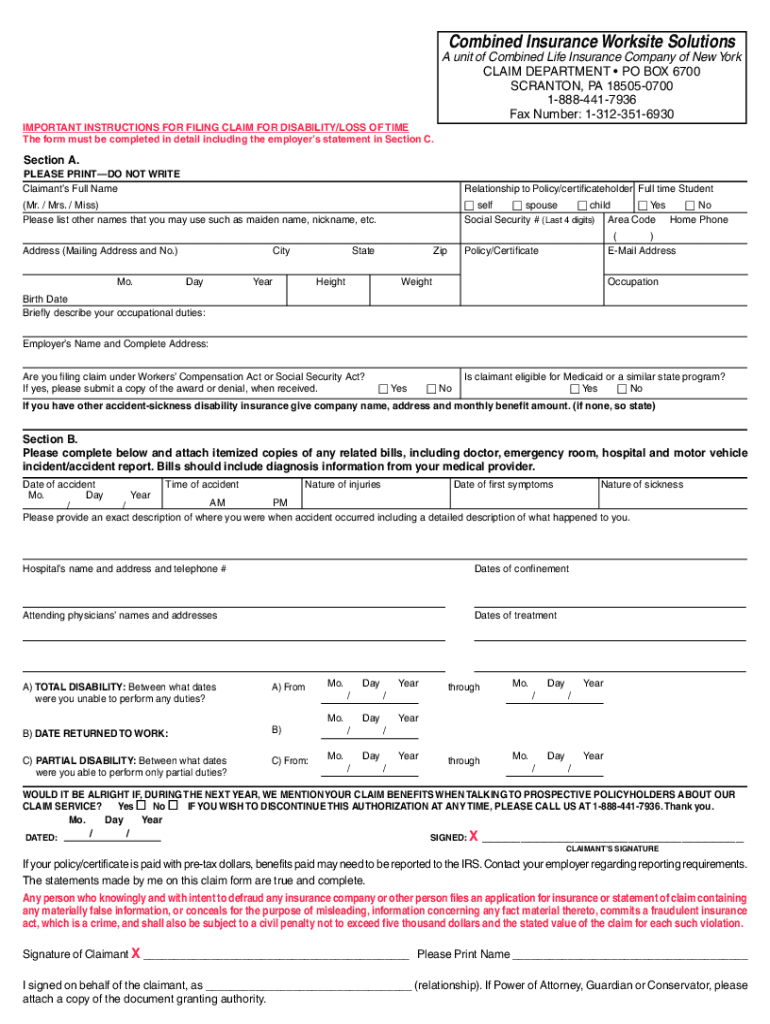
The Combined Insurance Form is a critical document used by policyholders to submit claims to Combined Insurance for processing and reimbursement. This form serves as the primary medium through which policyholders convey pertinent details about their claims, including their personal information, policy details, and the nature of their claim. Understanding the definition and meaning of this form is essential for ensuring that claims are processed efficiently and accurately. It facilitates communication between the policyholder and the insurance provider, ensuring that all necessary information is gathered to support the claim.
Components of the Definition
- Purpose: Clearly establishes the intent behind the submission—usually for reimbursement or claim coverage.
- Contents: Typically includes sections for personal and insurance policy information, described injuries or incidents, and medical or service provider details.
- Functionality: Acts as both a record and request for payment or claim processing from Combined Insurance.
How to Use the Combined Insurance Form
Utilizing the Combined Insurance Form effectively requires a clear understanding of its layout and the information required in each section. Users must follow specific steps to ensure all necessary details are included to prevent delays or rejections.
-
Gather Required Information: Before filling out the form, collect all necessary documents such as insurance policy numbers, incident or service details, and any supporting documents like medical records or invoices.
-
Complete Each Section Thoroughly: Fill out personal information, policy details, and description of claim accurately. Avoid leaving blank fields unless they are non-applicable.
-
Review for Accuracy: Double-check that all entries are correct and legible, as errors can lead to processing delays or claim denial.
-
Attach Supporting Documentation: Include any relevant documents that verify the claims, such as medical reports or receipts.
-
Submission: Follow the prescribed method for submission, whether online or by mail. Ensure all documents are securely attached if mailing.
How to Obtain the Combined Insurance Form
Acquiring the Combined Insurance Form is a straightforward process that can be executed through several methods depending on your preference or need for convenience.
-
Online Access: Visit the official Combined Insurance website to download a digital copy of the form. This is often the fastest method for accessing the form.
-
Insurance Agent: Contact your insurance agent, who may provide a copy directly or guide you through the acquisition process.
-
Insurance Office Visit: Visit a local Combined Insurance office to request a physical copy.
Tips for Online Access
- Look for downloadable PDFs to simplify the process of filling out and printing the form.
- Ensure a reliable internet connection for a smooth download.
Steps to Complete the Combined Insurance Form
Filling out the Combined Insurance Form involves several precise steps requiring attention to detail to ensure accuracy and completeness.
-
Personal Information Section: Start with providing accurate personal details such as name, address, and contact information.
-
Policy Details: Include policy number and other identifying details to link the form with your insurance account.
-
Claim Description: Describe the incident or service for which you are claiming insurance. Include dates, nature of injury or service, and other relevant details.
-
Medical or Service Information: Provide details about medical providers or service vendors, including contact details and services rendered.
-
Sign and Date: Conclude by signing and dating the form to validate the information and consent to its processing.
Why You Should Use the Combined Insurance Form
Submitting claims through the Combined Insurance Form provides numerous advantages, ranging from process clarity to faster settlement cycles.
- Efficiency: Streamlined process for claim submission and processing.
- Accuracy: Ensures all claim details are presented in an organized fashion, reducing back-and-forth queries.
Benefits of Proper Usage
- Expedites the claim approval process by minimizing errors.
- Provides a clear track of the claims history for future reference.
Important Terms Related to the Combined Insurance Form
Grasping the essential terminologies associated with the Combined Insurance Form can significantly enhance the form filling and submission experience.
Key Terms
- Claimant: The individual submitting the insurance claim.
- Premium: The regular payment made to maintain the insurance policy.
- Deductible: The portion of the claim that the policyholder must pay out-of-pocket before insurance coverage applies.
Common Misunderstandings
- Confusing Deductible with Premium—both are distinct financial elements of insurance policies.
Legal Use of the Combined Insurance Form
The Combined Insurance Form conforms to various legal standards to ensure that policyholders' rights are protected and that the claim's integrity is maintained throughout the submission and review process.
-
Confidentiality: Information provided in the form is safeguarded under privacy laws.
-
Compliance: Adheres to insurance regulations and guidelines ensuring legally binding claim submission.
Legal Implications
- Providing false information can lead to the cancellation of the claim and possible legal action.
Key Elements of the Combined Insurance Form
The form is structured into distinct sections, each geared towards capturing specific data crucial for the accurate assessment of a claim.
-
Personal Details: Information about the claimant for identification and communication.
-
Incident Description: Detailed account of the claim incident, including the date and specifics of the occurrence.
-
Medical Details: For health-related claims, include provider information and service descriptions.
Notable Requirements
- Certain sections may require additional documentation; e.g., medical reports must accompany health-related claims.




