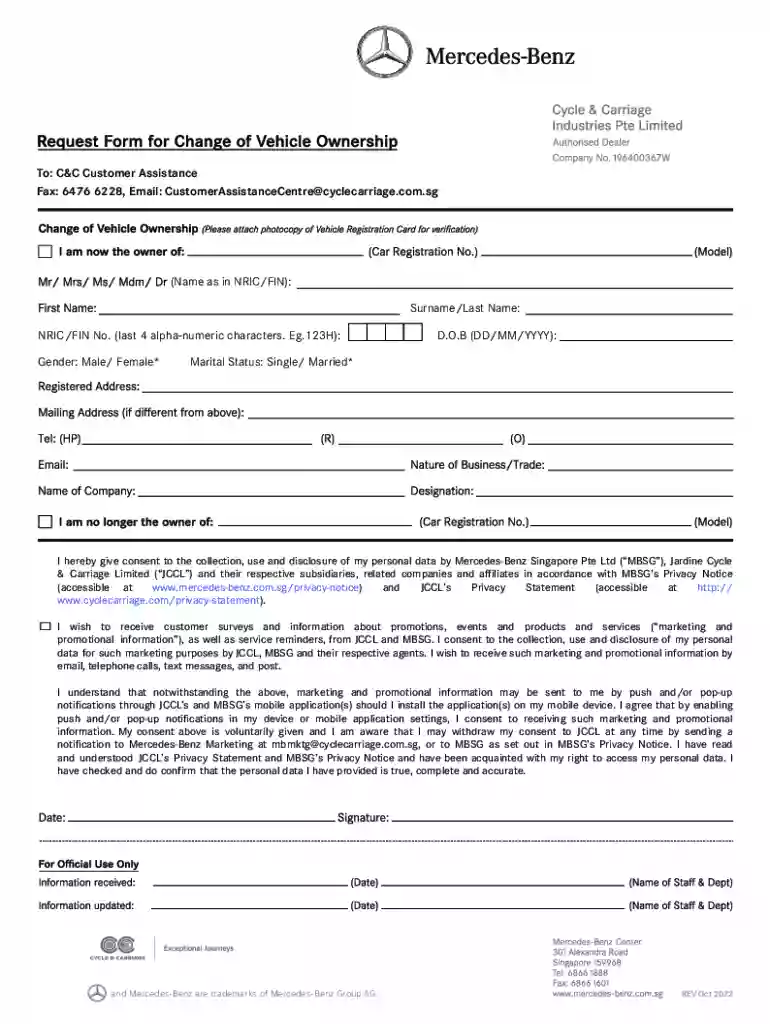
Definition and Purpose of the Request Form for Change of Vehicle Ownership
The Request Form for Change of Vehicle Ownership is a legal document used to transfer vehicle ownership from one person to another. This form is crucial during the sale of a vehicle, gifting, or anytime the ownership details need amending. The main purpose is to provide a detailed record of the new owner, ensuring that ownership transitions are transparent and compliant with regulatory standards. This form helps state authorities maintain accurate vehicle registries, which is essential for tracking ownership and liability.
Importance in Legal Transactions
Ensuring this form is completed accurately is vital as it affects legal responsibilities associated with the vehicle. The new owner becomes responsible for any liabilities, such as road accidents or legal violations. Additionally, the form ensures that state databases reflect current ownership, which is important for vehicle recalls or safety notices.
How to Obtain the Request Form for Change of Vehicle Ownership
Acquiring the Request Form for Change of Vehicle Ownership can be done through several channels:
- Department of Motor Vehicles (DMV): Most states offer this form directly from their DMV offices or websites. It can usually be downloaded and printed or filled out online.
- Licensed Vehicle Dealers: If purchasing through a dealer, they often supply the necessary forms as part of the vehicle sale process.
- Online Platforms: Some states have digital platforms where the form can be filled and submitted online, streamlining the process for tech-savvy users.
Considerations When Obtaining the Form
- Check if your state requires additional documentation, such as proof of identification or bill of sale, which may accompany the form.
- Verify the version of the form, as requirements can change periodically.
Steps to Complete the Request Form for Change of Vehicle Ownership
Completing the Request Form for Change of Vehicle Ownership involves several key steps:
- Gather Necessary Information: This includes personal details of the buyer and seller, vehicle identification number (VIN), and current odometer reading.
- Complete Buyer and Seller Information: Both parties need to provide full names, addresses, and signatures to validate the form.
- Provide Vehicle Details: Enter details such as make, model, and year of the vehicle.
- Submit the Form: Depending on your state’s regulations, submit the form via mail, online, or in person at a DMV office.
Detailed Process
- Proof of Sale: Attach a bill of sale or contract to confirm ownership transfer.
- Notarization: Some states require the form to be notarized as an added security measure.
Key Elements of the Request Form for Change of Vehicle Ownership
Understanding the key components is essential:
- Identifying Information: Fields for both the buyer’s and seller’s details.
- Vehicle Information: Includes VIN, make, model, year, and color.
- Purchase Details: Sale price and date of the transaction.
- Signatures: Mandatory spaces for signatures from both parties, sometimes requiring witness or notary presence depending on local laws.
Examples of Key Elements
- In Texas, the form includes a field for lien release if applicable, ensuring release of any third-party claims on the vehicle.
- California requires smog certification details on their form as part of the ownership transfer process.
State-Specific Rules for the Request Form for Change of Vehicle Ownership
Each state has unique provisions regarding vehicle ownership transfer:
- California: Requires a smog test certification and transfer forms within ten days after a sale.
- New York: Mandates proof of insurance and payment of sales tax before registering the vehicle in the new owner’s name.
- Florida: Offers an online portal to complete the form and requires an odometer disclosure statement for vehicles under ten years old.
Regional Variations
- Some states require additional emissions tests or safety inspections as part of the transfer process.
- Others may have digital submission options that simplify overall handling.
Important Terms Related to Request Form for Change of Vehicle Ownership
Understanding specific terms aids in accurate form completion:
- Vehicle Identification Number (VIN): A unique identifier for the vehicle, akin to a fingerprint.
- Bill of Sale: A document evidencing the transaction details between seller and buyer.
- Odometer Disclosure: A legal statement of a vehicle’s mileage at the time of sale.
Glossary Example
- Lienholder: An entity that holds a financial interest in the vehicle until payment completion, impacting the transferability of ownership.
Legal Use of the Request Form for Change of Vehicle Ownership
This form functions within a legal framework to facilitate ownership change.
- Primary Authority: Used by DMV offices across the United States to validate and process ownership changes.
- Legal Compliance: Ensures adherence to state-specific laws regulating vehicle transactions.
Consequences of Incorrect Usage
- Submission with errors can lead to rejection, incurring delays and potential fines.
- Fraudulent information can result in significant legal penalties, emphasizing the need for accuracy and honesty.
Required Documents for Request Form for Change of Vehicle Ownership
Transferring ownership successfully often requires accompanying documents:
- Proof of Identification: Such as a driver’s license or state ID.
- Bill of Sale: To confirm transaction particulars.
- Lien Release (if applicable): To prove no outstanding debts exist.
Additional Documentation
- Emissions Test Results: Required in states with strict environmental regulations.
- Insurance Proof: Some states necessitate proof of insurance to register the vehicle.