





Definition & Meaning
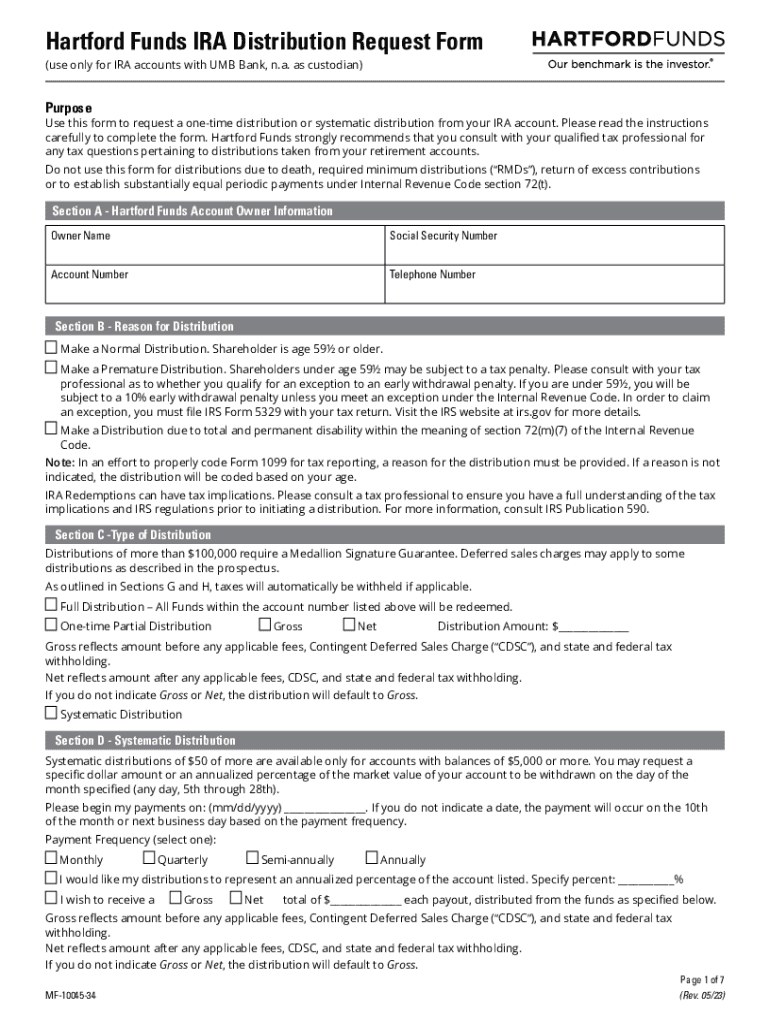
An "IRA Required Minimum Distribution (RMD) Request Form" is a document used by individuals to request the mandatory withdrawal amount from their Individual Retirement Account (IRA) after reaching a certain age. RMDs are enforced by the IRS to ensure that account holders begin to draw down their tax-deferred retirement assets, and the form facilitates the initiation of this process. Users typically need to fill out relevant sections to indicate how they want their distributions handled, ensuring compliance with federal tax regulations.
How to Use the IRA Required Minimum Distribution (RMD) Request Form
To use the IRA RMD Request Form effectively, individuals must understand the various sections and the information required. This typically involves:
- Personal Information: Entering your full name, address, and social security number.
- Account Details: Specifying the type of IRA, account number, and financial institution holding the account.
- Distribution Details: Indicating the amount to be withdrawn, whether as a lump sum or in installments.
- Payment Instructions: Choosing how you want to receive the distribution, such as a direct deposit or a mailed check.
- Signature and Date: Completing the form with your signature and date to validate consent for the withdrawal.
Steps to Complete the IRA Required Minimum Distribution (RMD) Request Form
Completing the RMD Request Form involves a series of steps, each of which must be carefully followed to ensure compliance:
- Gather Necessary Information: Ensure you have all personal, account, and tax details ready before beginning.
- Complete Personal Details Section: Accurately fill in your personal information, ensuring it matches IRS records.
- Specify IRA Account Details: Ensuring this matches the financial institutions' records helps prevent processing delays.
- Determine Distribution Style: Decide between one-time or systematic withdrawals based on your financial needs.
- Select Payment Method: Opt for the most convenient payment method available, considering transaction times.
- Consider Tax Withholding Options: Depending on your tax situation, you may need to opt for federal income tax withholding.
- Review and Sign: Carefully review the form for accuracy prior to signing and dating, as this is essential for acceptance.
Key Elements of the IRA Required Minimum Distribution (RMD) Request Form
The form includes several critical components:
- Personal Identification: Includes name, social security number, and contact information.
- Account Information: Specifies the type and number of the IRA account.
- Distribution Setup: Details options for lump sum or periodic payments.
- Payment Preferences: Allows for choice in how to receive funds.
- Tax Withholding Options: Section to decide on federal and potential state withholding.
- Signature Line: Required to authorize the distribution.
Legal Use of the IRA Required Minimum Distribution (RMD) Request Form
The form is legally recognized by financial institutions and the IRS for processing RMDs. It must be completed with accurate and truthful information to ensure compliance with legal requirements. Errors or omissions can lead to processing delays or potential penalties. It is advisable to consult a tax professional if you have questions about compliance or the implications of your RMD on your tax situation.
IRS Guidelines
The Internal Revenue Service (IRS) provides guidelines for calculating RMD amounts based on the account holder’s age and account balance at the end of the previous year. The calculation typically involves dividing the IRA balance by a life expectancy factor determined by the IRS. Failure to follow these guidelines, which are clearly outlined in the IRS publications, can result in a 50% excise tax on the amount that was not distributed as required.
Filing Deadlines / Important Dates
The RMD deadline is December 31 each year following the account holder turning 72. However, the first RMD can be delayed until April 1st of the year following the account holder's 72nd birthday. If the first RMD is delayed, two distributions will occur in the same year, which may impact tax liabilities. It is essential to adhere to these dates to avoid penalties.
Form Submission Methods (Online / Mail / In-Person)
The form can typically be submitted through:
- Online Submission: Many financial institutions allow electronic submissions through secure online portals.
- Mail: Traditional mailing to the financial institution’s address specified on the form.
- In-Person: Direct submission at a branch location if applicable to your financial institution.
Each method should follow the institution's guidelines to ensure the form is processed promptly.
Examples of Using the IRA Required Minimum Distribution (RMD) Request Form
Consider scenarios where an individual opts for a systematic withdrawal to meet ongoing expenses, while another might choose a lump sum to cover a one-time expenditure, like medical bills. Each scenario demonstrates a different application of the form to handle unique financial needs while complying with IRS mandates.
Required Documents
Additional documentation may be required to accompany the form, such as:
- Proof of Identity: Drivers' license or passport copy for verification.
- Account Statement: Recent IRA account statement to verify balance details.
- W-4P: For tax withholdings if the distribution is subject to federal tax.
Understanding these additional requirements helps prevent delays in processing the RMD request.