




01. Edit your request hearing motion proof form online
Type text, add images, blackout confidential details, add comments, highlights and more.

Type text, add images, blackout confidential details, add comments, highlights and more.

Draw your signature, type it, upload its image, or use your mobile device as a signature pad.

Send it via email, link, or fax. You can also download it, export it or print it out.
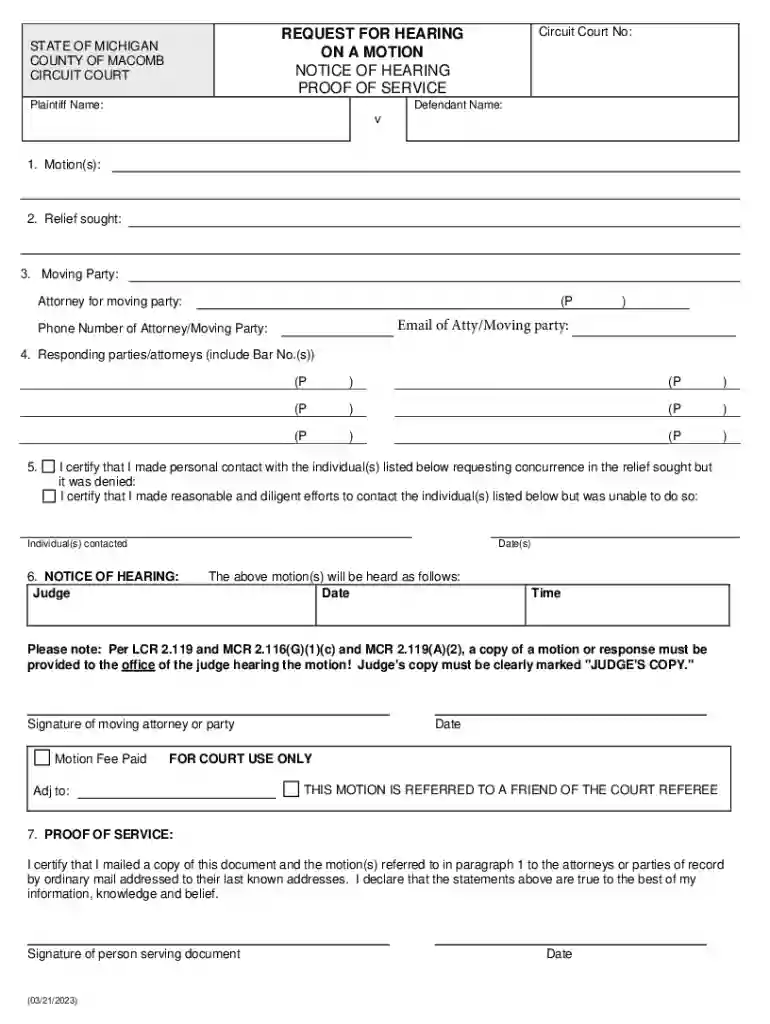
The "Request for Hearing on a Motion Notice of" is a legal document filed in a court of law, usually required to schedule a hearing for a motion that has been filed. This form notifies the court and involved parties about the motion requiring adjudication. Primarily used in civil litigation, this request ensures that the legal process moves forward systematically, allowing all parties to prepare their cases adequately before the hearing date. The notice is integral to maintaining transparency and fairness in legal proceedings.
To effectively use this notice, the filing party must correctly complete the document and submit it to the appropriate court. It should contain crucial details including the case number, names of parties involved, specific motion being addressed, and preferred hearing dates. When filling out the form, precision is key to prevent delays in court proceedings. After submission, the form serves as an official notification to other parties, ensuring everyone is informed of the impending court session.
This notice is a pivotal part of the legal process, ensuring that motions are heard in a timely and organized manner. By filing this notice, the moving party requests the court to set a date and time for oral arguments related to the motion. It upholds the rights of involved parties to be heard, contributing to judicial efficiency and adherence to procedural rules. Failure to file this notice can result in delays and potentially impact the outcome of the motion.
While the general purpose of the request remains consistent across states, specific procedural requirements may vary. For instance, some jurisdictions may require additional documentation or set deadlines for filing. It's essential for the filing party to familiarize themselves with local court rules and procedures to ensure compliance. Consulting state-specific legal resources or obtaining legal counsel can help navigate these variations efficiently.
This form is commonly used by attorneys representing clients in civil litigation. However, individuals representing themselves, or "pro se" litigants, may also utilize this notice when handling their own legal matters. Providing a formal mechanism for requesting a hearing, this form is a critical tool for anyone involved in legal proceedings who needs to notify the court and opposing parties of a motion they seek to have heard.


Consider a civil case where one party files a motion for summary judgment. The party would need to file this notice to schedule a hearing for the motion, ensuring the court addresses it before proceeding to trial. Another example might involve family law, where a party wishes to modify a custody arrangement. Filing a request for a hearing would allow them to present new evidence or circumstances to the court. Each scenario underscores the notice's role in establishing a formal avenue for legal discussions and decisions.
Depending on the court's capabilities, there are several ways to submit the request for a hearing notice. Many courts offer electronic filing systems, providing a convenient and quick method to submit forms online. Alternatively, you can mail the completed notice to the court or deliver it in person. Regardless of the method, ensuring that submission deadlines are met is critical to maintaining the procedural timeline of the case.
Failing to file the form correctly and on time can lead to significant procedural setbacks. The motion may go unheard, or the court could dismiss it altogether. This non-compliance can result in delays and potentially impact the case's outcome. Therefore, it's crucial to adhere to all filing requirements and ensure that service to all parties is executed correctly to avoid any penalties or adverse effects on the legal process.
We've got more versions of the request hearing motion proof form form. Select the right request hearing motion proof form version from the list and start editing it straight away!
At DocHub, your data security is our priority. We follow HIPAA, SOC2, GDPR, and other standards, so you can work on your documents with confidence.
Every pleading, written motion, and other paper must be signed by at least one attorney of record in the attorneys nameor by a party personally if the partyRead more
The party making a request for a hearing on a Motion may request either an evidentiary hearing (presenting evidence), oral arguments, or both. An evidentiaryRead more
Notice of Default and Right to Cure. Most contracts for sale require one party to give the other party notice of a material default and a reasonableRead more


