




01. Edit your certificate of acceptability tshwane online
Type text, add images, blackout confidential details, add comments, highlights and more.

Type text, add images, blackout confidential details, add comments, highlights and more.

Draw your signature, type it, upload its image, or use your mobile device as a signature pad.

Send certificate of acceptability tshwane pdf via email, link, or fax. You can also download it, export it or print it out.
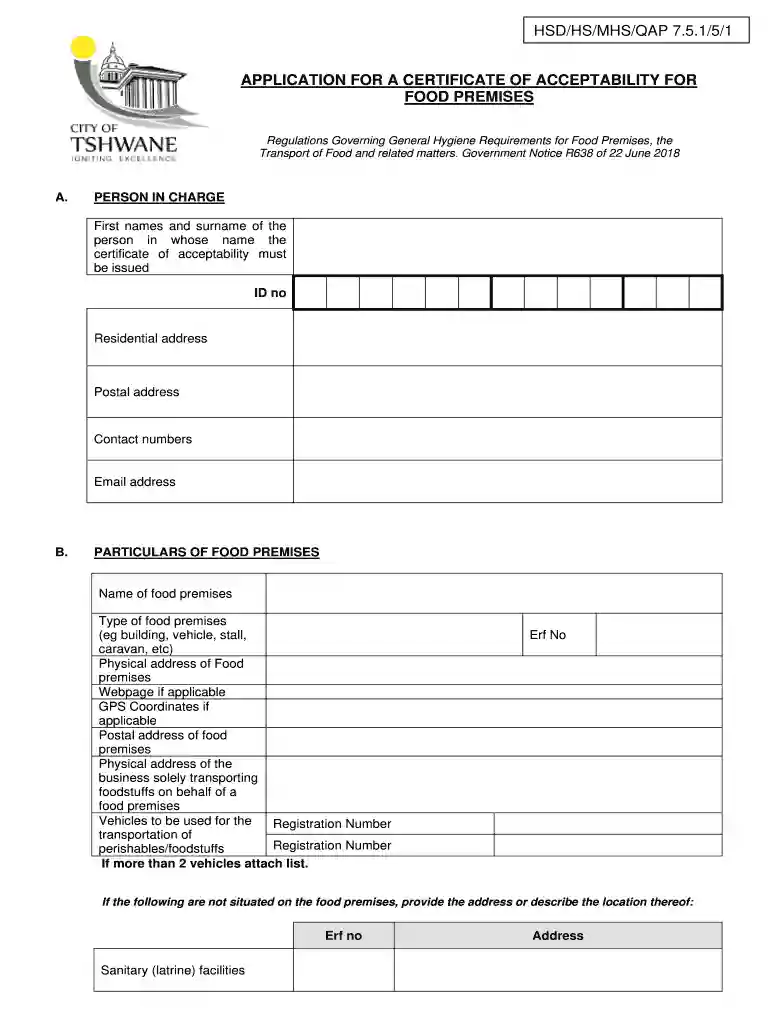
The Certificate of Acceptability application form, often referred to simply as the COA certificate, is an essential document for food establishments in Tshwane that complies with local health regulations. This certificate is governed by the Regulations on General Hygiene Requirements for Food Premises and Food Transport, ensuring that food businesses meet the necessary health and safety standards before they can operate legally.
Obtaining a Certificate of Acceptability confirms that a food premises meets specific hygiene and operational criteria set by Environmental Health Practitioners (EHPs). This include aspects such as the design and structure of the food facility, sanitation practices, and compliance with safety regulations regarding food handling and storage.
Food businesses must present this application form along with detailed information about their operations, including the type of food they handle, the nature of the food service provided, and the number of employees. A rigorous inspection process follows the submission, ensuring that all health guidelines are adhered to, and a certificate is only issued when a food business is compliant.
Completing the Certificate of Acceptability application form requires careful attention to detail and adherence to specific guidelines. The following steps outline the necessary actions to successfully fill out this form:
Gather Necessary Information: Begin by collecting all relevant information required for the application, including:
Obtain Required Documentation: A list of mandatory documents that you will need to submit alongside your application includes:
Complete the Application Form: With all gathered information and documentation, systematically fill out the application form. Ensure accuracy and clarity in your responses. Mistakes or omissions can delay the application process.
Review and Verify: After completing the application, review all entries to ensure all required fields are correctly filled and documentation is attached. It is beneficial to have someone else review your application for any overlooked details.
Submit the Application: Follow the specified submission methods—this may include online uploads, postal submissions, or in-person deliveries to your local Environmental Health Office. Ensure you keep a copy of the submitted application for your records.
Understanding the terminology associated with the Certificate of Acceptability application form can aid applicants in navigating the process more effectively. Here are crucial terms to know:
Knowledge of these key terms enhances comprehension of the application process and the regulations governing food safety.
Submitting a thorough and complete application for the Certificate of Acceptability is contingent upon including all necessary supporting documents. Here is a breakdown of the required documents:
Ensuring that these documents are up-to-date, accurate, and submitted alongside your application can significantly influence the approval timeline.
The application process for the Certificate of Acceptability normally involves several key stages, followed by an expected approval timeline:
Submission of Application: Once the application form and all required documentation are submitted to the local Environmental Health Office, the process begins.
Initial Review: The EHP conducts a preliminary review of the submitted documents to ensure that all necessary information has been provided.
Inspection Scheduling: After the initial review, an inspection of the food premises will be scheduled. This inspection assesses compliance with health regulations.
On-Site Inspection: An Environmental Health Practitioner visits the premises, evaluating the physical conditions, hygiene practices, and operational protocols.
Approval or Rejection: Following the inspection, the EHP will determine if the premises meet all necessary requirements. If approved, the Certificate of Acceptability will be issued; if not, the applicant will receive feedback on the deficiencies needing resolution.
Typically, the entire process—from submission to approval—can take anywhere from two to six weeks, depending on various factors such as local government workload, the completeness of the application, and available resources for inspections.
We've got more versions of the certificate of acceptability tshwane form. Select the right certificate of acceptability tshwane version from the list and start editing it straight away!
| Versions | Form popularity | Fillable & printable |
|---|---|---|
| 2024 | 4.6 Satisfied (56 Votes) | |
| 2021 | 4.6 Satisfied (51 Votes) | |
| 2021 | 4.8 Satisfied (37 Votes) | |
| 2020 | 4.3 Satisfied (58 Votes) | |
| 2020 | 4.6 Satisfied (39 Votes) | |
| 2018 | 4.1 Satisfied (45 Votes) | |
| 2018 | 4.8 Satisfied (111 Votes) | |
| 2018 | 4.1 Satisfied (52 Votes) | |
| 2017 | 4.8 Satisfied (231 Votes) | |
| 2016 | 4 Satisfied (37 Votes) | |
| 2015 | 4.9 Satisfied (31 Votes) | |
| 2015 | 4.4 Satisfied (25 Votes) | |
| 2015 | 4 Satisfied (56 Votes) | |
| 2014 | 4.5 Satisfied (47 Votes) | |
| 2014 | 4.3 Satisfied (29 Votes) |
At DocHub, your data security is our priority. We follow HIPAA, SOC2, GDPR, and other standards, so you can work on your documents with confidence.
Apply your certificate toward a degree This certificate can be applied toward the Associate of Applied Science in Allied Health degree, for those seeking
by RK Madzivhandila 2024 Cited by 2 This study aimed to explore the perception held by the community members regarding CHWs contribution to health promotion in Melusi informal settlements.Read more


