




01. Edit your form oic online
Type text, add images, blackout confidential details, add comments, highlights and more.

Type text, add images, blackout confidential details, add comments, highlights and more.

Draw your signature, type it, upload its image, or use your mobile device as a signature pad.

Send irs form 433 b via email, link, or fax. You can also download it, export it or print it out.
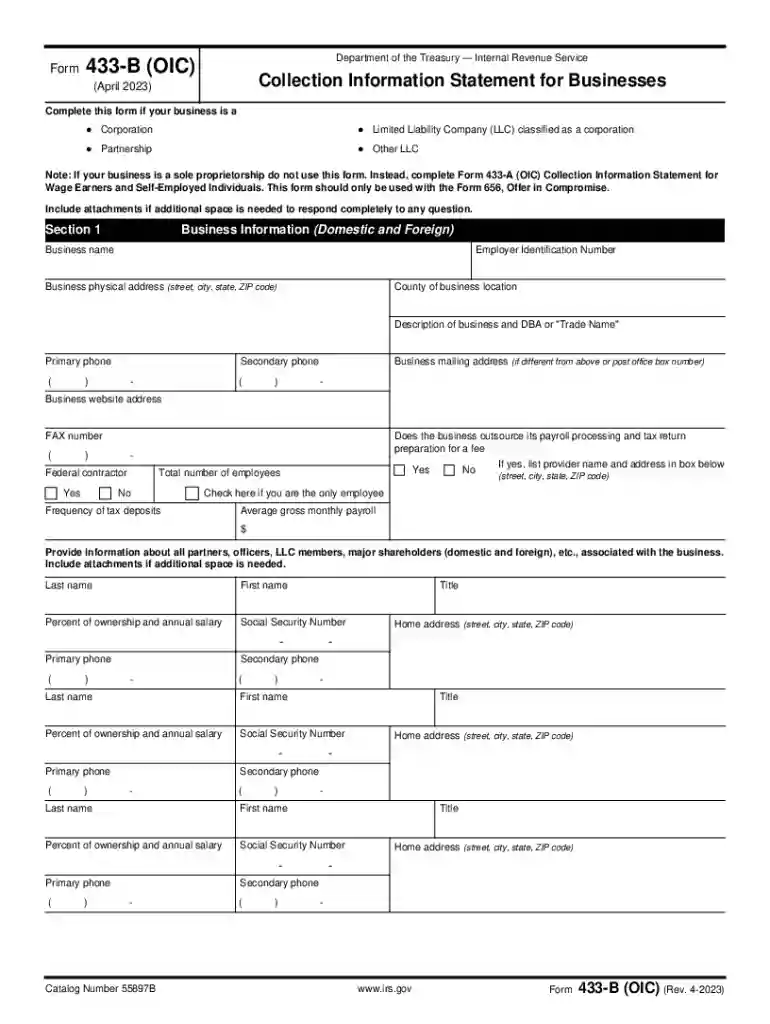
Form 433-B (OIC) (Rev 4-2023) is a Collection Information Statement for Businesses, issued by the IRS. This form is specifically used by businesses, including corporations, limited liability companies (LLCs), partnerships, and other entities, to provide detailed financial information when applying for an Offer in Compromise (OIC) to settle tax debts. By submitting this form, businesses can outline their financial situation, including assets, income, and expenses, to negotiate a reduced payment plan with the IRS. The primary aim is to present a transparent representation of the business's financial standing, facilitating a fair determination of a suitable offer amount for tax liabilities.
Gather Required Financial Documents: Before beginning the form, collect all necessary financial documents. This includes balance sheets, profit and loss statements, bank statements, and any documentation of assets and liabilities.
Business Information Section: Start by filling out general information about the business. This includes the legal name, employer identification number (EIN), and contact details of the company.
Asset Valuation: Detail all assets owned by the business. This encompasses machinery, vehicles, real estate, and other tangible properties. Accurate valuations are necessary to reflect true asset worth.
Income and Expenses Reporting: Provide a comprehensive report of the business's average income and monthly operating expenses. This allows the IRS to understand cash flow and financial stability.
Minimum Offer Calculation: Calculate the minimum offer amount based on the provided financial data. The IRS provides guidelines on how to compute this, factoring in disposable income and asset equity.
Review and Sign: Once filled out, review the form for accuracy. Business representatives or authorized individuals must sign the form to validate the information provided.
Asset Inventory: List and describe all business assets. Include pertinent details such as purchase price, current market value, and any liens or encumbrances.
Affiliations and Legal Issues: Declare any affiliations with other businesses and disclose legal matters that could affect financial standing or tax liability.
Offer Section: Clearly lay out the proposed offer terms, including the calculation and rationale for the proposed settlement amount.
Third-Party Designees: Identify any authorized representatives or third-party designees who can discuss and handle matters related to the form on the business's behalf.
The IRS has specific guidelines for completing Form 433-B (OIC). Businesses must adhere to IRS instructions regarding accurate and full disclosure of financial conditions. The form must be precise, without omissions or misrepresentations. The IRS reviews the stated income, expenses, and asset details to decide on acceptance or counteroffers. Compliance with these guidelines ensures a smoother review process and increases the likelihood of offer acceptance.
Filing Form 433-B (OIC) requires supporting documents including, but not limited to:
Ensure these documents are accurate and current to back up the details claimed in the form.
Businesses in financial distress, unable to pay full tax debts, typically use Form 433-B (OIC). This includes:
These entities use the form to propose settlements based on their current ability to pay, aiming to reduce potential enforceable tax recoveries by the IRS.


Various business structures can use Form 433-B (OIC), such as:
Understanding the entity type is crucial as it dictates the form’s financial sections requirements and implications.
Eligibility for submitting Form 433-B (OIC) involves:
Businesses must evaluate their financial health before proceeding with the application to ensure realistic and valid submissions.

After form submission, the IRS reviews the application. Key steps include:
The process can take several months, depending on the complexity of the case and IRS workload at the time of submission.
We've got more versions of the form oic form. Select the right form oic version from the list and start editing it straight away!
At DocHub, your data security is our priority. We follow HIPAA, SOC2, GDPR, and other standards, so you can work on your documents with confidence.
by EA Morse 2024 This outline covers DocHub developments in federal income taxation arising during the past year. It offers a selective treatmentRead more
Provide information about all partners, officers, LLC members, major shareholders (domestic and foreign), etc., associated with the business. IncludeRead more


