







Definition and Meaning
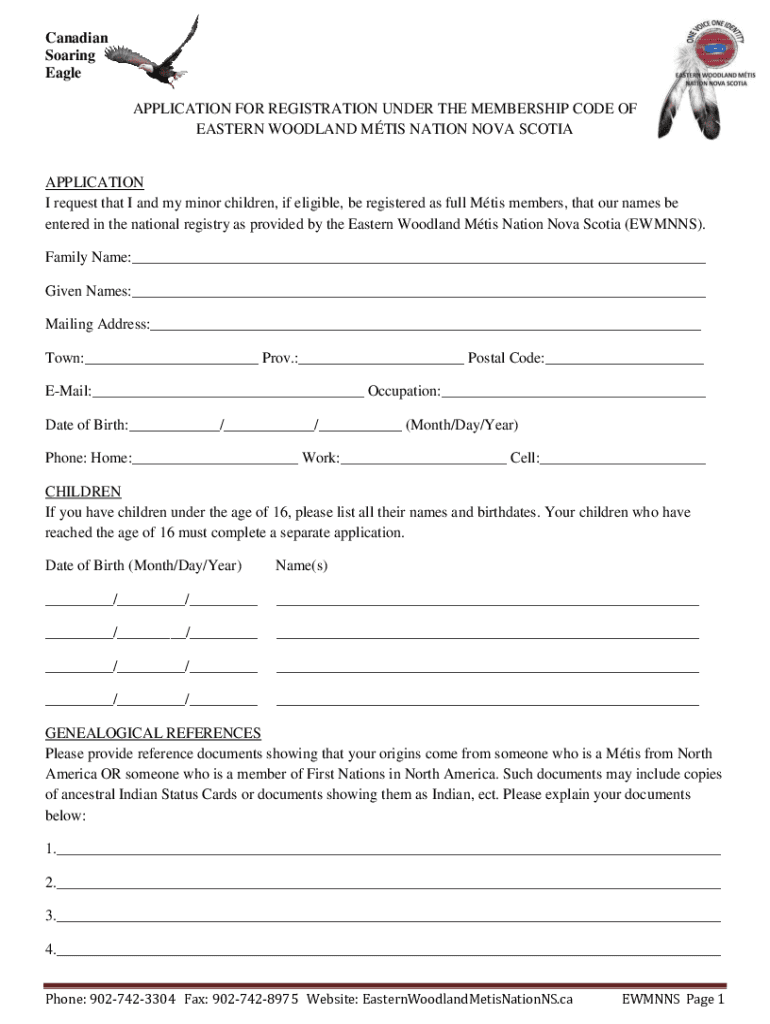
The "easternwoodlandmetisnationns caformsEWMNNSCanadian Soaring Eagle - Metis Nation NS" is an application form for individuals seeking registration as a full Métis member within the Eastern Woodland Métis Nation Nova Scotia (EWMNNS). This form is essential for those with Métis or First Nations ancestry looking to establish their status formally. It requires the applicant to provide personal information, genealogical references, and details about any minor children. The form serves not only as a registration tool but also as a means to preserve cultural heritage within the Métis community.
Steps to Complete the Form
Completing the "easternwoodlandmetisnationns caformsEWMNNSCanadian Soaring Eagle - Metis Nation NS" involves specific steps to ensure accuracy and completeness.
-
Gather Required Information: Collect personal identification details, genealogy records, and information about any dependents.
-
Fill Out Personal Information: Enter full name, address, and contact information accurately.
-
Provide Genealogical References: List ancestors to verify Métis or First Nations heritage, backed by official documents where possible.
-
Detail Minor Children: Include full information on children under your care, ensuring all details are current.
-
Review Submission Guidelines: Carefully read the form's instructions regarding additional documentation and fees.
-
Final Verification: Before submission, double-check all entered data for accuracy to avoid delays.
Key Elements of the Form
Understanding the critical elements can facilitate the effective completion of the form.
- Personal Details: Includes name, date of birth, and current address.
- Genealogical Documentation: Proof of Métis or First Nations ancestry through family records or official documentation.
- Minor Children Information: Details about children, including names and birthdates.
- Declaration of Honesty: A section where applicants attest to the accuracy of their information to prevent falsification.
Required Documents
Applicants must provide supporting documents along with the form to validate their Métis status.
- Birth Certificate: To confirm identity and birth details.
- Ancestry Records: Documents such as baptism records, marriage certificates, or census data linking you to Métis or First Nations roots.
- Identification: Valid government-issued ID to accompany your application.
Application Process and Approval Time
The application process begins once the form and all requisite documents are submitted.
- Submission Review: The EWMNNS Committee examines the form for completeness.
- Genealogy Verification: Ancestral records are assessed to confirm Métis or First Nations ties.
- Approval Duration: Typically, the process takes several weeks to months, depending on the application volume and document verification.
Legal Use of the Form
Submitting this form is a legally binding action, ensuring applicants provide truthful information.
- Importance of Accuracy: Misrepresentation can result in penalties, including denial of the application or revocation of any granted status.
- Privacy Regulations: Personal data is protected under privacy laws to safeguard applicants’ information.
Who Typically Uses the Form
This form primarily serves individuals of Métis or First Nations heritage aiming to gain acknowledgment and recognition from the EWMNNS.
- Métis Individuals: Looking to affirm their cultural identity officially.
- Descendants of First Nations: Seeking recognition of their heritage within the Métis community framework.


Eligibility Criteria
Applicants must meet specific criteria to be eligible for registration.
- Proof of Ancestry: Sufficient evidence of Métis or First Nations heritage is mandatory.
- Age Requirement: Typically, applicants should be of adult age unless filing on behalf of minor children.
- Honest Declaration: A sworn statement confirming the truthfulness of provided information.

Genealogical Documentation Requirements
Applicants are encouraged to provide robust genealogical documentation to support their application.
- Ancestral Records: Include birth and marriage certificates, land records, or church registries involving Métis or First Nations ancestors.
- Family Tree: A detailed family history chart may help establish lineage connections.
Important Terms Related to the Form
Familiarity with key terminology enhances understanding and completion of the form.
- Métis: Refers to people of mixed Indigenous and European ancestry with distinct cultural and historical backgrounds.
- Genealogy: The study of familial lines and history, critical for establishing Métis or First Nations connections.
- Applicant: The individual seeking registration, who must provide truthful and complete information.
Adhering to these blocks will ensure a comprehensive, detailed approach to completing and understanding the necessary steps and requirements for the "easternwoodlandmetisnationns caformsEWMNNSCanadian Soaring Eagle - Metis Nation NS." By following the guidelines, potential applicants can efficiently work through the form and ensure all essential aspects are covered to facilitate successful submission and potential approval.




