
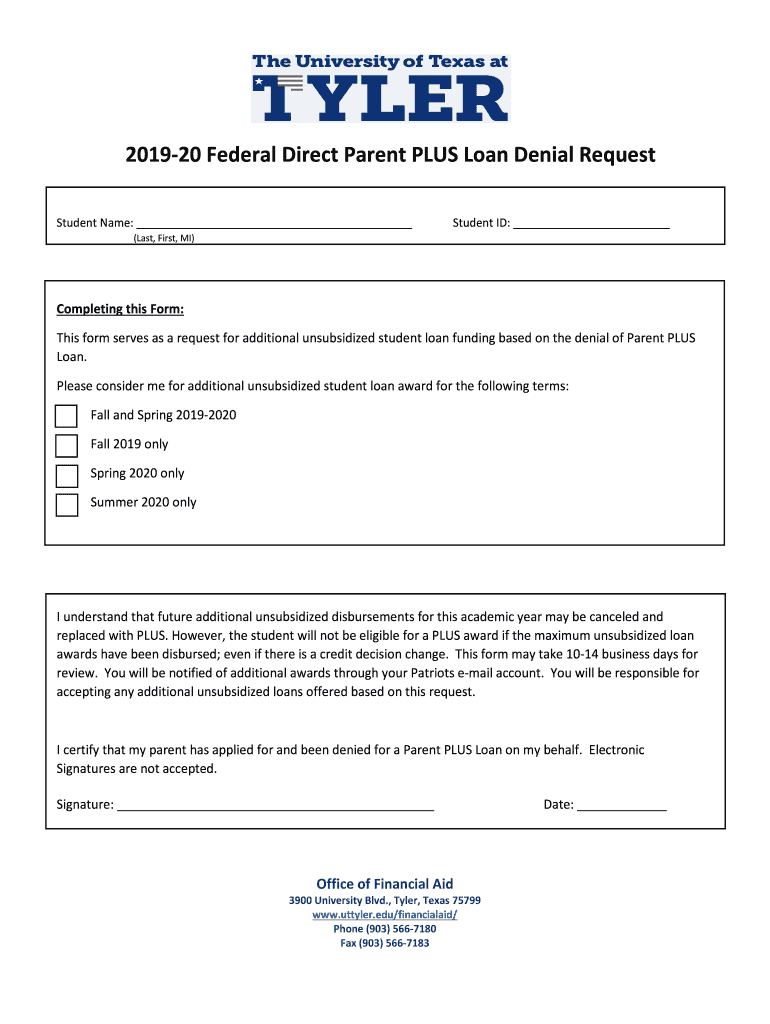







Definition & Meaning
The Parent PLUS Loan is a federal loan program designed to help parents fund their child's education beyond what the student may receive in federal loans themselves. The "parent denial plus loan" situation arises when a parent applies for this loan and is denied, typically due to adverse credit history. This denial opens up the possibility for the student to qualify for additional unsubsidized federal loans. The additional funds are intended to bridge the gap caused by the denial of the Parent PLUS Loan, reducing financial strain on students who might otherwise lack resources to continue their education.
How to Obtain the Parent Denial PLUS Loan
To apply for a Parent PLUS Loan, parents must complete the Free Application for Federal Student Aid (FAFSA) and a separate PLUS loan application. Upon denial, the student becomes eligible for extra unsubsidized loan amounts. The additional borrowing involves contacting the school's financial aid office, which will guide through their internal process. Required documentation may include the original denial notice and potentially a new application if additional information is requested.
Required Documents
- Parent PLUS Loan denial notice
- Student's FAFSA submission
- Identification documents (e.g., student ID, social security card)
- Any additional documents requested by the school's financial aid office
Steps to Complete the Parent Denial PLUS Loan Process
- Complete FAFSA: The FAFSA must be filled out and submitted as the first step to determine financial aid eligibility.
- Parent PLUS Application: Parents must apply for a PLUS Loan. If denied, the student gains eligibility for increased unsubsidized loans.
- Contact Financial Aid Office: Provide the PLUS denial notice to your school's financial aid office, and inquire about the process for obtaining additional unsubsidized loan funds.
- Submit Additional Documentation: If requested, provide any further documentation needed by the financial aid office for processing the increased loan.
Important Terms Related to the Parent Denial PLUS Loan
- Adverse Credit History: This refers to negative marks on a credit report that can result in loan denial, such as bankruptcy, foreclosures, or defaults.
- Unsubsidized Loan: Unlike subsidized loans, these accrue interest from the time funds are disbursed, requiring students to budget for higher overall repayment costs.
- FAFSA: The Free Application for Federal Student Aid is a mandatory form for obtaining federal student loans, including the Parent PLUS Loan.
Who Typically Uses the Parent Denial PLUS Loan
Primarily, these loans support students whose parents have been denied a PLUS Loan. This group often includes students from lower-income families or those with a lack of credit history or poor credit standing. The additional unsubsidized loans help cover tuition, housing, and other educational expenses, enabling students to continue their education despite the loan denial.


Application Process & Approval Time
Once a Parent PLUS Loan is denied, the student must connect with their financial aid office to explore additional unsubsidized loan options. Many institutions aim for quick processing, typically within two to three weeks. However, this can vary depending on the institution's specific practices and the time of the academic year.
Key Steps
- Contact the financial aid office immediately upon receiving denial
- Submit any required forms promptly
- Monitor loan processing timelines through the financial aid office
Examples of Using the Parent Denial PLUS Loan
Consider Emma, a college sophomore, whose parent was denied a Parent PLUS Loan due to adverse credit. Emma submits the denial notice to her university's financial aid office. As a result, she becomes eligible for additional unsubsidized loans, which she uses to cover her tuition and room charges. This allows Emma to focus on her studies without the immediate financial burden her parent's loan denial would have caused.
State-Specific Rules for the Parent Denial PLUS Loan
While the federal government sets overarching guidelines for loan processes, individual states may have additional considerations. Some states offer grants or alternative school loan programs that can complement federal loans, offering further financial support options to students. Students should contact both their school's financial aid office and state education board to explore any additional aid for which they may qualify.




