
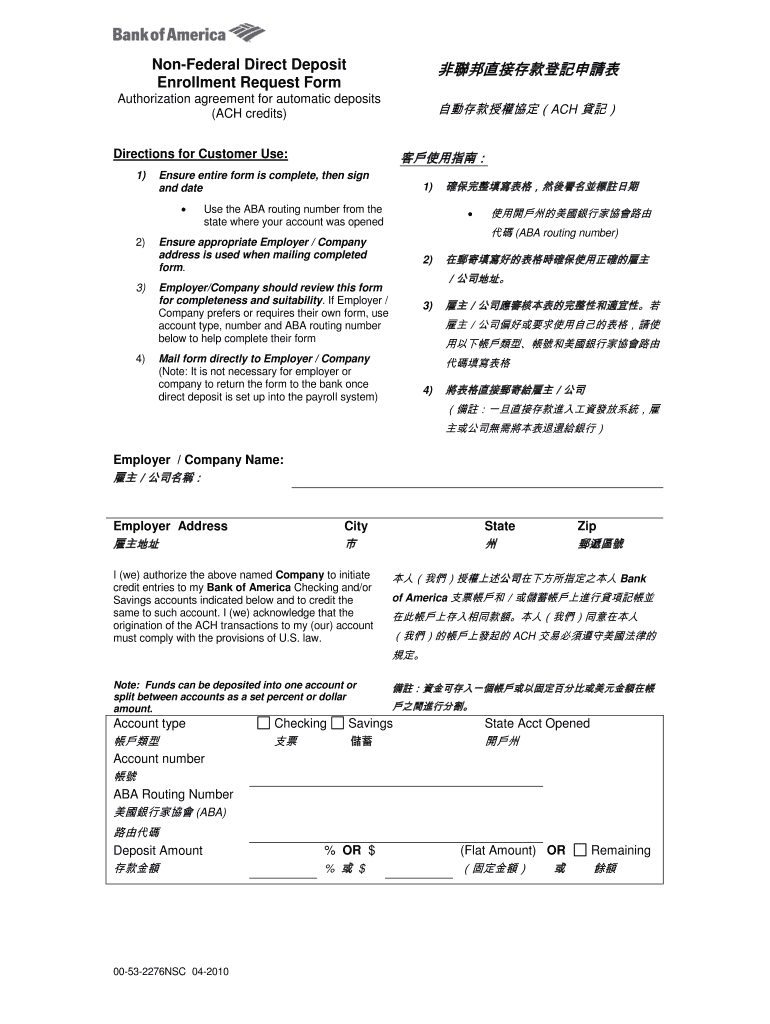







Definition & Meaning
The 53 Non-Federal Enrollment Request Form is primarily used to authorize automatic deposits (ACH credits) into Bank of America accounts. It facilitates the direct deposit of funds from non-federal entities, simplifying the process for both the payee and the payer. By filling out this form, individuals and businesses can authorize their employer or other payer to deposit funds directly into their bank account, minimizing the need for paper checks and enhancing security.
How to Use the 53 Non-Federal Enrollment Request Form
When using the 53 Non-Federal Enrollment Request Form, individuals need to provide details such as their bank account number, routing number, and personal identification details. The form typically includes fields for the account holder’s name, address, and contact information to ensure accurate processing. After completing the required sections, the form is submitted to the relevant employer or organization handling the payments.
Practical Tips for Accuracy
- Double-check Account Details: Ensure the account and routing numbers are correct to avoid delays in processing payments.
- Keep a Copy: Retain a completed copy of the form for your records and future references.
- Update as Necessary: If your banking information changes, submit an updated form promptly to prevent disruptions in deposits.
Steps to Complete the 53 Non-Federal Enrollment Request Form
- Fill in Personal Information: Begin by entering your full name, address, and contact details. Ensure all spellings and numbers are accurate.
- Provide Bank Details: Accurately input your bank account and routing numbers. These are critical for facilitating successful direct deposits.
- Sign and Date: Verify all entered information, then sign and date the form to confirm authorization.
- Submit to Payer: Send the completed form to your employer or the specific entity responsible for managing your payments.
Verification Process
- Check for Completeness: Ensure all fields are filled out, and there are no missing or incorrect inputs.
- Bank Verification: Confirm with your bank that the details provided match their records to avoid processing issues.
Key Elements of the 53 Non-Federal Enrollment Request Form
- Account Holder Information: Name, address, and contact information.
- Banking Information: Account and routing numbers for direct deposit.
- Authorization Section: Declaration by the account holder authorizing direct deposit.
- Contact Information for the Payer: Details on where to send the completed form.
Additional Features
- Multilingual Options: Available in both English and Chinese to accommodate a diverse user base.
- Instructions Page: Includes detailed guidelines to help users accurately complete each section.
Who Typically Uses the 53 Non-Federal Enrollment Request Form
Individuals and businesses who receive payments from non-federal sources often use this form. Common users include employees looking for direct deposit of their paychecks, independent contractors receiving freelance payments, or individuals expecting recurring payments such as annuities or settlements.


Business Contexts
- Private Sector Employees: Those employed outside the federal government.
- Contractors and Freelancers: Individuals who need streamlined payment options.
- Recipients of Regular Non-Federal Payments: Such as retirees receiving pensions.
Important Terms Related to the 53 Non-Federal Enrollment Request Form
- ACH Credit: Automated Clearing House transaction used for direct deposit payments.
- Routing Number: A nine-digit number used to identify the financial institution in a transaction.
- Direct Deposit: The electronic transfer of funds directly into a bank account.
Understanding Key Financial Terms
- Beneficiary: The person or entity receiving the payment through direct deposit.
- Issuer: The entity that authorizes and executes the deposit transaction.
Form Submission Methods: Online, Mail, In-Person
The form can be submitted through various channels depending on the requirements of the issuing organization.
- Online: Some institutions offer electronic submission through secure portals or email. This method is fast and ensures prompt processing.
- Mail: Physical submission via postal services remains a common method, requiring mailing to the specified address of the payer.
- In-Person: For organizations that require or prefer physical submission, completing and handing in the form at a designated office can be an option.
Pros and Cons of Each Submission Method
- Online Submission: Quick and efficient but requires a reliable internet connection.
- Mail Submission: No immediate internet access is needed but can be slower to process.
- In-Person Submission: Offers personal interaction and verification but may not be convenient for all users.
Digital vs. Paper Version
Both digital and paper versions of the 53 Non-Federal Enrollment Request Form are available, each with its strengths.
Digital Version
- Flexibility: Allows for easy corrections and updates.
- Environmentally Friendly: Reduces paper waste and is easier to store electronically.
- Integration: Can be seamlessly integrated with digital workflow systems like DocHub for editing and signing.
Paper Version
- Accessibility: Useful for users with limited digital access or who prefer physical documentation.
- Tangible Record: Provides a physical copy for filing and archiving.




