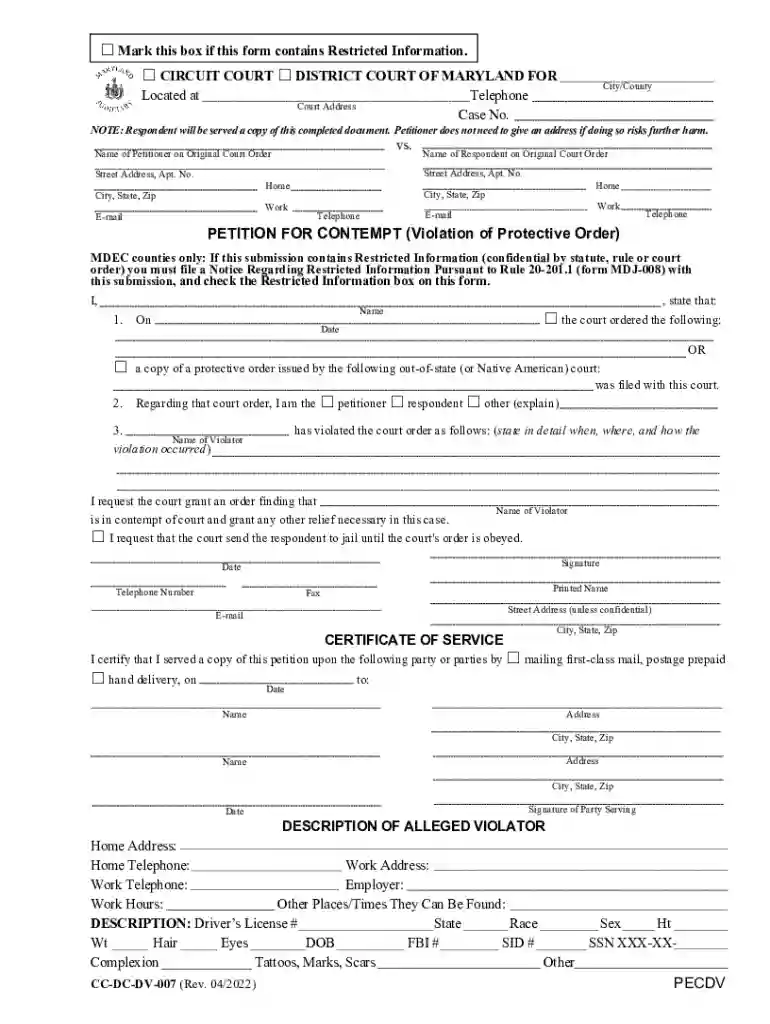
Violation petition 2026

Get Form
cc dc dv 007 Preview on Page 1

Here's how it works

01. Edit your cc dc dv 007 online
Type text, add images, blackout confidential details, add comments, highlights and more.

02. Sign it in a few clicks
Draw your signature, type it, upload its image, or use your mobile device as a signature pad.

03. Share your form with others
Send it via email, link, or fax. You can also download it, export it or print it out.

Definition and Meaning of a Violation Petition

A violation petition is a formal legal document filed with a court when an individual or entity is accused of not complying with a previously issued court order. This document serves as a request for the court to review the alleged non-compliance and take action to enforce the original court order. The violation petition details the specific nature of the violation and may request penalties or other corrective measures. In the U.S. legal system, such petitions are commonly used in cases involving protective orders, probation terms, or custody arrangements. The submission of a violation petition triggers a legal process that allows the accused party to respond and for a judge to evaluate the case.

Key Components of a Violation Petition

  • Petitioner's Details: Includes the name, address, and contact information of the individual or organization filing the petition.
  • Respondent's Details: Information about the party accused of violating the court order.
  • Case Details: Original court case number and date of the initial order.
  • Nature of Violation: A detailed description of how the court order was allegedly violated.
  • Relief Sought: Specific action or remedy the petitioner is requesting from the court.
  • Supporting Evidence: Documentation or evidence supporting the claim of a violation.

Steps to Complete the Violation Petition

  1. Obtain the Form: Acquire the official violation petition form from the court's website or clerical office where the original case was filed.
  2. Fill Out Personal Information: Enter your personal and contact information in the designated fields.
  3. Detail the Violation: Provide a concise and accurate description of the violation, referencing the specific terms of the original court order.
  4. Attach Evidence: Include any evidence supporting your claim, such as emails, photos, or eyewitness statements.
  5. Specify Requested Action: Clearly state what action you are requesting the court to take regarding the violation.
  6. Review and Sign: Carefully review the completed form for accuracy before signing and dating it.
  7. Submit the Petition: File the petition with the appropriate court, typically through mail, online submission, or in person.

Legal Use of the Violation Petition

Violation petitions are primarily used in legal contexts to enforce compliance with court orders. They can be used in cases like:

  • Protective Orders: When a party violates a restraining or protective order, endangering the petitioner.
  • Probation Terms: To address instances where an individual has not adhered to the conditions of their probation.
  • Custody Arrangements: In family law, when a parent fails to comply with custody or visitation terms.
  • Contractual Obligations: If a party violates the terms of a legal contract that was previously sanctioned by a court.

Important Terms Related to Violation Petition

  • Contempt of Court: Legal finding that someone is disobeying a court order.
  • Protective Order: Legal injunction requiring one party to do or not do specific acts.
  • Probation Violation: Failure to comply with the terms and conditions of probation.
  • Custody Violation: Non-compliance with court-ordered custody arrangements.

State-Specific Rules for Violation Petitions

Legal procedures for handling violation petitions can vary significantly from one state to another in the U.S. It is important to understand the specific rules that apply in your jurisdiction. Some states may have unique forms or additional requirements for filing a violation petition.

Common Variations Include:

  • Filing Fees: The cost to file a violation petition may differ by state.
  • Timing and Deadlines: Deadlines for submitting a petition and obtaining a hearing.
  • Required Documentation: States may vary in the type of evidence needed to support a claim.

Examples of Using a Violation Petition

Violation petitions can be applied in various scenarios, such as when a tenant violates the terms of a court-ordered eviction process or when someone disregards a non-disclosure agreement enforced by a legal judgment.

Practical Scenarios:

  • Domestic Violence Cases: Filing a petition when a protective order is breached.
  • Business Agreements: When a party fails to comply with court-enforced contract terms.
  • Child Support: Requesting enforcement when a parent fails to make required payments.

Required Documents for Filing

To successfully file a violation petition, gather essential documents, including the original court order, evidence of compliance violations, and any communications that substantiate your claims. These documents form the basis of your petition and support your case in court.

Examples of Supporting Documents:

  • Original Court Order: Necessary to reference specific terms allegedly violated.
  • Correspondence Records: Emails, letters, or messages proving the violation.
  • Eyewitness Statements: Affidavits from individuals who observed the violation.

Who Typically Uses the Violation Petition

Violation petitions are used by individuals and entities directly affected by the non-compliance of a court order. These can include private citizens, businesses, or government entities seeking to enforce legal decisions.


decoration image ratings of Dochub

Common Users:

  • Domestic Abuse Victims: Individuals seeking enforcement of protective orders.
  • Probation Officers: Officials ensuring compliance with court-mandated probation terms.
  • Attorneys: Legal professionals representing clients needing court enforcement.
  • Business Owners: Companies upholding contract terms through judicial channels.
decoration image

See more violation petition versions

We've got more versions of the violation petition form. Select the right violation petition version from the list and start editing it straight away!
Versions Form popularity Fillable & printable
2022 4.8 Satisfied (37 Votes)
2020 4.3 Satisfied (29 Votes)
2003 4 Satisfied (34 Votes)
be ready to get more

Complete this form in 5 minutes or less

Get form

Got questions?

We have answers to the most popular questions from our customers. If you can't find an answer to your question, please contact us.
Contact us
If a court order gives certain custody or visitation rights to a party and the other party fails to obey the order, the complaining party may file a petition alleging a violation of the order.
When a petition is filed, the plaintiff and the defendant are given the opportunity to settle the case privately or to use an alternative dispute resolution (ADR) process rather than go to trial. The court may also provide a summary judgment. If the case goes to trial, the judge will ultimately issue a verdict.
No. An attorney is licensed by the State to represent you in court. You usually have the right to appear without one, but you cant assign that right to anyone else.
Drafting the Complaint In some circumstances, you file a petition or a motion. The court has several complaint forms that you may use in drafting your complaint. The forms are available online and at the Pro Se Intake Unit. You may also write your own complaint without using a court form.
In some circumstances, you file a petition or a motion. The court has several complaint forms that you may use in drafting your complaint. The forms are available online and at the Pro Se Intake Unit. You may also write your own complaint without using a court form.

Security and compliance

At DocHub, your data security is our priority. We follow HIPAA, SOC2, GDPR, and other standards, so you can work on your documents with confidence.

Learn more
ccpa2
pci-dss
gdpr-compliance
hipaa
soc-compliance
be ready to get more

Complete this form in 5 minutes or less

Get form

People also ask

Many people have successfully represented themselves. Others have gone to court and found that their case was more complicated or that the court process was more difficult than they expected.
A petition is a legal document that formally requests a court order.

Related links