




01. Edit your form online
Type text, add images, blackout confidential details, add comments, highlights and more.

Type text, add images, blackout confidential details, add comments, highlights and more.

Draw your signature, type it, upload its image, or use your mobile device as a signature pad.

Send it via email, link, or fax. You can also download it, export it or print it out.
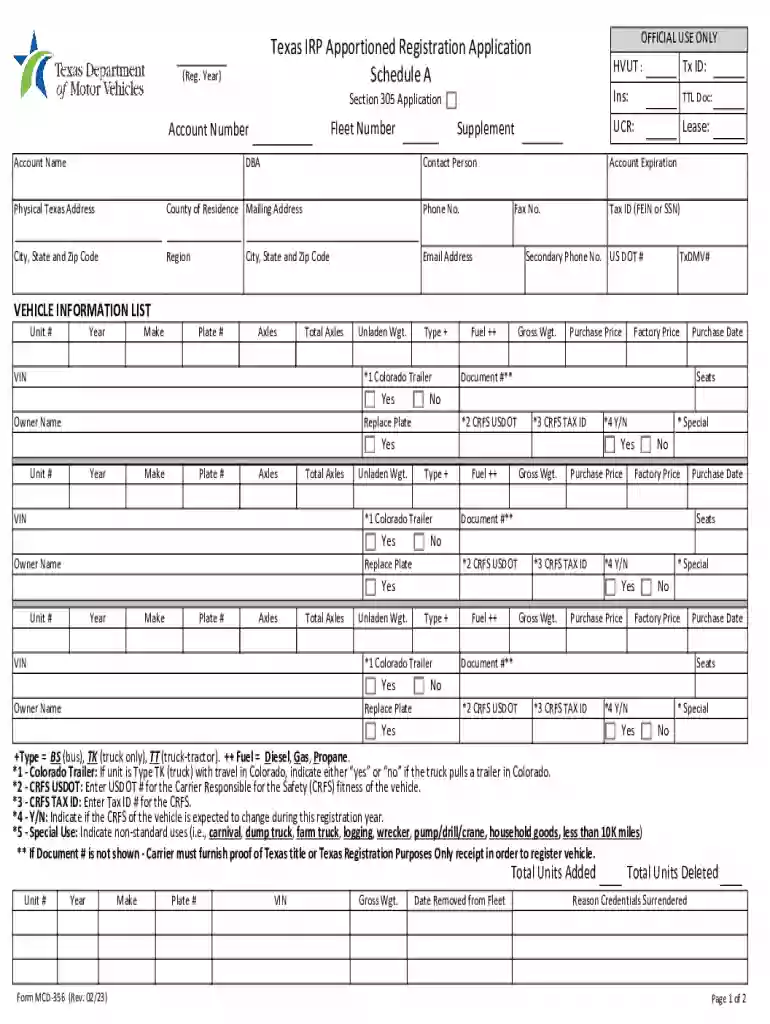
The Texas IRP Apportioned Registration Application is a critical document for fleet owners operating commercial vehicles across state lines. This application is part of the International Registration Plan (IRP), an agreement among U.S. states and Canadian provinces that facilitates the distribution of registration fees based on the distance traveled in each jurisdiction. For fleet operators, completing this application ensures that their vehicles are registered properly, allowing them to legally operate on an interstate basis while fairly allocating taxes and fees to the jurisdictions where they travel. This not only helps in maintaining compliance but also simplifies the administrative burden of registering vehicles in multiple states.
To obtain the Texas IRP Apportioned Registration Application, business owners can access it through the Texas Department of Motor Vehicles (TxDMV) website. The TxDMV provides downloadable forms along with detailed instructions for completion. Alternatively, applicants may visit a local TxDMV Regional Service Center to receive a physical copy of the application. It is crucial to ensure that the most recent version of the application is used to prevent any processing delays.
Filling out the Texas IRP Apportioned Registration Application requires attention to detail. The form contains several sections that must be accurately completed to ensure compliance and avoid delays. Fleet operators need to furnish detailed information about their vehicles and operations.
Schedule A: Includes vehicle-specific details such as unit number, year, make, weight, and ownership details. This section helps in identifying each vehicle and linking it to its owner.
Schedule B: Requires reporting of distances traveled in various jurisdictions, which is essential for calculating fees proportional to travel.
Fleet operators should have their vehicle information, travel records, and other documentation ready to streamline the completion process. Double-checking information before submission can prevent errors that may result in application rejection or delays.
The Texas IRP Apportioned Registration Application has several key elements that fleet operators must understand to ensure precise completion.
Insurance Verification: Proof of insurance is mandatory to process the application. Operators must demonstrate adequate coverage for the vehicles being registered.
Payment of Fees: Fees are calculated based on the distance traveled in each jurisdiction. Understanding how these fees are determined is crucial for accurate submission.
Compliance with State Regulations: Applicants must ensure all vehicles comply with Texas and IRP regulations, including safety and emissions standards.
Texas has specific rules governing the IRP application process that fleet operators need to be aware of. These rules ensure that all commercial vehicles operating interstate have the correct documentation and fee allocations.
Renewal Deadlines: Operators must adhere to annual renewal deadlines to prevent penalties or suspension of registration.
Distance Reporting Variations: Specific calculations may vary based on previous travel and anticipated changes in travel patterns.
Understanding these rules can aid operators in maintaining compliance and avoiding late fees or legal complications.
Submitting the completed Texas IRP Apportioned Registration Application requires several supporting documents. Ensuring that these documents are prepared and included with the application can facilitate a smoother processing experience.
Vehicle Registration Proof: Documentation showing current registration status for each vehicle.
Insurance Certificate: Valid insurance documentation for all vehicles listed in the application.
Travel Logs: Detailed logs of miles traveled by jurisdiction, essential for computing apportioned fees.
Gathering these documents in advance allows for a more efficient application process and helps avoid the need for resubmission due to missing paperwork.
Operators have various options for submitting the Texas IRP Apportioned Registration Application, each with its own set of procedures. Understanding these methods can help in choosing the most convenient option based on individual circumstances.
Online Submission: The TxDMV offers an online portal for submitting applications, which provides a fast and secure method for processing.
Mail Submission: Applicants can send completed forms and documents via mail. It is recommended to use a method that provides tracking to ensure delivery.
In-Person Submission: Visiting a TxDMV Regional Service Center allows for immediate review and submission of documents.
Choosing the right submission method depends on the operator's preference and needs for timely processing. Each method has specific guidelines for ensuring proper handling and processing.
Complying with the legal requirements of the Texas IRP Apportioned Registration Application is essential for lawful interstate operation. Failure to comply could result in penalties, fines, or an inability to operate legally across state lines.
Adherence to IRP Guidelines: Ensure all aspects of the IRP guidelines are met, including accurate reporting and documentation.
Maintaining Proper Records: Keeping detailed records of all filings, payments, and related documents is vital for both compliance and auditing purposes.
Understanding and adhering to all legal requirements and guidelines helps fleet operators manage their registrations effectively and maintain lawful operations across jurisdictions.
We've got more versions of the Texas IRP Apportioned Registration Application form. Select the right Texas IRP Apportioned Registration Application version from the list and start editing it straight away!
At DocHub, your data security is our priority. We follow HIPAA, SOC2, GDPR, and other standards, so you can work on your documents with confidence.
Where Do I Obtain IRP Registration? All new account applications must be processed at a TxDMV Regional Office (see. Appendix A). Submitting these applicationsRead more
Texas IRP Information Packet; Email: TxFLEET@TxDMV.gov. How to Apply. All new motor carrier accounts must be created online in TxFLEET. VisitRead more


