




01. Edit your fafsa waiver printable online
Type text, add images, blackout confidential details, add comments, highlights and more.

Type text, add images, blackout confidential details, add comments, highlights and more.

Draw your signature, type it, upload its image, or use your mobile device as a signature pad.

Send fafsa waiver template via email, link, or fax. You can also download it, export it or print it out.
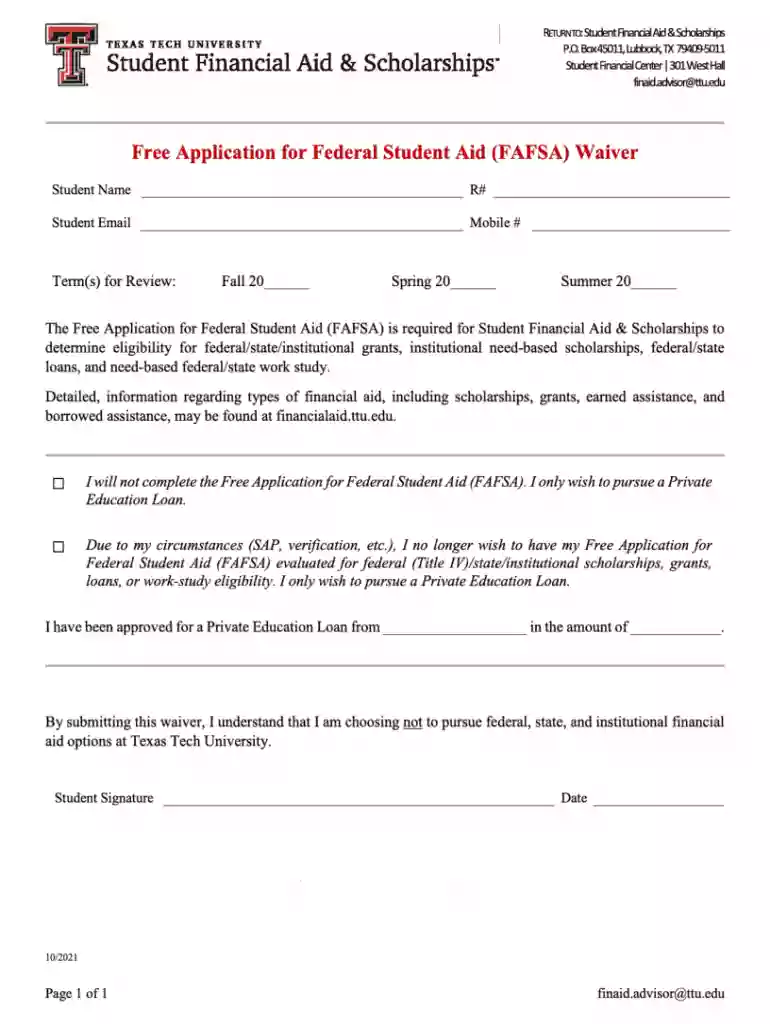
The FAFSA waiver refers to a specific exemption or modification made to the standard requirements of the Free Application for Federal Student Aid (FAFSA). This waiver might be granted in various circumstances to accommodate students who face certain challenges in completing their FAFSA application under regular protocols. Understanding the intricacies of this waiver is essential for applicants seeking financial assistance for college or vocational education in the United States.
A FAFSA waiver can be applicable in scenarios where students or their families are unable to provide standard financial documentation due to unique circumstances. For example, students without parental support or those experiencing financial hardships may qualify for such waivers. These waivers ensure that all students, regardless of individual challenges, have the opportunity to apply for necessary aid to continue their education.
To effectively use a FAFSA waiver, students must first identify their eligibility based on their personal circumstances. Waivers can cover various requirements, such as parental information or signature in cases where obtaining such details is impractical or impossible.
Determine Eligibility: Understand the specific criteria that might qualify you for a FAFSA waiver. These can include homelessness, legal status as a ward of the court, or other dire financial circumstances.
Gather Necessary Documentation: Although a waiver reduces the requirement for standard documents, some proof of your situation might still be required. This could involve letters from social workers or legal documents attesting to your circumstances.
Communicate with Financial Aid Offices: Reach out to the financial aid office of your intended institution to discuss your situation. They can provide specific guidance on available waivers and how to apply them to your FAFSA submission.
Follow Institutional Procedures: Each school may have different processes for handling waivers, so ensure you understand and adhere to these protocols to maximize your chances of receiving aid.
Securing a FAFSA waiver typically involves a multi-step process that requires coordination with your educational institution and possibly legal or financial advisors. Here are steps to obtain a waiver:
Contact the School’s Financial Aid Office: Initiate a conversation as early as possible to discuss your circumstances with financial aid counselors who can advise on the necessary steps.
Collect Supporting Documentation: Prepare any necessary documentation that substantiates your need for a waiver. This can range from letters detailing your financial situation to official documents.
Complete a Dependency Override Request: If your situation involves a dependency status that does not reflect reality (such as lack of parental support), you might need to request a formal reevaluation of your dependency status.
Submit Required Forms: Ensure all paperwork is completed accurately and submitted before deadlines. Forms might include detailed explanations of your situation alongside any official documentation.
Follow Up: Stay in contact with the financial aid office to check on the progress of your waiver request and ensure that all criteria have been met.
The completion of a FAFSA waiver involves specific steps, each crucial for ensuring that the application for aid is processed without the standard requirements:
Self-Assessment: Evaluate if your situation fits the eligibility criteria for a waiver. Common causes include being an independent student, a hardship case, or having special circumstances.
Initial FAFSA Submission: Fill out the FAFSA form as completely as possible, identifying sections where a waiver is needed.
Notification of Special Circumstances: Clearly indicate in your application wherever a waiver is requested, detailing your specific situation.
Submission of Supporting Documentation: Work with your school to submit any additional documentation required as proof of your circumstances.
Verification Process: Be prepared for a potential verification process, where additional information might be requested by the financial institution to validate your eligibility for a waiver.
Final Approval: Once all necessary steps are completed and documentation reviewed, wait for confirmation of waiver approval.
Eligibility for a FAFSA waiver is determined by several factors that distinguish a student's situation from the norm:
Independent Student Status: Students who are considered independent for federal student aid purposes may qualify for certain waivers, especially if they have unique living situations.
Financial Hardship: Severe financial difficulties that prevent the acquisition of standard financial documents can be a basis for a waiver. This might include recent job loss of a parent or guardian, or other drastic financial downturns.
Special Circumstances: This includes students who are wards of the state, in foster care, or under legal guardianship, as well as those experiencing homelessness or substantial family disruption.
Understanding these criteria is key to determining if a waiver is applicable and how to pursue one effectively.


While a waiver may exempt you from standard documentation, certain documents may still be necessary to substantiate your waiver request, including:
Letters from Authorities: Confirmation letters from legal, educational, or social authorities that describe your unique circumstances.
Legal Documents: If applicable, court orders or other legal documents that establish your status as an independent student or validate conditions of hardship.
Personal Statements: Written personal narratives detailing your situation can provide context and aid in waiver approval.
Various methods exist for submitting a FAFSA waiver, allowing flexibility based on your situation and resources:
Online Submission: Many schools offer an online portal for waiver requests, where documentation can be uploaded and submitted electronically.
Mail: Physical copies of your form and supporting documents can be sent directly to the institution’s financial aid office; ensure you have tracked delivery for security.
In-Person: Directly submitting your application to the financial aid office can be beneficial if you need immediate feedback or have complicated circumstances.
The method of submission may impact processing time, so consider each option’s advantages regarding your personal timeframe.
Understanding the different versions of the FAFSA waiver is important, especially if dealing with outdated forms or processes from previous years:
Current Academic Year vs. Previous Years: Waivers and forms might vary slightly from year to year. It's crucial to ensure that you are completing and submitting the correct version for the current academic term.
Institution-Specific Variants: Schools may have their own modified waiver forms which are distinct from the federal versions. Check with your institution to ensure you’re using the correct documentation.
Having clarity on the version and relevant procedures will aid in a smoother waiver application process and better alignment with academic timelines.
Recognizing the significance of the FAFSA waiver involves understanding its ability to provide much-needed flexibility for students facing unique challenges. The waiver supports equitable access to financial aid by accommodating those who may struggle with conventional application standards. Successfully navigating the waiver process requires clarity, proactive communication with financial aid offices, and attention to detail in fulfilling all necessary requirements to obtain the needed support and pursue educational goals.
We've got more versions of the fafsa waiver printable form. Select the right fafsa waiver printable version from the list and start editing it straight away!
At DocHub, your data security is our priority. We follow HIPAA, SOC2, GDPR, and other standards, so you can work on your documents with confidence.
For example, not completing this waiver will not affect a students ability to graduate. Please also note that this form is protected by all applicable studentRead more
Nov 17, 2016 This waiver is not valid until all requested documentation is provided to the Financial Aid Office, and all documentation has been verified.Read more
The Capella Progress Reward scholarship may decrease the amount of funding that can be offered from other sources, such as federal financial aid. In someRead more


