




01. Edit your form online
Type text, add images, blackout confidential details, add comments, highlights and more.

Type text, add images, blackout confidential details, add comments, highlights and more.

Draw your signature, type it, upload its image, or use your mobile device as a signature pad.

Send it via email, link, or fax. You can also download it, export it or print it out.
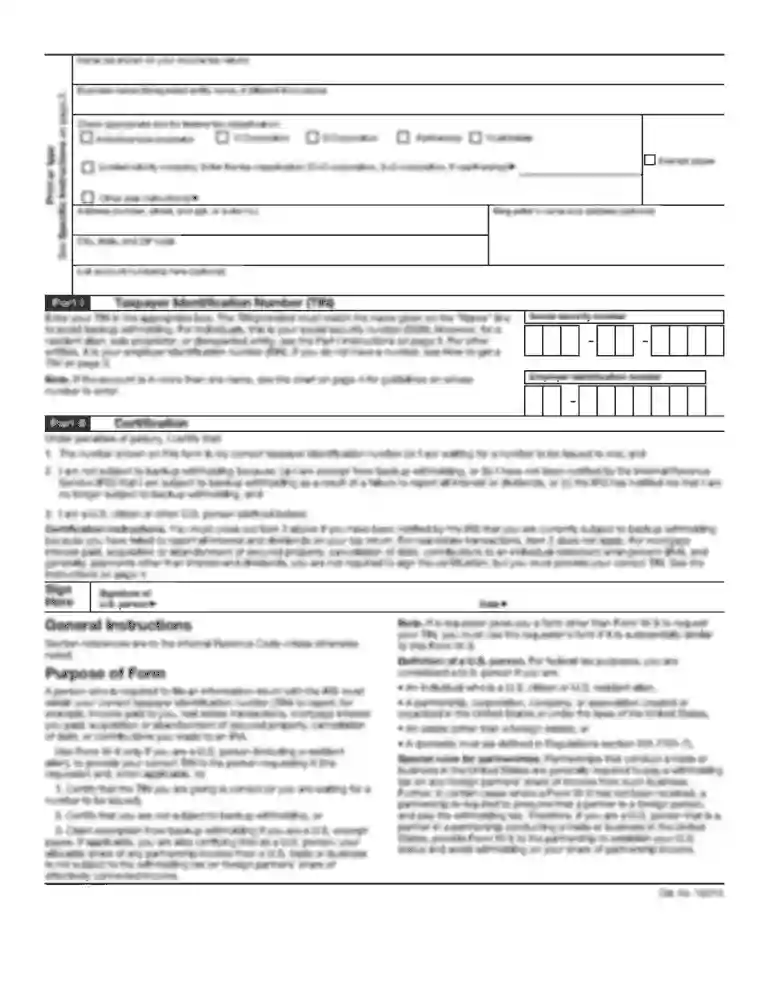
The sample W-9 form, formally known as the “Request for Taxpayer Identification Number and Certification,” is a standard Internal Revenue Service (IRS) document used by U.S. persons to provide their correct Taxpayer Identification Number (TIN) to entities that must file information returns with the IRS. This form is integral in various financial transactions and is often used by individuals, businesses, and independent contractors to report income other than wages, salaries, and tips. The W-9 form acts as a formal request for your TIN and serves as a certification of your tax-related information, ensuring compliance with IRS requirements.
Fill In Your Personal Information: Begin by entering your name as shown on your tax return. If you're a business, enter the full name of your company. Complete the address section, including street address, city, state, and ZIP code.
Select Your Federal Tax Classification: Choose the appropriate box that represents your federal tax classification, such as an individual/sole proprietor, C Corporation, S Corporation, Partnership, Trust/estate, LLC, etc. Ensure accuracy to avoid complications.
Provide Your Taxpayer Identification Number: In Part I of the form, enter your Social Security Number (SSN) if you are an individual, or your Employer Identification Number (EIN) for businesses. This is crucial for proper reporting of non-wage income.
Certification: Part II requires your signature to certify the accuracy of the information provided. Signing the form without errors ensures compliance with IRS regulations, safeguarding against potential penalties.
Submit the Form: Once completed, submit the form directly to the requester (e.g., a client or financial institution), not the IRS. It's advisable to keep a copy for your records.


The IRS requires that the W-9 form be accurate and up-to-date to prevent misreporting of income. False or incorrect information may lead to penalties, so users must ensure accuracy when completing the form. Additionally, individuals or entities issuing payments typically request a W-9 from each payee for reporting purposes, aligning with IRS guidelines for maintaining transparency in non-wage income reporting.
Failure to submit an accurate W-9 form can result in penalties from the IRS. Providing false information could lead to fines or, in severe cases, legal action for tax evasion. The most common penalty involves backup withholding, where the issuer must withhold a percentage of payments for tax purposes if the payee does not meet W-9 requirements.
Though the W-9 form is federally standardized, some states may have additional requirements for taxation and reporting. It's important to verify state-specific rules that may impact the form's completion, especially if you're conducting business in states with unique tax codes or obligations.
Freelance Graphic Designer: A graphic designer who provides services to multiple clients will complete a W-9 for each to ensure income reported on Form 1099 is matched with the IRS records.
Sole Proprietor in Consulting: A consultant hired by a corporation must provide a W-9 form to the finance department to facilitate the correct tax filings related to consultant fees.
The sample W-9 form is a critical document for ensuring tax compliance, enabling proper income reporting, and avoiding potential penalties. Understanding its components and correct application facilitates smoother transactions and minimizes the risk of IRS issues.
We've got more versions of the sample w9 form form. Select the right sample w9 form version from the list and start editing it straight away!
| Versions | Form popularity | Fillable & printable |
|---|---|---|
| 2014 | 4.2 Satisfied (31 Votes) |
Yes, and it’s really easy! DocHub is an online PDF editor with advanced document management functions that allow you promptly modify your documents, complete blank fields and drop new ones for other people to fill out, and create eSignatures in several ways. Upload your sample w9 form, give information as required, and select how you want to eSign your document - by typing your name, drawing your signature, uploading its image, or utilizing a QR code.
You can find the latest and most relevant version of the sample w9 form in our DocHub forms library. Search it by categories or utilize the search field to find the exact template that suits your case. You can open this form for editing once you find it.
At DocHub, your data security is our priority. We follow HIPAA, SOC2, GDPR, and other standards, so you can work on your documents with confidence.
Use Form W-9 to request the taxpayer identification number (TIN) of a U.S. person (including a resident alien) and to request certain certifications and claims
The type and amount of income that qualifies for the exemption from tax. 5. Sufficient facts to justify the exemption from tax under the terms of the treatyRead more


