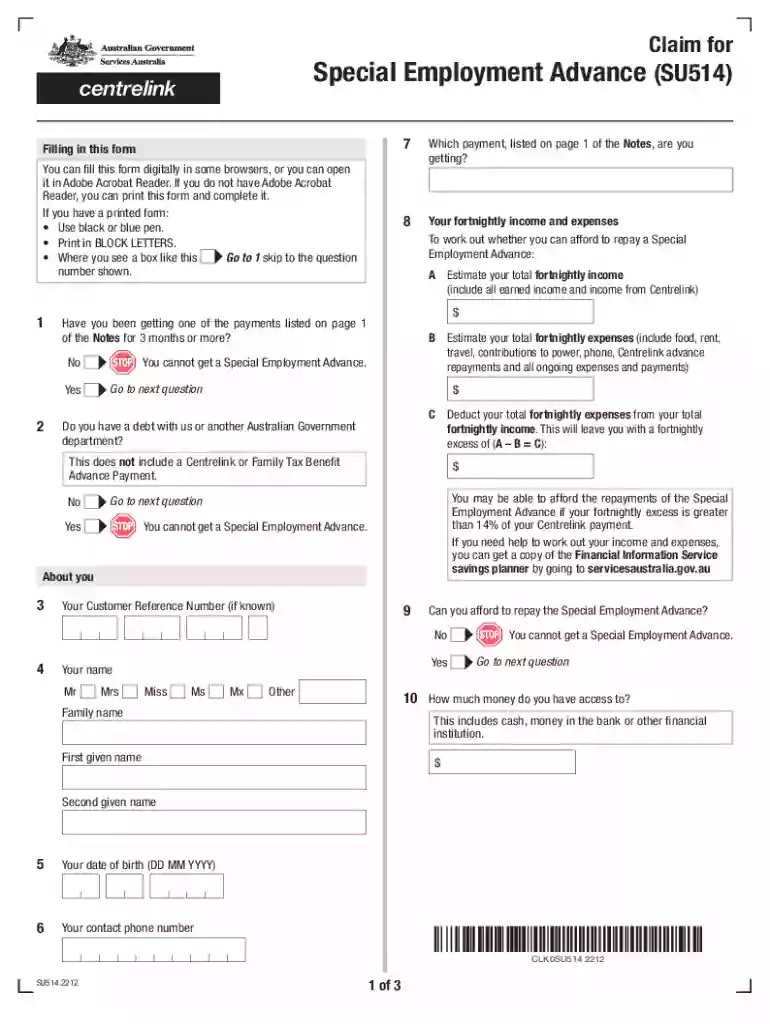
Definition and Purpose of the Special Employment Advance (SU514)
The Special Employment Advance (SU514) is a financial assistance program designed to support individuals facing financial hardship when starting a new job. This advance aims to bridge the gap for those who need immediate funds to cover essential work-related expenses. The SU514 provides temporary financial relief, allowing recipients to focus on their job transition without the additional stress of financial instability.
Real-World Scenarios & Examples
- Job Commencement Costs: Individuals required to relocate or purchase work attire can use the SU514 to cover these immediate expenses.
- Delayed First Paycheck: The advance helps mitigate financial strain between job commencement and the first paycheck.
- Transportation Expenses: Those who need to secure reliable transportation to start a job may utilize these funds for fuel or vehicle repairs.
Eligibility Criteria for the SU514
Eligibility for the Special Employment Advance is contingent upon several criteria. Applicants must demonstrate a clear need for financial assistance and meet specific prerequisites outlined by the administering agency.

Basic Eligibility Requirements
- Proof of Employment Offer: Applicants must provide documentation confirming a legitimate job offer.
- Income Threshold: There are income limits to qualify, ensuring those with the greatest need receive assistance.
- Residency: Generally, the applicant must be a resident of the United States, with potential state-specific residency requirements.
Case-by-Case Considerations
- Past Assistance: Individuals who have previously received similar advances may have their applications reviewed more stringently.
- Existing Financial Obligations: Consideration for other debts or financial assistance received that may impact eligibility.
Required Documentation for the SU514
Proper documentation is crucial in the application process for the SU514. Applicants must submit accurate and comprehensive documents to support their request.
Essential Documents
- Employment Verification: Letter from the employer or contract outlining job details.
- Identification: Valid government-issued ID, such as a driver's license or passport.
- Proof of Financial Hardship: Recent bank statements or bills demonstrating a lack of funds.
- Additional Documentation: Depending on individual circumstances, additional documentation may include rental agreements, utility bills, or transportation receipts.
Steps to Complete the SU514 Application
Applying for the SU514 requires following precise steps to ensure all requirements are met and the application is processed efficiently.
Application Process
- Gather Necessary Documents: Collect all relevant paperwork, ensuring no required documentation is overlooked.
- Complete the Form: Fill out all sections of the SU514 form, accurately entering all requested information.
- Submit the Application: Choose a submission method – online, mail, or in-person – and ensure the application is sent to the correct address or platform.
- Follow-Up: Monitor the application status through the provided channels and be prepared to supply additional information if requested.
Application Process and Approval Time
The SU514 application process involves several stages, with varying timelines for approval based on the method of submission and completeness of the application.
Approval Timeline
- Online Submission: Typically expedited, with processing times ranging from a few days to a couple of weeks.
- Mail or In-Person Submission: May take longer due to postal times or in-person processing delays, usually extending up to several weeks.
Factors Affecting Approval Time
- Completeness and Accuracy: Fully completed applications with no errors or missing information are processed faster.
- Demand and Resource Availability: High demand periods may extend processing times due to increased application volume and resource allocation.
Who Typically Uses the SU514
The Special Employment Advance caters to a specific demographic, primarily those transitioning between jobs or entering the workforce under financially strained conditions.

Common Beneficiaries
- New Graduates: Individuals starting their first jobs who lack savings to manage initial employment expenses.
- Low-Income Workers: Those previously unemployed or underemployed who need immediate financial support.
- Single Parents: Parents re-entering the workforce after an extended period, facing the dual challenge of supporting a family while managing job-related costs.
Legal Considerations and Implications of the SU514
Understanding the legal framework surrounding the SU514 is crucial for applicants to ensure compliance and proper utilization of funds.
Legal Guidelines
- Repayment Terms: The advance is typically structured with specific repayment terms, which vary based on individual financial situations.
- Reporting Requirements: Beneficiaries may need to report the receipt and use of these funds to relevant authorities or during tax filing.
Compliance and Penalties
- Misuse of Funds: Inappropriate use or misrepresentation in the application may lead to penalties or repayment demands.
- Non-Compliance: Failure to adhere to terms could affect eligibility for future assistance or entail legal consequences.
State-Specific Variations and Regulations
Although the SU514 operates broadly, specific regulations and terms can vary by state, affecting eligibility and application procedures.
Variations in Policy
- Eligibility Criteria: States may have additional criteria based on local economic conditions or specific target demographics.
- Application Procedures: Variations in how applications are processed, depending on state-specific administrative practices.
Adapting to Local Rules
Applicants should familiarize themselves with their respective state’s regulations to ensure compliance and take advantage of any localized assistance programs that may complement the SU514.