




01. Edit your form 1 firms online
Type text, add images, blackout confidential details, add comments, highlights and more.

Type text, add images, blackout confidential details, add comments, highlights and more.

Draw your signature, type it, upload its image, or use your mobile device as a signature pad.

Send form 1 firms online via email, link, or fax. You can also download it, export it or print it out.
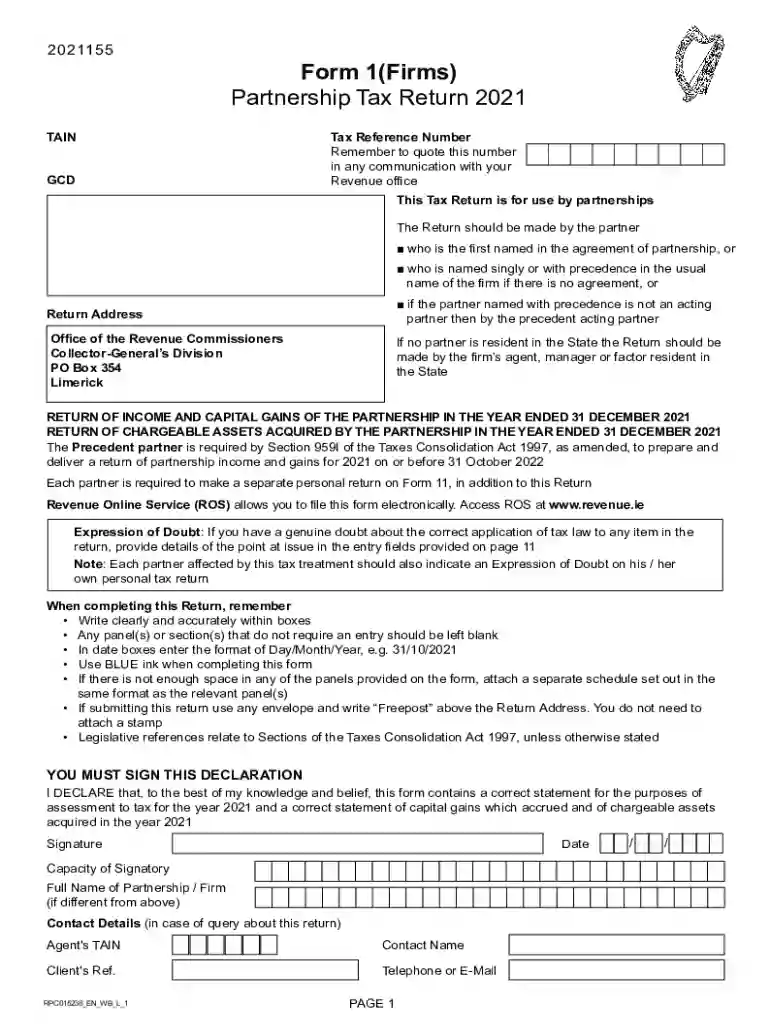
Form 1 firms is a specific document used in the partnership framework, particularly for reporting income and capital gains. This form is often utilized in the context of partnership tax returns, where it plays a crucial role in ensuring that all financial activities are accurately reported and comply with the relevant regulations. It is designed to capture various financial data points and serve as an official record for tax authorities.
Utilization of form 1 firms involves following specific procedures to ensure compliance. Here's a step-by-step guide:
Using this systematic approach helps maintain accuracy and compliance with tax laws.
Completing form 1 firms involves detailed attention to each section of the form:
This process ensures that all financial activities are accounted for and reported correctly.
Form 1 firms is predominantly used by business partnerships. These entities range from small, family-owned businesses to large, multi-member partnerships. It is a crucial document for:
These users rely on form 1 firms for accurate financial reporting and tax compliance.
Several key terms are essential for understanding and completing form 1 firms:
Familiarity with these terms aids in accurately completing the form.
State-specific regulations can influence the completion and filing of form 1 firms:
Understanding these state-specific nuances ensures compliance with local tax laws.
Critical components must be addressed when filling out form 1 firms:
Incorporating these elements ensures the form's validity and accuracy.
Failure to comply with the requirements of form 1 firms can lead to significant penalties:
Awareness of these penalties emphasizes the importance of accurate and timely filing.
We've got more versions of the form 1 firms form. Select the right form 1 firms version from the list and start editing it straight away!
At DocHub, your data security is our priority. We follow HIPAA, SOC2, GDPR, and other standards, so you can work on your documents with confidence.
A partnership must file an annual information return to report the income, deductions, gains, losses, etc., from its operations, but it does not pay income tax.
If you are filing this form solely to elect allocation. See the instructions for Line 5 property, whether tangible or intangible,.Read more


