




01. Edit your form online
Type text, add images, blackout confidential details, add comments, highlights and more.

Type text, add images, blackout confidential details, add comments, highlights and more.

Draw your signature, type it, upload its image, or use your mobile device as a signature pad.

Send it via email, link, or fax. You can also download it, export it or print it out.
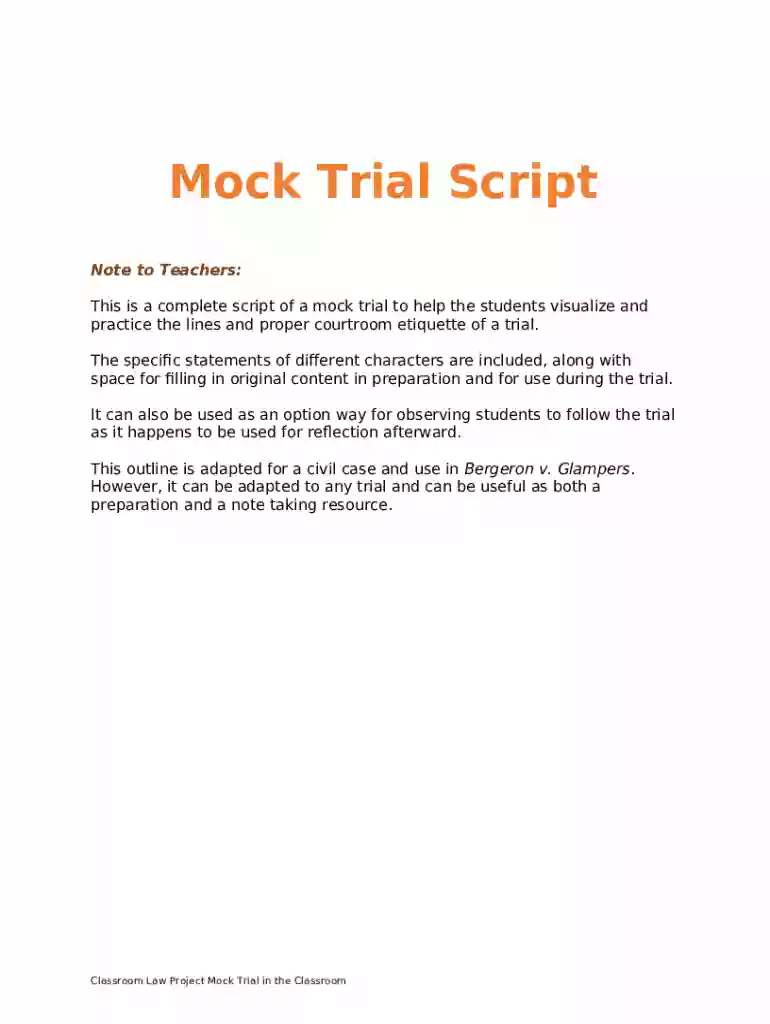
The "Mock-Trial-in-the-Classroom-Full-Mock-Trial-Script docx" is a comprehensive tool for educators aiming to simulate a courtroom environment, providing students with a realistic experience of a civil trial. Specifically designed for the case Bergeron v. Glampers, this educational document details various courtroom roles, including judge, attorneys, bailiff, and witnesses. It acts as both a rehearsal guide and a reflection resource on courtroom procedures, ensuring students gain practical understanding and skills.
Educators utilize the Mock Trial Script to facilitate a hands-on learning experience in the classroom. The script serves as a detailed guide for conducting mock trials, incorporating roles and courtroom decorum. Students take on various roles, practicing legal procedures and honing public speaking skills. Teachers follow the script to direct proceedings, ensuring participants understand each step and its significance within the trial.
The Mock Trial Script can be accessed through platforms like DocHub, which allows for editing, signing, and sharing of documents in various formats. Users can download the script as a docx file from the educator's resources section on educational websites or platforms that support legal education.
Educators need to prepare the Mock Trial Script by tailoring it to their classroom needs. Customization may involve role assignments, time allocations for sections, and adjustments based on class size or course objectives.
Mock trials using the scripted format enhance learning by providing students with experiential knowledge of legal processes. Adopting scripted mock trials in the classroom supports critical thinking, debate, teamwork, and an understanding of the judiciary system's functioning.
Primarily aimed at educators and students, the Mock Trial Script serves individuals seeking to enrich legal education and understanding. High school teachers, college instructors, and legal educators utilize this resource to introduce practical elements of civics and law courses.
While the script itself is educational, it is crucial for educators to ensure that any representations or simulations adhere to accurate legal standards. This includes understanding student rights and responsibilities in educational simulations.
The structured layout of the mock trial script underscores essential trial stages, ensuring all aspects of a civil case are covered. Its format encourages comprehensive engagement from participants in all trial phases.
By employing the Mock Trial Script in classroom settings, educators foster an interactive and dynamic environment that promotes active learning of legal principles and processes.
At DocHub, your data security is our priority. We follow HIPAA, SOC2, GDPR, and other standards, so you can work on your documents with confidence.
Sample Mock Trial Scripts Resources: Free Speech and Social Media Case (PDF) (link is external), Goldilocks v. The Three Bears (for elementary school students)Read more
Apr 14, 2025 A complete application includes: (1) this signature page; (2) typed responses to the questions; (3) resume; (4) transcript; and (5) legalRead more


