







Definition & Meaning
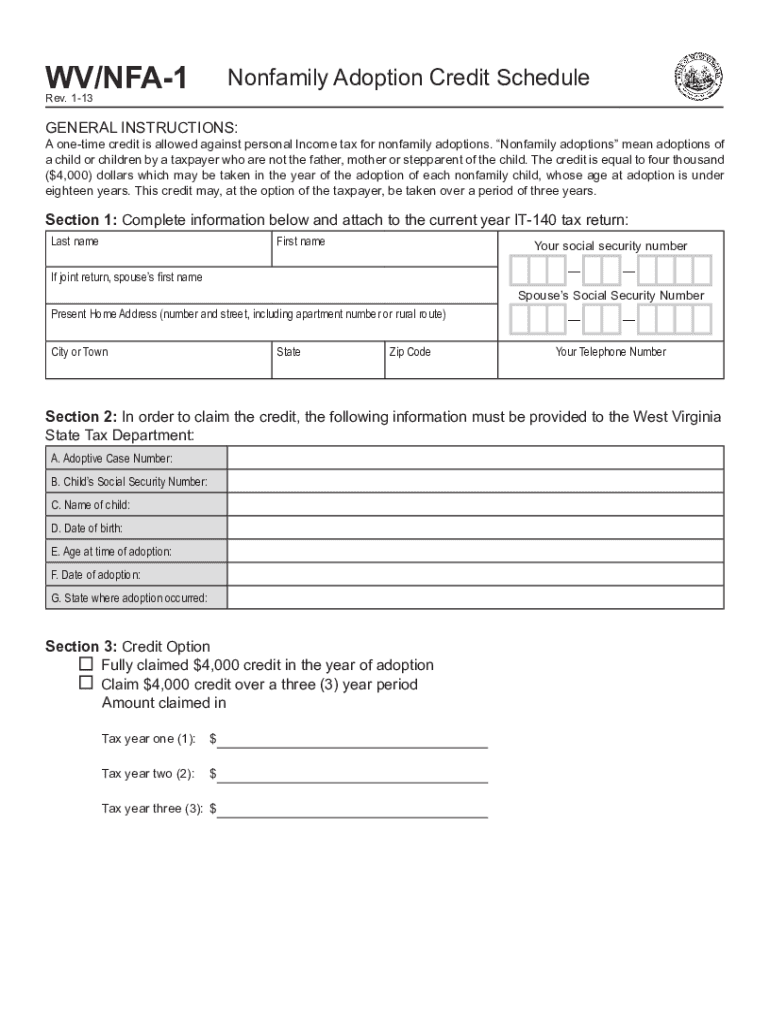
The WV NFA-1, commonly referred to as the Nonfamily Adoption Credit Schedule, is a specific document utilized in the state of West Virginia. This form is essential for taxpayers who wish to claim a one-time personal income tax credit associated with the adoption of non-biological or non-stepchildren. Designed to provide financial relief, this credit is a significant aid for adoptive parents by offering a credit of $4,000 either in the year of adoption or spread over a period of three years.
How to Use the WV NFA-1
To effectively utilize the WV NFA-1 form, applicants need to systematically fill out the necessary sections, ensuring all required fields are completed accurately. The form will request personal identification data, detailed adoption information, and the method chosen for claiming the tax credit. Ensuring precision in this process is crucial, as inaccuracies can lead to delays or rejections. The form itself provides specific instructions, which should be followed meticulously to avoid any issues.
Step-by-Step Instructions
- Review the requirements for claiming the adoption credit.
- Gather required documentation, including proof of adoption and related expenses.
- Complete personal information sections, ensuring all details match official records.
- Fill out adoption details, including date and adoption agency details.
- Choose your preferred method to claim the tax credit—either in one lump sum or spread over three years.
- Double-check all entries for accuracy and completeness.
Steps to Complete the WV NFA-1
Completing the WV NFA-1 involves several deliberate steps which must be executed with care:
- Collection of Required Documents: Gather all necessary adoption documentation, including official adoption papers.
- Reading Instructions: Spend time understanding the form’s guidelines to ensure full compliance.
- Filling Out Personal Details: Enter your full name, address, and taxpayer identification number.
- Adoption Information: Include detailed information about the adoption, such as the child's date of birth and the date of adoption finalization.
- Selection of Credit Option: Indicate whether you opt for a one-time credit or a payment spread over three years.
- Review and Verification: Carefully check each section for completeness and accuracy.
- Submission: Submit the completed form by the due date, ensuring you keep a copy for your records.
Required Documents
A successful submission of the WV NFA-1 requires several supporting documents to authenticate the details provided in the form:
- Official adoption certificate or decree
- Identification for both the adoptive parent(s) and the child
- Payment receipts or financial documentation related to the adoption fees
- Any other state or federal adoption-related approvals or documentation
Legal Use of the WV NFA-1
The primary legal function of the WV NFA-1 is to document eligibility for the adoption tax credit within West Virginia. It is crucial that the form be used only for legitimate adoption expenses that comply with both state and federal regulations. Misuse or fraudulent claims can result in significant penalties, including fines or disqualification from credit.
Filing Deadlines / Important Dates
For the WV NFA-1, adherence to submission timelines is critical to ensuring eligibility for the tax credit. The form should generally be filed in conjunction with the taxpayer's annual income tax return. However, deadlines can vary slightly based on specific circumstances such as the adoption date. Taxpayers should check with the West Virginia Department of Revenue for the exact filing deadline relative to their situation.
Who Typically Uses the WV NFA-1
The form is primarily utilized by West Virginia residents who have legally adopted children who are not their biological or stepchildren. It is an essential document for adoptive parents seeking financial relief through state-sanctioned tax credits.


Examples of Using the WV NFA-1
Consider a family in Charleston, West Virginia, who adopted a child in 2022. They would complete the WV NFA-1 as part of their tax filing in 2023, choosing either to take the entire $4,000 credit in 2023 or spread it over three years. Similarly, another family in Morgantown that completed an adoption in 2020 might choose to file for the remaining credit balance in subsequent tax years.
Understanding these practical applications helps provide clarity on how the WV NFA-1 can be utilized to benefit adoptive families financially.




