Tax liens arizona 2026

Get Form
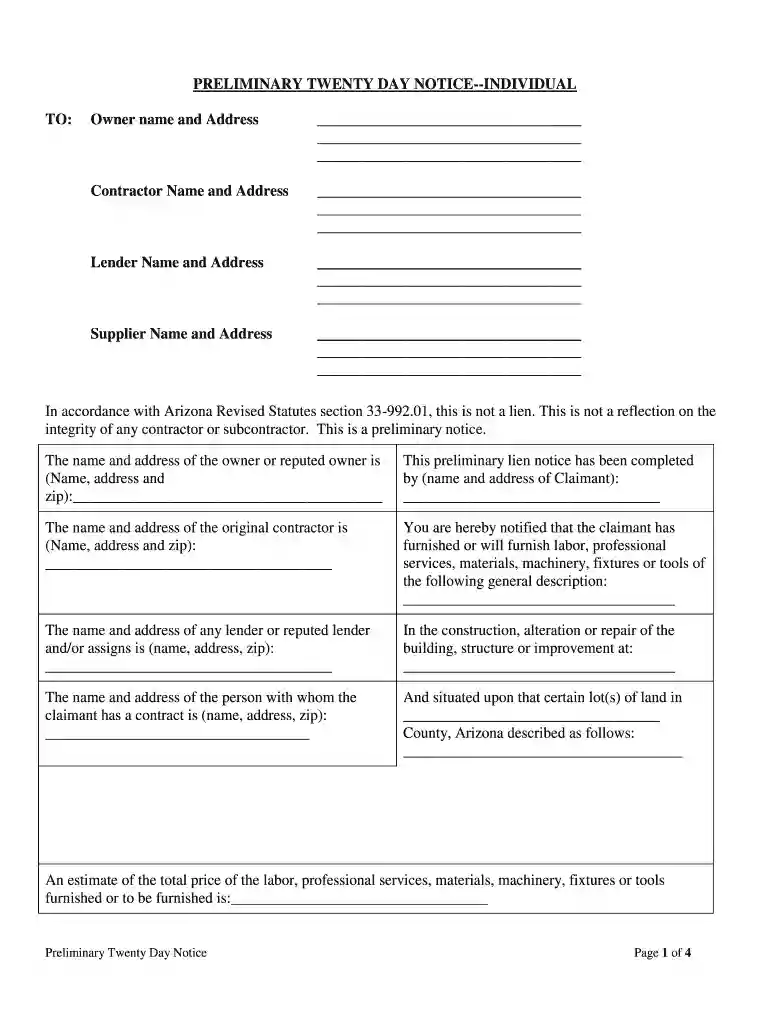
tax liens arizona Preview on Page 1

Here's how it works

01. Edit your form online
Type text, add images, blackout confidential details, add comments, highlights and more.

02. Sign it in a few clicks
Draw your signature, type it, upload its image, or use your mobile device as a signature pad.

03. Share your form with others
Send it via email, link, or fax. You can also download it, export it or print it out.

Definition and Meaning of Tax Liens in Arizona

Tax liens in Arizona refer to the legal claim placed by the government on real estate due to unpaid property taxes. This lien grants the state the authority to collect the debt owed by the property owner. If these taxes remain unpaid, the property can eventually be seized and sold to recover the owed amount. It is a way for the state to ensure property owners meet their tax obligations.

Example of How Tax Liens Work

  • If a property owner in Arizona fails to pay their property taxes, the local government may place a tax lien on their property.
  • The lien acts as a claim against the property, and the owner cannot sell or refinance without first settling the debt.
  • In some cases, the property may be auctioned to recover the unpaid taxes.

How to Use Tax Liens in Arizona

Investors can use tax liens in Arizona as an investment strategy. By purchasing tax liens at auction, investors can earn interest on the unpaid taxes. The property owner must repay the lien holder the delinquent amount plus interest to clear the lien, making it a potentially profitable venture for investors.

Steps for Investing in Tax Liens

  1. Research available properties with unpaid taxes in Arizona.
  2. Attend tax lien auctions, which are usually conducted by county governments.
  3. Bid on liens for properties of interest.
  4. If successful, receive a certificate indicating ownership of the lien.
  5. Collect repayment with interest from the property owner.

How to Obtain Tax Liens in Arizona

To obtain a tax lien in Arizona, individuals typically participate in county-held tax lien auctions. These auctions are publicly announced and provide prospective investors the opportunity to bid on liens for delinquent properties.

Process to Follow

  • Visit the county treasurer’s website to find information about upcoming tax lien auctions.
  • Register to participate in the auction.
  • Value the property and decide on a maximum bid.
  • Win the auction and receive a tax lien certificate from the county.

Steps to Complete a Tax Lien Purchase

When purchasing a tax lien, specific steps need to be followed to ensure compliance with Arizona state laws and to secure the investment.

Detailed Procedure

  1. Pre-Auction Preparation: Research properties and set maximum bid amounts.
  2. Auction Participation: Attend the auction, either online or in person, and place bids on desired liens.
  3. Winning the Bid: Pay the bid amount and any additional fees to the county treasury office.
  4. Certificate Receipt: Receive the lien certificate detailing legal rights to collect the unpaid taxes.
  5. Monitoring and Collection: Keep track of the lien's status and approach the property owner for repayment.

State-Specific Rules for Tax Liens in Arizona

Arizona has unique rules governing tax liens that investors and property owners must understand. These rules define auction processes, payment terms, and redemption periods.

Key Rules and Regulations

  • Arizona employs a competitive bidding process for tax liens, with interest rates typically starting at a higher percentage and decreasing through bids.
  • Investors earn statutory interest on liens, capped by Arizona law.
  • Property owners have a three-year redemption period to repay the lien plus interest.

Important Terms Related to Tax Liens in Arizona

Understanding specific terminology is essential for navigating tax liens in Arizona.

Glossary of Terms

  • Lien Certificate: A legal document showing the lien holder's right to collect debt.
  • Redemption Period: The timeframe within which the property owner must repay the lien.
  • Interest Rate: The percentage of interest accruing on the unpaid taxes.
  • Foreclosure: Legal action taken if the owner fails to settle the lien within the redemption period.

Legal Use of Tax Liens in Arizona

Tax liens must be used within the framework of Arizona's legal system, which outlines specific rights and procedures associated with lien enforcement and foreclosure.

Legal Procedures and Rights

  • Lien holders can initiate foreclosure proceedings if the property owner does not redeem the lien within three years.
  • The lien holder must follow due process, providing notice and allowing the owner opportunities to redeem before foreclosure.

Examples of Using Tax Liens in Arizona

Investors often use tax liens as a way to diversify portfolios or enter the real estate market with lower capital investment.

Real-World Application

  • An investor purchases a lien at a 6% interest rate for a property valued at $100,000 in Arizona.
  • The property owner repays the lien after one year, resulting in a profit of $6,000 for the investor.
  • Alternatively, after the redemption period, the investor proceeds with foreclosure, potentially acquiring the property at a fraction of its market value.

By understanding these aspects, individuals can make informed decisions about engaging with tax liens in Arizona, whether as property owners facing a tax lien or as investors aiming to purchase them at auction.

be ready to get more

Complete this form in 5 minutes or less

Get form

Got questions?

We have answers to the most popular questions from our customers. If you can't find an answer to your question, please contact us.
Contact us
The interest rate for these liens is set at 16% annual simple interest, prorated monthly. There is a $10 nonrefundable fee for each purchase. Your collateral for the lien is the property; if the property is poor, so is your lien. We advise you to look at the property.
By selling a tax lien certificate to a third-party investor, the municipality receives a guaranteed payment for the late taxes, and investors willing to accept the risk will be rewarded with interest payments as property owners repay that debt over time.
The lien doesnt change ownership in and of itself, but one way or another, the government will be paid. Redeeming a lien: Redeeming a lien means paying the tax owed, and this can be done by the homeowner (or the owners agent or attorney), an heir of the owner or anyone else who has a claim on the property.
The Tax Lien Sale provides for the payment of delinquent property taxes by an bidder. The tax on the property is auctioned in open competitive bidding based on the least percent of interest to be received by the bidder.
Generally, interest accrues on any unpaid tax from the due date of the return (without any extensions) until the date of payment in full. The interest rate is determined quarterly and is the federal short-term rate plus 3 percent.

Security and compliance

At DocHub, your data security is our priority. We follow HIPAA, SOC2, GDPR, and other standards, so you can work on your documents with confidence.

Learn more
ccpa2
pci-dss
gdpr-compliance
hipaa
soc-compliance
be ready to get more

Complete this form in 5 minutes or less

Get form

People also ask

How tax lien investing works. To recover the delinquent tax dollars, municipalities can then sell the tax lien certificate to private investors, who take care of the tax bill in exchange for the right to collect that money, plus interest, from the property owners when they eventually pay back their balance.
To be eligible to bid, you must complete the following steps on the auction web site: Complete online registration. Complete IRS Form W-9, W-8BEN, or W-8BEN-E as applicable - Note: Real Auction does not have the foreign IRS forms. Submit a deposit (online via ACH) Establish a budget. Receive bidder number assignment.
Assignable liens are available for purchase by assignment at 16% interest rate.

Related links