







Definition & Meaning
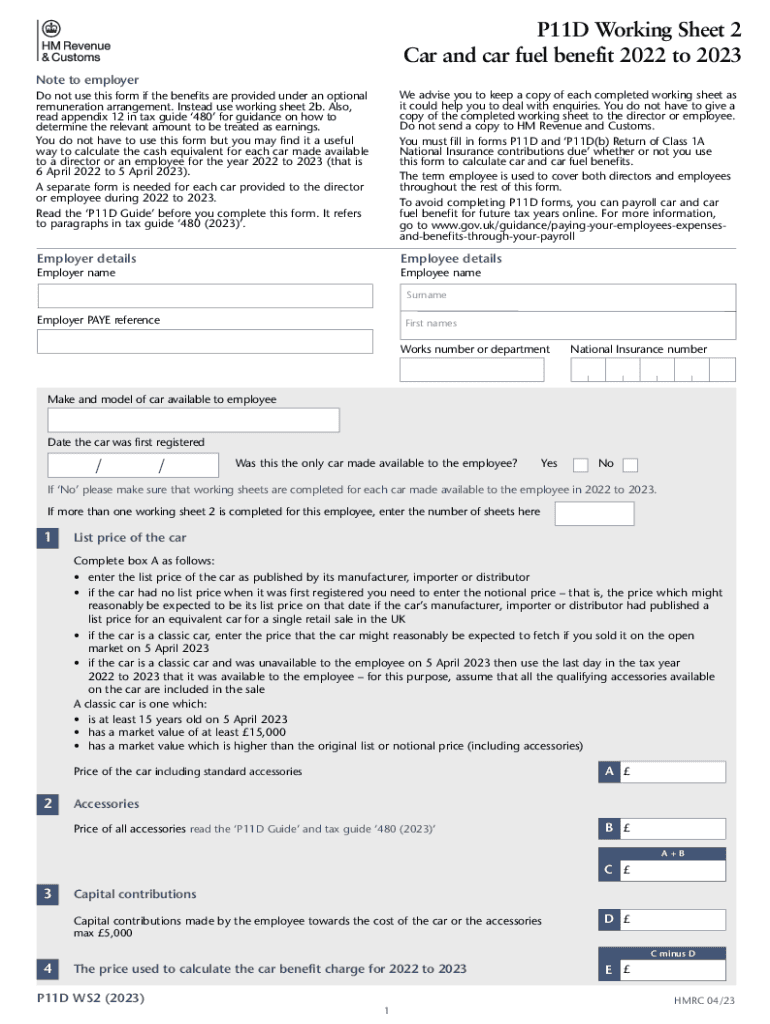
The P11D Working Sheet 2 for car and car fuel benefits is an essential document used by employers to determine the tax implications of providing company cars or fuel to employees. Pertinent to the tax year 2022 to 2023, this form helps calculate the cash equivalent of these benefits, which affects the taxable income of employees. The cash equivalent is determined by considering several factors, including the vehicle's CO2 emissions and, in some cases, its original value and type of fuel. Employers are required to report these benefits to ensure accurate taxation and compliance with tax laws.
Important Components
- CO2 Emissions: The vehicle’s carbon dioxide emission level is pivotal in determining the appropriate percentage to calculate the cash equivalent.
- Fuel Type: Different methodologies may apply based on whether the car operates on petrol, diesel, or electricity.
- Value of Vehicle: For certain cars, the original market price is considered to assess the benefit's value.
- Provision of Fuel: If the employer provides fuel for personal use, this is also evaluated for tax purposes.
How to Use the P11D Working Sheet 2 for Car and Fuel Benefits
Employers should follow a structured approach to utilize the P11D Working Sheet 2 effectively. This ensures both compliance and accuracy in calculating tax liabilities for employee benefits.
Key Steps
- Gather Vehicle Information: Collect details including the car's registration number, CO2 emissions, original market value, and list price.
- Determine Fuel Provision: Establish whether the employee receives fuel benefits and note the circumstances of usage.
- Calculate Cash Equivalent: Apply the appropriate CO2 emission percentages to determine the cash equivalent of the benefits.
- Record Keeping: Ensure that completed worksheets are kept on file for potential audits and reference in preparing annual employee tax documents.
Steps to Complete the Form
Completing the P11D Working Sheet 2 involves a series of well-defined steps to ensure all necessary information aligns with tax regulations.
Detailed Procedure
- Header Section: Enter the employer’s and employee’s details, including names, addresses, and contact information.
- Vehicle Details: Record the specific attributes of the vehicle, such as make, model, and fuel type.
- Benefit Calculation: Utilize the worksheet to input all relevant vehicle data and perform calculations based on specified percentages for CO2 emissions.
- Fuel Benefits: Determine if there’s a fuel provision and calculate the corresponding cash equivalent.
- Review and Validate: Cross-check your entries and calculations for accuracy before submitting.
Why Use the P11D Working Sheet 2 for Car and Fuel Benefits
The P11D Working Sheet 2 is integral for meeting legal obligations concerning employee benefits in the form of cars and fuel. It facilitates precise reporting to HMRC, helping avoid penalties and ensure that employees understand their tax liabilities regarding these benefits.
Advantages
- Compliance: Helps meet statutory requirements for tax reporting.
- Clarity: Provides a clear structure for calculating cash equivalents.
- Accuracy: Reduces errors in determining taxable benefits.
Who Typically Uses the P11D Working Sheet 2
Various stakeholders within an organization may need to engage with the P11D Working Sheet 2.


Typical Users
- Payroll Departments: Responsible for calculating payroll taxes and accurately reflecting benefits.
- HR Professionals: Often manage employee benefits and need forms to ensure tax compliance.
- Finance Teams: Use it to integrate benefit calculations into financial records.
Key Elements of the P11D Working Sheet 2
Understanding the primary elements within the working sheet aids in proper usage and compliance.
Core Sections
- Employee Identification: Ensures the form is specific to the right individual.
- Benefit Assessment: Detailed input areas for vehicle specifics and benefit calculations.
- Company Details: Information verifying the employer’s registration and contact information.
Legal Use of the P11D Working Sheet 2
The P11D Working Sheet 2 is mandated by tax laws in the UK, ensuring that employers report benefits provided to employees that fall under taxable categories.
Legal Requirements
- Mandatory Reporting: Employers must report all relevant employee benefits annually.
- Detailed Information: Precise data entry is critical for avoiding legal repercussions.
- Submission Deadlines: Filing must adhere to specific dates to prevent penalties.
Form Submission Methods
The submission process for the P11D form involves multiple methods, ensuring flexibility for different types of employers.
Methods
- Online Submission: Filing directly through government tax portals allows faster processing.
- Postal Service: Traditional mail submissions remain valid for those who prefer physical documentation.
- In-Person: Direct submission at designated government offices for personalized assistance.
Penalties for Non-Compliance
Failure to adhere to submission guidelines and calculate benefits correctly can result in significant penalties.
Consequences
- Fines: Monetary penalties for inaccurate or late filings.
- Audits: Increased likelihood of audits which can further incur costs and operational disruptions.
- Reputational Damage: Non-compliance can affect an organization’s standing both financially and socially.




