
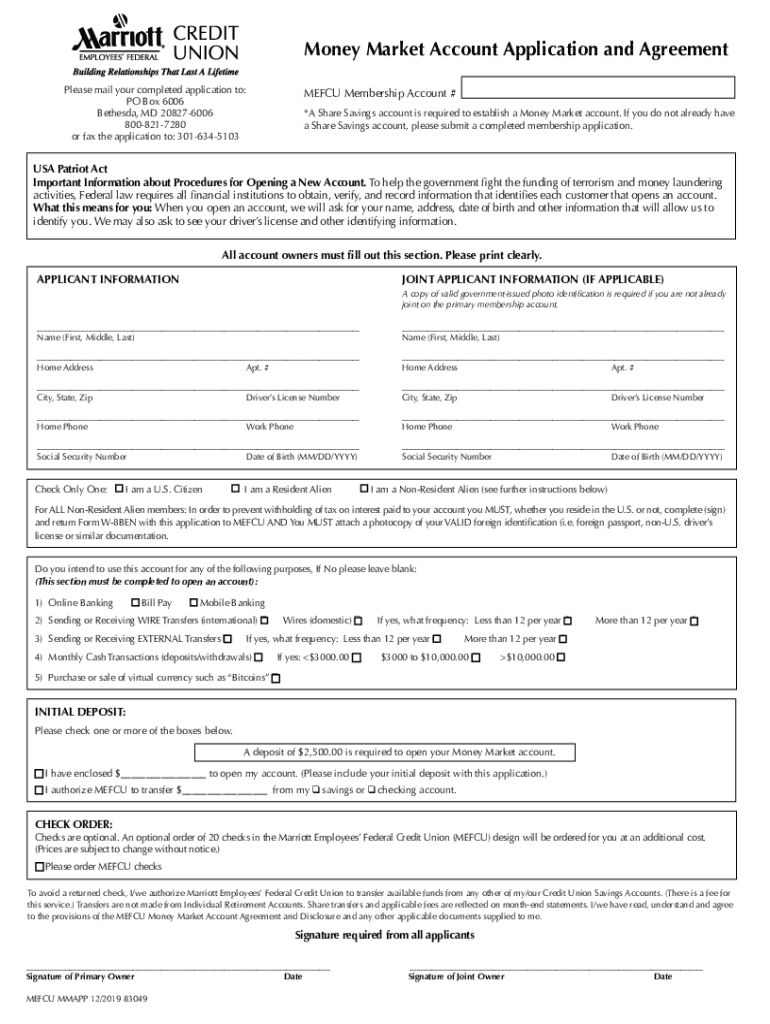







Definition and Meaning of a Money Market Account Application and Agreement
A Money Market Account Application and Agreement is a formal document used by financial institutions, such as the Marriott Employees' Federal Credit Union (MEFCU), to establish terms for opening and maintaining a money market account. It outlines the information required from applicants, including personal data, and sets forth the rules governing account operations. This agreement is crucial for ensuring compliance with federal regulations, such as the USA Patriot Act, while securing both the institution's and the account holder's interests.
Key Aspects of the Agreement
- Account Ownership: Details who owns the account and specifies joint account ownership conditions.
- Transaction Restrictions: Limits are set on withdrawals and transfers, often reflecting federal guidelines.
- Overdraft Protection: Terms are set for any overdraft protection services offered with the account.
- Fee Structures: Information on the fees associated with account maintenance and transaction services.
Steps to Complete the Money Market Account Application and Agreement
Applying for a money market account involves several steps to ensure all required information is accurately provided and legally binding.
- Gather Required Documentation: Before you begin the application, collect necessary documents such as identification, Social Security numbers, and proof of address.
- Personal Information Section: Fill out personal details, including full legal name, contact information, and identification numbers.
- Consent and Acknowledgement: Read the terms of the agreement carefully and consent to the terms regarding fund withdrawals, transfers, and compliance mandates.
- Submit Your Application: Depending on the preferences of MEFCU, submission can be done through online portals or printed forms by mail.
Important Tips
- Accuracy is Critical: Double-check all information for accuracy to avoid delays.
- Read Every Detail: Ensure you understand the agreement to avoid unforeseen issues regarding fees or withdrawals.
Eligibility Criteria for Money Market Account Application
Not everyone is eligible to open a money market account with MEFCU. Understanding the eligibility criteria is fundamental for successful submission.


Common Eligibility Factors
- Membership with MEFCU: Typically, individuals must be employees or affiliates of certain organizations to apply.
- Minimum Deposit Requirements: Often a minimum deposit amount must be maintained.
- U.S. Citizenship or Residency: Applicants are usually required to be U.S. citizens or permanent residents.
Required Documents for Money Market Account Application
Before starting the application process, prepare all necessary documents to streamline your experience.
Essential Documents
- Proof of Identification: Government-issued ID, such as a passport or driver's license.
- Proof of Address: Recent utility bills or lease agreements to confirm residency.
- Social Security Number: Required for identity verification and tax purposes.
Legal Use of the Money Market Account Application and Agreement
The legal framework surrounding the Money Market Account Application and Agreement ensures that applicants and financial institutions comply with relevant laws.
Compliance Requirements
- USA Patriot Act Compliance: This act requires financial institutions to verify identities to prevent fraudulent activities.
- Data Protection Laws: Institutions must protect applicants' personal data with robust security measures, such as encryption.
Form Submission Methods
MEFCU provides several options for submitting the Money Market Account Application and Agreement, allowing applicants to choose what best fits their needs.
Submission Options
- Online Submission: Offers convenience and quick processing. Ensure your internet connection is secure before submitting sensitive information.
- Mail Submission: Allows you to send a hard copy of your application directly to MEFCU's specified address.
- In-Person Submission: Some applicants may prefer to deliver the form directly to a branch, which allows for immediate assistance with any questions.
Key Elements of the Money Market Account Application and Agreement
Understanding the key elements of the agreement can help in navigating the application process efficiently.
Major Components
- Identification Requirements: Ensures compliance with verification standards.
- Account Terms and Conditions: Details the rules regarding account use, maintenance, and closure.
- Signatures and Certifications: The applicant's acknowledgment of understanding and agreeing to the terms.
Application Process and Approval Time
Knowing what to expect during the application process can help set realistic timelines for account setup.
Process Outline
- Initial Review: MEFCU reviews submitted documentation for completeness and accuracy.
- Identity Verification: Ensures compliance with regulatory standards.
- Account Setup: Once approved, applicants receive account details and access instructions.
Typical Timeframes
- Review Period: Can vary but generally takes several business days.
- Approval Notification: Applicants receive confirmation once the account is set up and ready for use.
Examples of Using the Money Market Account Application and Agreement
Exploring examples of how this agreement is utilized can provide practical insights.
Scenario Examples
- Joint Account Application: Both parties must consent and provide identification for joint accounts.
- Business Use Cases: Businesses may apply for these accounts when managing cash flow or reserves efficiently.
Penalty Risks for Non-Compliance
Understanding the risks associated with failing to comply with the agreement underscores the importance of adherence.
Potential Consequences
- Account Closure: Non-compliance can result in the financial institution closing the account.
- Legal Repercussions: May include fines or additional legal action for serious breaches.
By detailing these components, the Money Market Account Application and Agreement provides a comprehensive framework for managing a vital financial service while maintaining compliance with regulatory standards.




