FLR 17F Form 17F 2026

Get Form
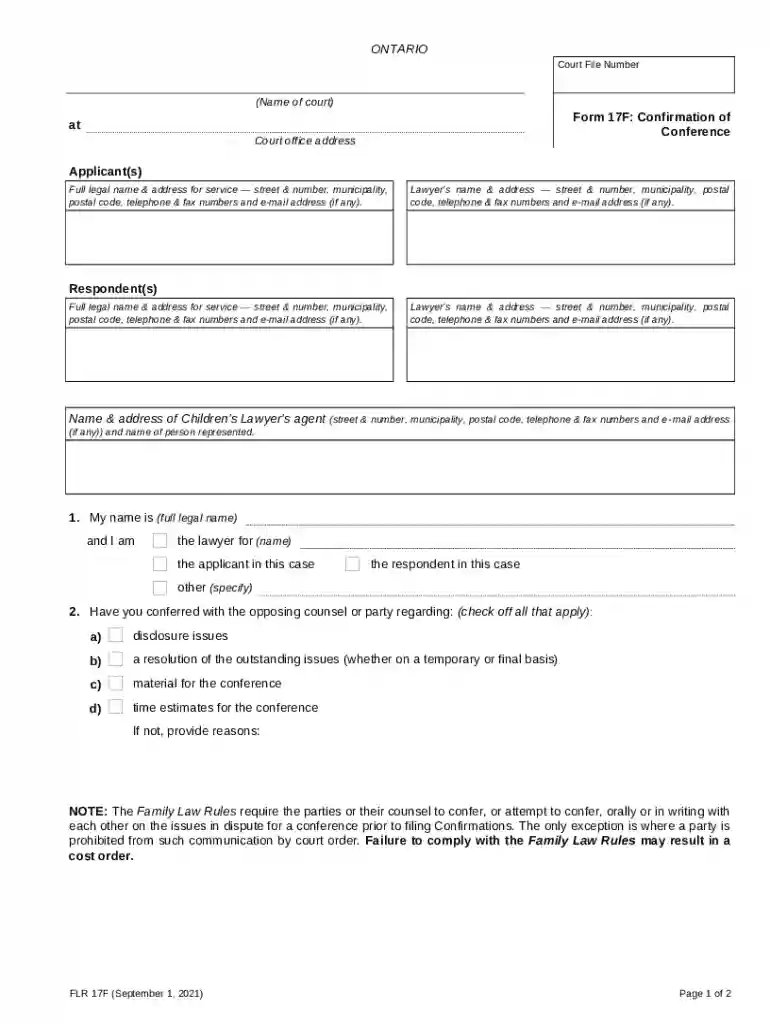
FLR 17F Form 17F Preview on Page 1

Here's how it works

01. Edit your form online
Type text, add images, blackout confidential details, add comments, highlights and more.

02. Sign it in a few clicks
Draw your signature, type it, upload its image, or use your mobile device as a signature pad.

03. Share your form with others
Send it via email, link, or fax. You can also download it, export it or print it out.

Understanding the FLR 17F Form 17F

The FLR 17F Form 17F is a crucial document used in Ontario's court system, particularly in family law matters. It is known as the Confirmation of Conference form, and its primary purpose is to facilitate communication between the applicants and respondents in a family law case. By providing a structured format, the form ensures that all parties are clear about the issues at hand before entering a case conference.

Key Elements of the FLR 17F Form 17F

  • Identification Information: The form requires detailed information about the parties involved, including their names, addresses, and contact information.
  • Conference Details: Specific sections are dedicated to outlining the time, date, location, and presiding judge for the conference. This ensures that all participants are aligned on logistics.
  • Issues to be Discussed: The form lists critical issues that need to be resolved, promoting a focused discussion during the conference.
  • Confirmation Section: It includes a declaration confirming that the parties have discussed and attempted to resolve the issues listed in the form.

How to Obtain the FLR 17F Form 17F

The FLR 17F Form 17F is accessible through various channels to accommodate different needs.

  1. Online Access: The form can often be downloaded from official court websites in PDF format, allowing users to complete it digitally or by hand.
  2. Court Clerk Offices: Physical copies are available at local family court clerk offices. This method is preferred by individuals who seek guidance on form completion.
  3. Legal Aid Services: Legal aid offices may provide both electronic and paper versions of the form, often accompanied by instructions for those needing assistance.

Steps to Complete the FLR 17F Form 17F

Filling out the FLR 17F Form 17F requires careful attention to ensure all sections are completed accurately.

  1. Provide Personal Information: Enter the full names and contact details of all parties involved, ensuring accuracy.
  2. Schedule Details: Accurately fill in the conference date, time, and location, which can usually be retrieved from correspondence with the court.
  3. List Discussion Points: Clearly outline the issues to be addressed, drawing from previous court communications or agreements.
  4. Sign and Confirm: All parties must sign the form, signifying mutual agreement to the discussed issues and conference arrangement.

Important Terms Related to FLR 17F Form 17F

  • Conference: A formal meeting in court where parties discuss and resolve issues.
  • Applicant and Respondent: These legal terms refer to the individuals engaged in the family law case, with the applicant being the initiator.

Who Typically Uses the FLR 17F Form 17F

The form is primarily used by parties involved in family law cases, including:

  • Lawyers: Representing either party, lawyers use the form to facilitate pre-conference discussions.
  • Mediators: When involved, mediators rely on this form to ensure all topics are discussed equitably.
  • Family Members: Directly involved parties, such as spouses or parents in dispute, complete and review the form as part of the legal process.
decoration image ratings of Dochub

Legal Use of the FLR 17F Form 17F

Legal compliance with the FLR 17F Form 17F is essential:

  • Compliance with Family Law Rules: The form acts as a pre-requisite for scheduling a case conference, underscoring its critical role in the legal framework.
  • Confirmation of Discussion: It provides proof that parties have met the requirement to confer prior to official court proceedings.

State-Specific Rules for the FLR 17F Form 17F

Though the FLR 17F Form 17F is specific to Ontario, similar forms and practices might be present in other provinces or states. Users should consult local legal guidelines to ensure accurate completion and filing of equivalent forms elsewhere.

Penalties for Non-Compliance

Failing to complete or submit the FLR 17F Form 17F properly can lead to several consequences:

  • Delayed Hearings: Incomplete or inaccurate forms may result in the rescheduling of conferences, causing unwanted delays.
  • Fines or Sanctions: Legal penalties may be imposed for non-compliance, particularly if delays affect court scheduling.

By understanding these detailed aspects of the FLR 17F Form 17F, participants in family law cases can ensure they are well-prepared for their case conferences, promoting efficient and clear communication in the legal process.

See more FLR 17F Form 17F versions

We've got more versions of the FLR 17F Form 17F form. Select the right FLR 17F Form 17F version from the list and start editing it straight away!
Versions Form popularity Fillable & printable
2021 4.2 Satisfied (52 Votes)
2018 4.9 Satisfied (36 Votes)
be ready to get more

Complete this form in 5 minutes or less

Get form

Got questions?

We have answers to the most popular questions from our customers. If you can't find an answer to your question, please contact us.
Contact us
To start a new court case, you always have to fill out Form 8: Application (general) in addition to the form that your case is about. For example, if you have to go to court to start a case about child custody and access, you would fill out Form 8 and Form 35.1 Affidavit in Support of Claim for Custody or Access.
For a case conference, bring all relevant evidence such as videos, texts, and documents that support your claims. Organize them clearly and be prepared to explain their relevance if the judge requests. Ensure copies are available for the court and opposing party if required.
Once you have served your documents, you must complete Form 6B: Affidavit of Service (one for each party in the case that received the documents) and file it at the court where you issued your application. This form provides the court with proof that your documents were served on the respondent and any other party.
Essentially, a case conference is held so that the parties involved in the matter can meet with a judge to discuss the case and the judge can give an idea of how the case will turn out.

Security and compliance

At DocHub, your data security is our priority. We follow HIPAA, SOC2, GDPR, and other standards, so you can work on your documents with confidence.

Learn more
ccpa2
pci-dss
gdpr-compliance
hipaa
soc-compliance
be ready to get more

Complete this form in 5 minutes or less

Get form