




01. Edit your speech language therapy referral online
Type text, add images, blackout confidential details, add comments, highlights and more.

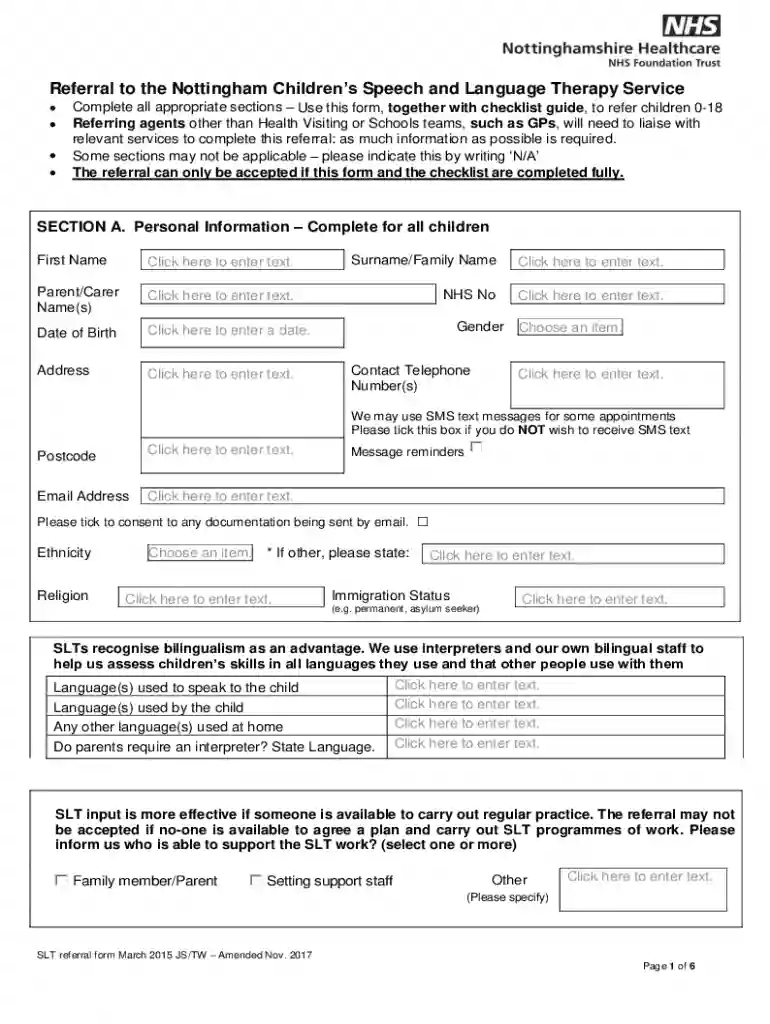
Type text, add images, blackout confidential details, add comments, highlights and more.

Draw your signature, type it, upload its image, or use your mobile device as a signature pad.

Send nhs speech language therapy referral form via email, link, or fax. You can also download it, export it or print it out.
The Children's Speech and Language Therapy Service is designed to address the communication needs of children aged 0-18. It involves the evaluation and treatment of speech, language, and communication issues, which can affect a child’s ability to express thoughts, interact with others, and perform in educational settings. This service is vital as it supports the holistic development of a child’s communication skills and can be pivotal in improving their quality of life.
Speech and language disorders can vary greatly in severity and type, including delays in speech development, articulation inaccuracies, stuttering, and language comprehension challenges. This service provides tailored therapy interventions to support each child’s unique needs.
Accessing the Children's Speech and Language Therapy Service involves several steps. First, it is essential to observe and identify any potential speech or language concerns in a child. If there are signs of difficulty, seek a professional evaluation to determine the scope and nature of the issue.
Therapy sessions are conducted individually or in groups, depending on the child’s specific needs. Sessions usually involve exercises to improve speech sound articulation, increase language comprehension, and build vocabulary.
Completing the referral form accurately is critical to ensure acceptance into the program. The form consists of several sections, all of which must be completed thoroughly.
Accurately completing each section ensures that the speech and language therapists have all necessary information to proceed with the evaluation and therapy process appropriately.
Meeting the eligibility criteria for the Children's Speech and Language Therapy Service is essential for acquiring assistance.
Ensure all required documentation, such as medical records and previous assessments, accompany the referral form to facilitate a seamless evaluation process.
Utilizing the Children's Speech and Language Therapy Service can be life-changing for children experiencing communication challenges. The professional support offered by the service can radically enhance a child's ability to interact with their peers, succeed academically, and express themselves effectively.
Early intervention is key in speech and language therapy. Addressing communication barriers at a young age boosts the likelihood of significant improvements and helps integrate children into mainstream education and social environments more effectively.
The Children's Speech and Language Therapy Service caters to a diverse range of children with various speech and language disorders. Common users of the service include:


Additionally, the service can be particularly beneficial for children with disabilities or those who are bilingual, offering specialized interventions suited to their specific communication needs.
Legal adherence is an integral aspect of engaging with the Children's Speech and Language Therapy Service. Compliance with consent protocols ensures ethical standards and legal requirements are met.
Ensuring informed consent and maintaining confidentiality upholds the legal rights of every participant in the service.
Submitting the referral form can be done through multiple channels. Understanding these options helps ensure timely submission and initiation of services.
Choose the most practical and secure method applicable to your circumstances. Consider the urgency of the child’s needs and the immediacy required for starting therapy.
We've got more versions of the speech language therapy referral form. Select the right speech language therapy referral version from the list and start editing it straight away!
With DocHub, it’s pretty simple. The platform offers users an add-on called DocHub for Gmail, which you can locate in the Google Workspace Marketplace without being charged. Install it and give it access to your Google account. Open your email with your Children's Speech and Language Therapy Service attached and click on the add-on button in the right-side panel. Sign in to your DocHub account, and import the form to our editor, where you can complete it and sign.
Document editing with DocHub is equally convenient on desktop and mobile devices. You just need an internet browser to revise your Children's Speech and Language Therapy Service on Android. Open our site and sign in to access the tools you require. Add your file and introduce your intended changes. After that, you can keep your form in your file storage or send it out right away.
At DocHub, your data security is our priority. We follow HIPAA, SOC2, GDPR, and other standards, so you can work on your documents with confidence.
Brenner Childrens speech-language pathologists (also referred to as SLPs or speech therapists) are experts in evaluating infants, children and adolescents.Read more
Think of ways to help elicit language throughout the day. Sing songs and dance, sing familiar songs and sing them often. Offer choices: Although you may knowRead more


