




01. Edit your form online
Type text, add images, blackout confidential details, add comments, highlights and more.

Type text, add images, blackout confidential details, add comments, highlights and more.

Draw your signature, type it, upload its image, or use your mobile device as a signature pad.

Send it via email, link, or fax. You can also download it, export it or print it out.
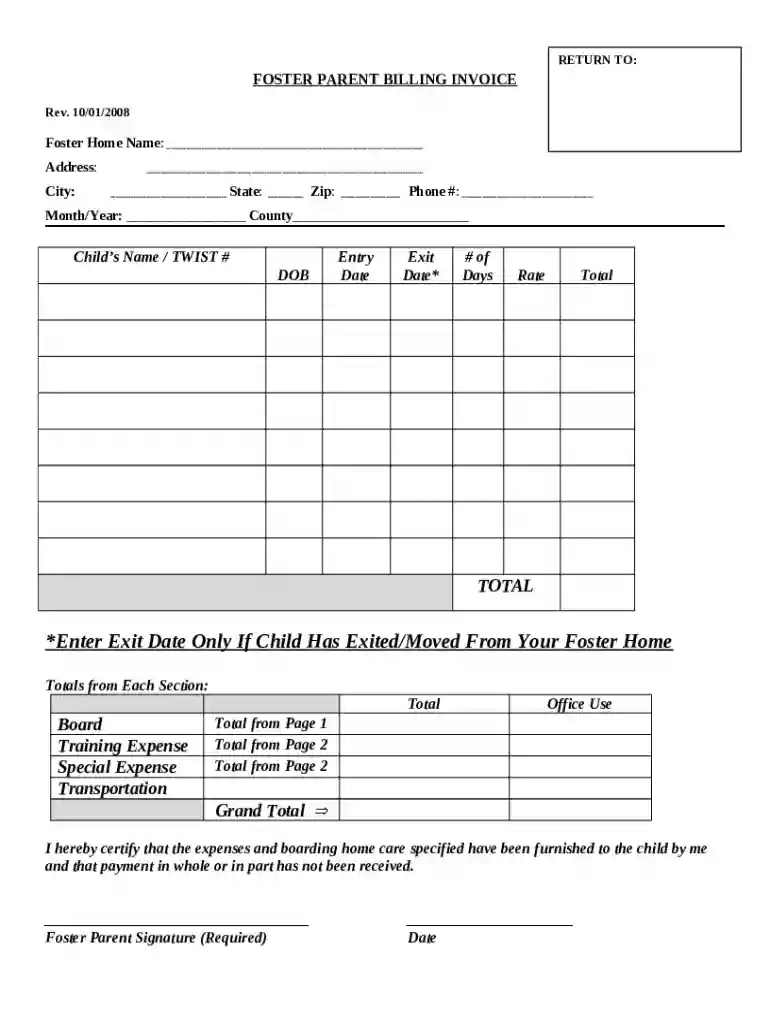
The "Foster Parent Invoice - RETURN TO FOSTER PARENT BILLING" is a structured document used primarily by foster parents in the United States to submit expenses incurred in the care of foster children to the relevant authorities. This invoice serves as a formal record detailing the costs associated with daily care, special expenses, and applicable reimbursements.
Foster parents use this invoice to report and claim reimbursement for costs related to the foster child’s care. Understanding its structure helps ensure accurate submissions.
Completing the invoice accurately is a crucial step to ensure timely reimbursements.
Section One: Child’s Information
Section Two: Days of Care
Section Three: Rate and Total Costs
Section Four: Special Expenses
Section Five: Attach Documentation
Finalize and Sign
The invoice must be used in compliance with legal and state-specific guidelines to ensure that all expenses are legitimate and within the prescribed limits.
Understanding the critical elements and their purpose aids in the accurate filing of the invoice.
Illustrating practical scenarios provides clarity on how the invoice functions in real-world applications.
Completing the invoice correctly hinges on having all necessary documentation to support reimbursement claims.
Submitting the invoice promptly can often be done through multiple channels, depending on the state or agency.
Understanding these methods can help foster parents choose the most effective submission approach for their circumstances.
We've got more versions of the Foster Parent Invoice - RETURN TO FOSTER PARENT BILLING form. Select the right Foster Parent Invoice - RETURN TO FOSTER PARENT BILLING version from the list and start editing it straight away!
At DocHub, your data security is our priority. We follow HIPAA, SOC2, GDPR, and other standards, so you can work on your documents with confidence.
You can submit the invoice by returning it to a Childrens Division team member or dropping it off at a local office. More Information. Foster Parent PolicyRead more
Oct 5, 2018 Sec. 1. Short title; table of contents. DIVISION ASPORTS MEDICINE LICENSURE. Sec. 11. Short title. Sec. 12. Protections for covered sportsRead more


