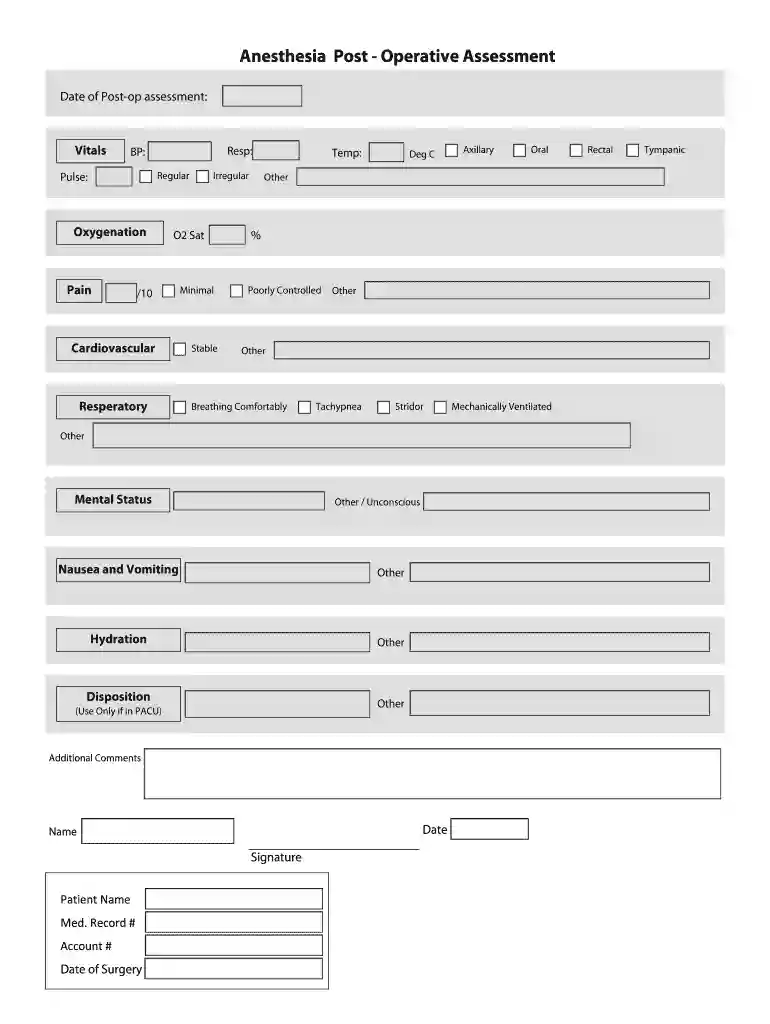
Anesthesia post form 2025

Get Form
anesthesia post form Preview on Page 1

Here's how it works

01. Edit your form online
Type text, add images, blackout confidential details, add comments, highlights and more.

02. Sign it in a few clicks
Draw your signature, type it, upload its image, or use your mobile device as a signature pad.

03. Share your form with others
Send it via email, link, or fax. You can also download it, export it or print it out.

How to use or fill out anesthesia post form with our platform

Form edit decoration
9.5
Ease of Setup
DocHub User Ratings on G2
9.0
Ease of Use
DocHub User Ratings on G2
  1. Click ‘Get Form’ to open the anesthesia post-operative assessment in the editor.
  2. Begin by entering the 'Date of Post-op assessment' at the top of the form. This is crucial for tracking patient progress.
  3. Fill in the 'Vitals' section, including 'Resp', 'BP', and 'Pulse'. Ensure accuracy as these metrics are vital for assessing patient recovery.
  4. In the 'Oxygenation' field, indicate the patient's O2 saturation level and pain score out of 10. This helps in evaluating respiratory function and comfort.
  5. Complete the 'Mental Status' section by selecting options like 'Breathing Comfortably' or noting any irregularities such as 'Tachypnea'.
  6. Document any additional comments or observations in the provided space to give a comprehensive overview of the patient's condition.
  7. Finally, enter your name, signature, medical record number, account number, and date of surgery at the bottom before saving or sharing the completed form.

Start using our platform today to streamline your document editing and enhance your workflow!

be ready to get more

Complete this form in 5 minutes or less

Get form

Got questions?

We have answers to the most popular questions from our customers. If you can't find an answer to your question, please contact us.
Contact us

Sign in to your DocHub account and add your anesthesia post form to our editor using one of its upload methods - from your device, cloud storage, secure URL, or your DocHub folders if you have already processed your form before. Open our editor, click the Sign button in the top toolbar, and decide on your signing method. You can use a picture of your handwritten signature, draw it, type in your name, or use a QR code instead.

It is a no-brainer on a computer or via a mobile device to complete a anesthesia post form with DocHub. All you need to do is open any installed internet browser on your smartphone and proceed to the DocHub website. Once authenticated, add your document and open it in editing mode. Use our toolbar to make your edits and save changes. Optionally, keep your file in your files or send it to a recipient immediately.

Collapsed lung (atelectasis): Surgery that uses general anesthesia or a breathing tube can cause a collapsed lung. This rare condition occurs when air sacs in the lung deflate or fill with fluid. Malignant hyperthermia: People who have malignant hyperthermia (MH) experience a dangerous reaction to anesthesia.
Intraoperative complications are hypotension, bradycardia, cardiac arrest, hematoma, and spinal cord trauma. Postoperative complications are post-dural puncture headaches (PDPH), back pain, nausea and vomiting, shivering, transient hearing loss, and urinary retention 4.
The most common complications include: Shock. Shock is a severe drop in blood pressure that causes a dangerous slowing of blood flow throughout the body. Bleeding. Wound infection. Deep vein thrombosis. Pulmonary embolism. Lung problems. Urinary retention. Reaction to anesthesia.

People also ask

The American Society of Anesthesiologists (ASA) formally established evidence-based NPO guidelines in 1998, and virtually all anesthesia societies today have adopted some modest variation of the ASAs 2-4-6-8 rule. Healthy patients are permitted clear (nonparticulate) liquids up to 2 hours prior to surgery,
Hypertension is a very common problem in the postoperative period. Sympathetic nervous system activation resulting from noxious stimuli, such as pain, anxiety, bladder distension, fluid overload, hypoxemia, hypercarbia, and hypothermia, are common precipitants.
Five complica- tions that commonly occur during anesthesia include hypo- tension, hypothermia, abnormal heart rate (eg, bradyarrhythmias, tachyarrhythmias), hypoventila- tion, and difficult recovery (eg, prolonged duration, dysphoria, pain).

Related links