Definition and Meaning
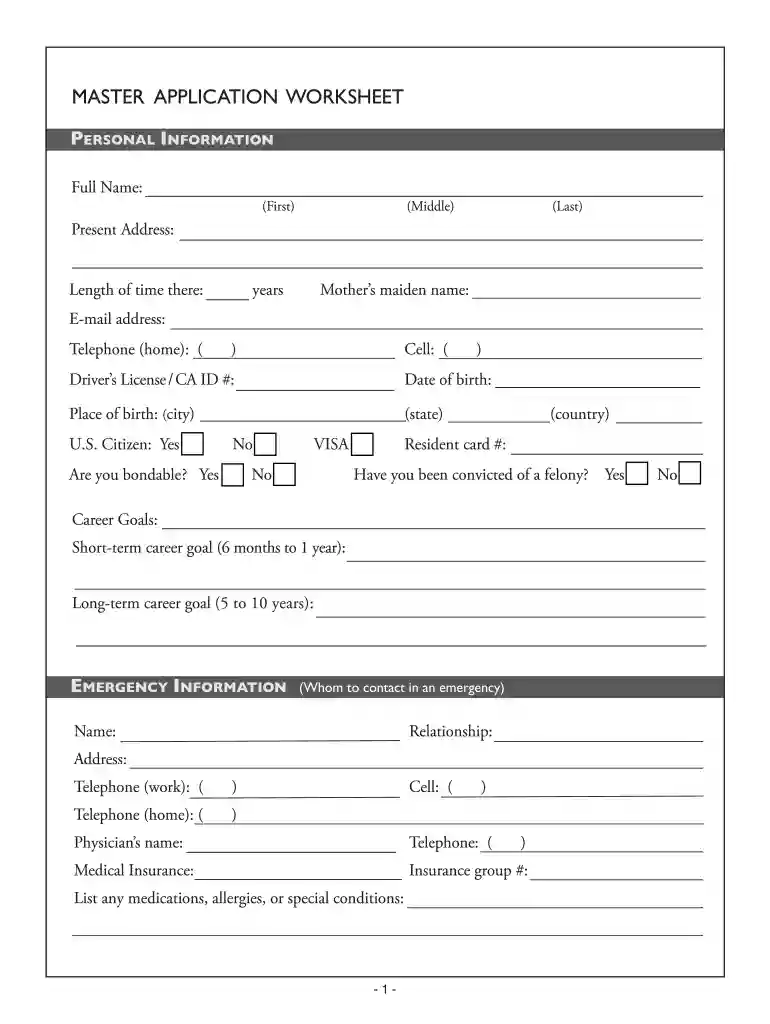
An application worksheet is a comprehensive form designed to collect a wide range of information from an applicant. This type of form typically includes sections for personal details, contact information, and career objectives. It serves as a foundational document used in various settings, such as job applications, educational program admissions, or organizational memberships. By organizing relevant information in one place, an application worksheet streamlines the process for both the applicant and the reviewer, ensuring that no critical details are overlooked.
Core Structure of an Application Worksheet
- Personal Information: Name, address, phone number, and email address.
- Career Goals: A brief outline of professional aspirations and objectives.
- Emergency Contacts: Contacts in case of an emergency.
- Work Experience: Listing of previous employment, including job roles and responsibilities.
- Education Background: Records of high school, college, and any additional certifications.
- Skills and Abilities: Special skills, including languages and technical competencies.
- Extracurricular Activities: Involvement in clubs, sports, or volunteer work.
- References: Professional or personal references who can vouch for the applicant's qualifications.
Steps to Complete the Application Worksheet
Completing an application worksheet involves several careful steps to ensure that all information provided is accurate and comprehensive. Here's a detailed guide to assist you through this process.
- Gather Necessary Information: Compile all relevant personal, educational, and professional details beforehand.
- Fill Out Personal Details: Start with easy sections like name and contact information to avoid mixing up data.
- List Career Goals and Objectives: Clearly outline what you aim to achieve in your career to provide context to reviewers.
- Emergency Contact Information: Ensure that the contacts listed are reliable and informed about their inclusion in the worksheet.
- Work Experience: Include job titles, descriptions, and dates, focusing on roles that highlight relevant skills and achievements.
- Education Background: Record accurate details of your academic history and any specialized training received.
- Identify Special Skills: Highlight any unique skills or competencies relevant to the application context.
- Review and Include References: Consult with references beforehand to ensure their willingness to provide testimonials on your behalf.
Tips for Efficient Completion
- Verify each section for accuracy to minimize errors.
- Use concise language to maintain clarity.
- Secure any documentation that may be needed for verification.
Key Elements of the Application Worksheet
The application worksheet is made up of several integral components, each designed to capture distinct aspects of an applicant's profile.
Personal and Emergency Information
- Identity Verification: Requires full legal name and any applicable aliases.
- Contact Methods: Prompt for current address, phone number, and email address to facilitate communication.
- Emergency Contacts: Listings should include the relationship to the applicant, ensuring they are reliable and reachable.
Professional Background
- Employment Record: Details surrounding past employment, roles, and accomplishments.
- Professional Skills: Inclusion of skills pertinent to the job or opportunity for which you are applying.
Education and Training
- Academic History: Covering high school and post-secondary education with dates and achievements.
- Additional Training: Certification or courses that contribute to the applicant’s qualifications.
Benefits for Users
- Organized Data Collection: Facilitates efficient data sorting and decision-making.
- Compliance and Verification: Assists in meeting documentation requirements for regulatory compliance.
- Comprehensive Overview: Ensures that all relevant aspects of an applicant’s profile are considered.
Electronic vs. Paper Application Worksheet
In today’s digital age, the choice between electronic and paper application worksheets is significant, offering distinct advantages and limitations.
Digital Application Worksheets
- Accessibility: Can be filled out and submitted online, allowing greater convenience and flexibility.
- Real-time Updates: Enables instantaneous edits and corrections without reprinting the entire form.
- Environmentally Friendly: Reduces paper waste and physical storage requirements.
Paper Application Worksheets
- Familiarity: Some find traditional methods easier to navigate or more reliable.
- Tangible Record: Provides a physical copy for personal records or further processing.
- Limited Technology Dependence: Not reliant on devices or internet connectivity.
Important Terms Related to Application Worksheet
Understanding the terminology associated with application worksheets is beneficial for completing and utilizing the form effectively.
Key Terms
- Applicant Information: The essential details submitted by the person filling out the form.
- Verification Documents: Supporting materials that authenticate the information provided.
- Submission Deadline: The final date by which the completed application worksheet must be returned.
- Required Fields: Sections of the form marked as mandatory, necessary for the application to be considered complete.
Clarification of Common Terms
- Confidentiality Agreement: Sometimes required to ensure that information shared in the worksheet remains private.
- Consent to Share Information: Permission granted by the applicant to the institution or organization to utilize the information provided.