




01. Edit your form online
Type text, add images, blackout confidential details, add comments, highlights and more.

Type text, add images, blackout confidential details, add comments, highlights and more.

Draw your signature, type it, upload its image, or use your mobile device as a signature pad.

Send it via email, link, or fax. You can also download it, export it or print it out.
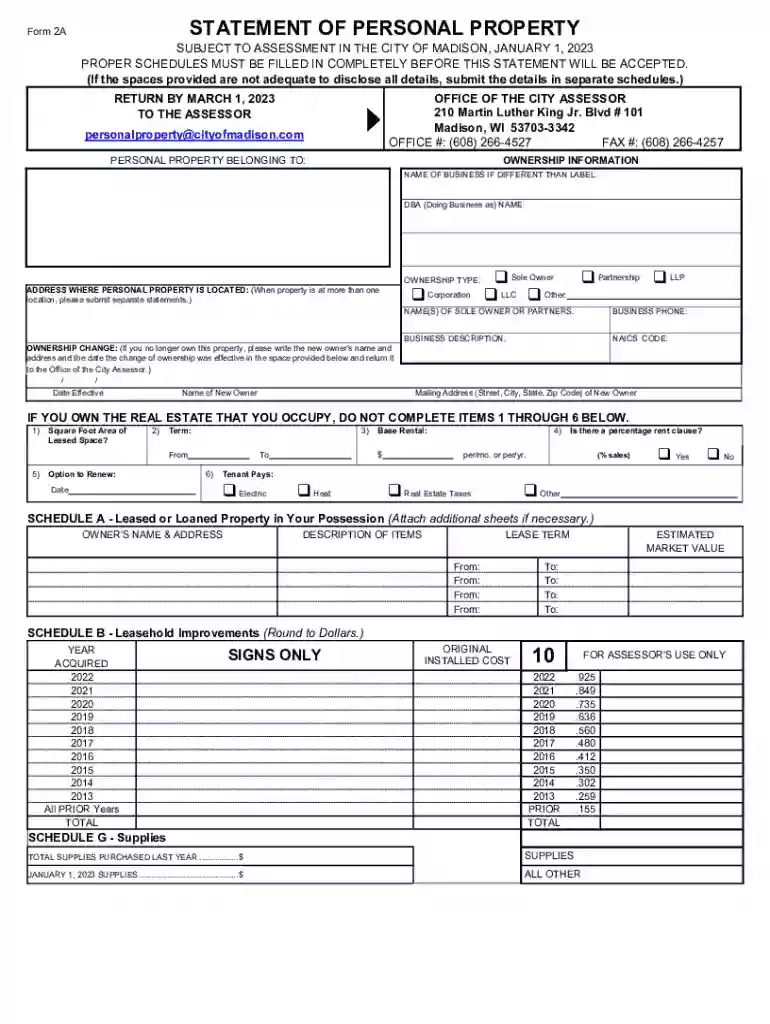
The "Annual Statement of Personal Property Instructions" is a crucial guide for businesses and individuals who need to report personal property for taxation purposes. The form generally applies to assets and properties owned as of the first of January of the reporting year. The document requires detailed information about ownership, property specifics, and various categories, such as leased equipment and office furniture. By following these instructions, filers can accurately complete and submit their information to municipal or county assessors, as required by law.
The instructions serve as a step-by-step guide to accurately completing the Annual Statement of Personal Property. Begin by gathering necessary information, such as ownership details and the types of property owned. Review sections on how to categorize items correctly. For instance, separate fully owned materials from leased items, and differentiate between furnishings versus business equipment. The instructions provide clarity on required attachments and supporting documentation, ensuring your submission is complete.
The form is primarily used by business owners and entities like corporations, partnerships, and limited liability companies (LLCs). It also applies to self-employed individuals who utilize personal assets for business activities. Often, these instructions are also pertinent to property managers and accountants who handle the financial documentation and tax obligations of various entities. Importantly, understanding these guidelines ensures that reported values coincide with legal requirements for property taxation.


Several key terms are essential for understanding these instructions:
The completed statement must be submitted by March 1 of the reporting year. It's critical to adhere to this deadline to avoid penalties. Some jurisdictions may offer extensions, but processes and eligibility will vary. It's advisable to submit filings well before the deadline to account for any potential errors or required corrections.
When filing the statement, include:
These documents substantiate the information reported and aid in the assessment of fair property value for taxation purposes.
Failure to comply with filing requirements can result in significant penalties. Late submissions may incur fines or result in an estimated assessment made by the local taxing authority, which could be unfavorable. Additionally, consistent non-compliance might lead to audits or increased scrutiny of your business’s financial records by state and local tax agencies.
The instructions and form can typically be completed either digitally or in paper format. Digital submissions are becoming more favorable due to ease of access and the ability for real-time updates. Many local tax offices provide portals for online submission, which streamline the process and reduce errors associated with manual entries. However, paper submission remains accepted, requiring physical delivery to the tax authority’s office.
Consider a consultancy firm that uses various office equipment. The firm must report owned computers, furniture, and leased copiers on their annual statement. Utilizing the instructions, the firm can accurately record each item's value and categorize assets correctly, ensuring compliance with local tax laws. This process not only helps in avoiding penalties but also aids in maintaining detailed records for financial planning and business continuity.
When preparing to complete the statement, pay close attention to:
By incorporating these elements into your preparation strategy, you ensure that the filing is comprehensive and compliant with the specific requirements laid out in the instructions.
We've got more versions of the Annual Statement of Personal Property Instructions form. Select the right Annual Statement of Personal Property Instructions version from the list and start editing it straight away!
Log in to your DocHub account and add your Annual Statement of Personal Property Instructions to our editor using one of its upload options - from your device, cloud storage, protected URL, or your DocHub folders if you have already processed your form before. Open our editor, click the Sign key in the top toolbar, and choose your signing method. You can use an image of your handwritten signature, draw it, type in your name, or utilize a QR code as an alternative.
Using a swift editing platform like DocHub, you do not require anything but a browser and connection to the internet to modify your Annual Statement of Personal Property Instructions on the internet swiftly. Add your document or find the appropriate form in DocHub’s catalog, open our editor with one click, and complete it digitally. To revise your forms at any time, register a free account with DocHub.
At DocHub, your data security is our priority. We follow HIPAA, SOC2, GDPR, and other standards, so you can work on your documents with confidence.
May 2, 2017 Federal employers are also required to file quarterly and annual reports with the CNMI Division of Revenue and. Taxation. For questionsRead more
What type of personal property is exempt? ♢ Registered motor vehicles. ♢ Livestock. ♢ Household goods or personal effects not owned for financial gain or profit.Read more
The simplest and easiest method to file both the Annual Report and Personal Property Tax Return is through Maryland Business Express (MBE).


