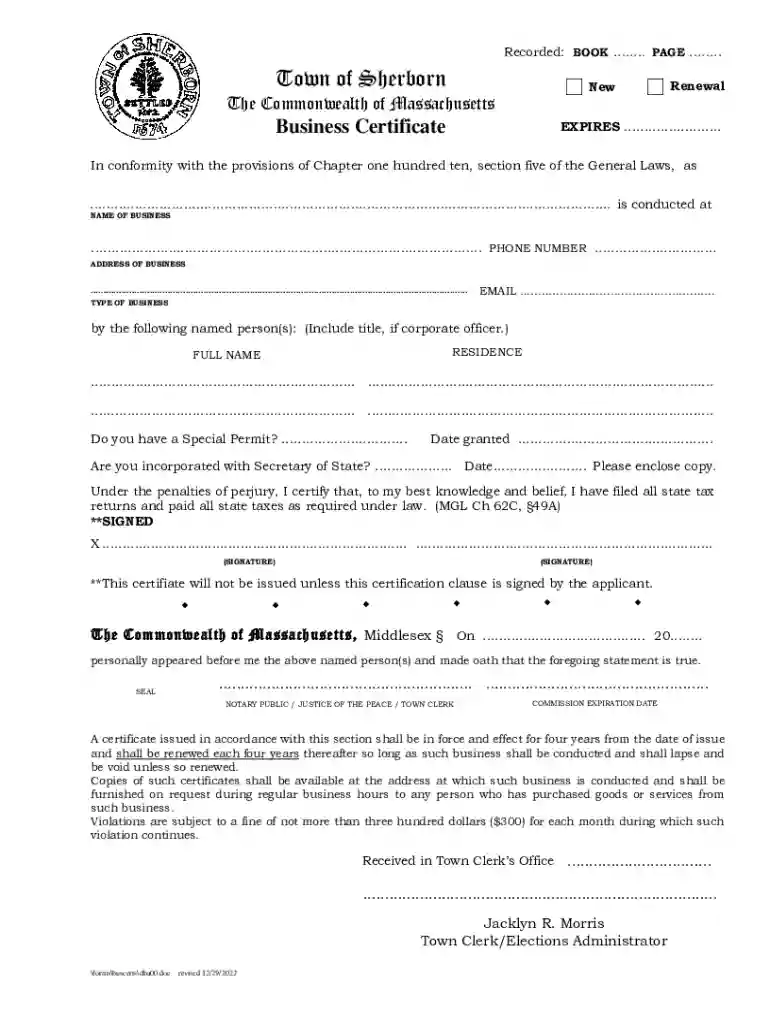
Business Certificate Procedure and Application 2026

Get Form
Business Certificate Procedure and Application Preview on Page 1

Here's how it works

01. Edit your form online
Type text, add images, blackout confidential details, add comments, highlights and more.

02. Sign it in a few clicks
Draw your signature, type it, upload its image, or use your mobile device as a signature pad.

03. Share your form with others
Send it via email, link, or fax. You can also download it, export it or print it out.

Definition & Meaning

The "Business Certificate Procedure and Application" refers to the formal process through which a business registers its existence with a municipal or state government. The business certificate serves as legal documentation proving a business's operation under a specific name and address. This ensures the business complies with local regulations and is recognized by governmental entities. Typically, the certificate includes crucial details such as the business name, address, type, and owner's information. Understanding this document is vital for legitimate business operation within the United States. Most states mandate acquiring a business certificate as part of establishing a new business entity.

Importance of a Business Certificate

  • Legality: Secures the legal recognition for conducting business.
  • Tax Compliance: Essential for aligning with state tax requirements.
  • Public Record: Registers the business publicly, enhancing its credibility.

Key Elements of the Business Certificate Procedure and Application

The Business Certificate encompasses several vital components that every applicant must address. Key sections typically found in the application include:

  • Business Name and Address: Clearly stated to ensure distinct identity.
  • Business Type: Explanation of the nature and structure, such as LLC, Corporation, or Partnership.
  • Owner Information: Details of all involved individuals or entities.
  • Certification of Tax Compliance: Affirmation that the business complies with tax obligations.
  • Notary Acknowledgment: Validation of the document by a recognized notary.
  • Duration: Typically valid for four years and subject to renewal.

Understanding these elements is crucial for proper submission and successful registration.

Steps to Complete the Business Certificate Procedure and Application

  1. Preparation and Gathering Information: Collect essential personal and business information, including identification and ownership proof.
  2. Filling Out the Application: Complete each section accurately. Paying attention to details ensures no information is omitted or incorrect.
  3. Notarization: Visit a notary public to certify the application.
  4. Submitting the Application: Choose the submission method: online, mail, or in-person at designated municipal offices.
  5. Fee Payment: Include required fees, which can vary by state or locality.
  6. Waiting for Approval: After submission, approval times vary; however, it usually takes a few weeks.
  7. Receiving the Certificate: Once approved, a certificate is issued, officially recognizing the business.

Detailed understanding of these steps aids in smooth navigation through the application process.

Required Documents

To complete the business certificate application, specific documents are necessary:

  • Proof of Business Name Reservation: Verifying no other entity uses the same name.
  • Personal Identification: Government-issued ID of all business owners.
  • Proof of Address: Verification for both the business location and owners.
  • Tax Identification Number: Essential for complying with IRS requirements.
  • Operating Agreement: Relevant for entities like LLCs, detailing internal management.

Providing complete and accurate documents streamlines processing and avoids delays.

Who Typically Uses the Business Certificate Procedure and Application

The business certificate application serves a diverse range of users, including:

  • New Entrepreneurs: Establishing legitimacy for startup ventures.
  • Existing Business Owners: Aligning with new regulations or relocating.
  • Partnerships: Formalizing business structures involving multiple owners.
  • Corporations and LLCs: Ensuring recognition under state and municipal regulations.
  • Retail Businesses: Particularly those with physical storefronts.

Understanding the user demographic helps in tailoring application procedures to specific business needs.


decoration image ratings of Dochub

State-Specific Rules for the Business Certificate Procedure and Application

Different states implement unique rules regarding business certificate applications:

  • Massachusetts: Requires a four-year renewal cycle and specific notary acknowledgment.
  • California: May necessitate additional environmental compliance endorsements.
  • New York: Distinct regulations for businesses operating in multiple locations.

Familiarity with state-specific guidelines ensures applications meet all regional requirements and avoid hurdles during processing.

Penalties for Non-Compliance

Not adhering to business certificate mandates can lead to significant consequences:

  • Fines and Penalties: Monetary charges for failing to maintain a valid certificate.
  • Cease and Desist Orders: Temporary closure of operations until compliance is restored.
  • Reputational Damage: Loss of credibility and trust among customers and partners.
  • Legal Action: Potential lawsuits arising from non-registered business actions.

Maintaining compliance is critical for uninterrupted business operation and avoiding negative impacts.

Digital vs. Paper Version

Business certificate applications come in both digital and paper forms, each with distinct features:

  • Digital Version:

    • Offers convenience of online submission and faster processing.
    • Reduces paperwork and allows easy access and updates.
    • Ideal for tech-savvy individuals comfortable using government portals.
  • Paper Version:

    • Traditional method for those without reliable internet access.
    • Can be directly submitted or mailed to municipal offices.
    • Preferred in areas with specific in-person verification requirements.

Choosing the right version can depend on accessibility, familiarity with digital interfaces, or personal preference for physical documentation.

See more Business Certificate Procedure and Application versions

We've got more versions of the Business Certificate Procedure and Application form. Select the right Business Certificate Procedure and Application version from the list and start editing it straight away!
Versions Form popularity Fillable & printable
2022 4.8 Satisfied (54 Votes)
2007 4 Satisfied (36 Votes)
be ready to get more

Complete this form in 5 minutes or less

Get form

Got questions?

We have answers to the most popular questions from our customers. If you can't find an answer to your question, please contact us.
Contact us
A business registration certificate is an official document issued by a government authority that confirms a companys legal existence and compliance with local regulations, allowing it to operate and engage in business activities.
A business license is not the same as registering an LLC. They both have separate purposes and are individually beneficial for your business.
Generally speaking, a business registration certificate is what allows the state to identify and recognize your business as a separate legal entity. Upon the successful completion of the filing process, the state will confer the legal benefits of registration on your business.

Security and compliance

At DocHub, your data security is our priority. We follow HIPAA, SOC2, GDPR, and other standards, so you can work on your documents with confidence.

Learn more
ccpa2
pci-dss
gdpr-compliance
hipaa
soc-compliance
be ready to get more

Complete this form in 5 minutes or less

Get form