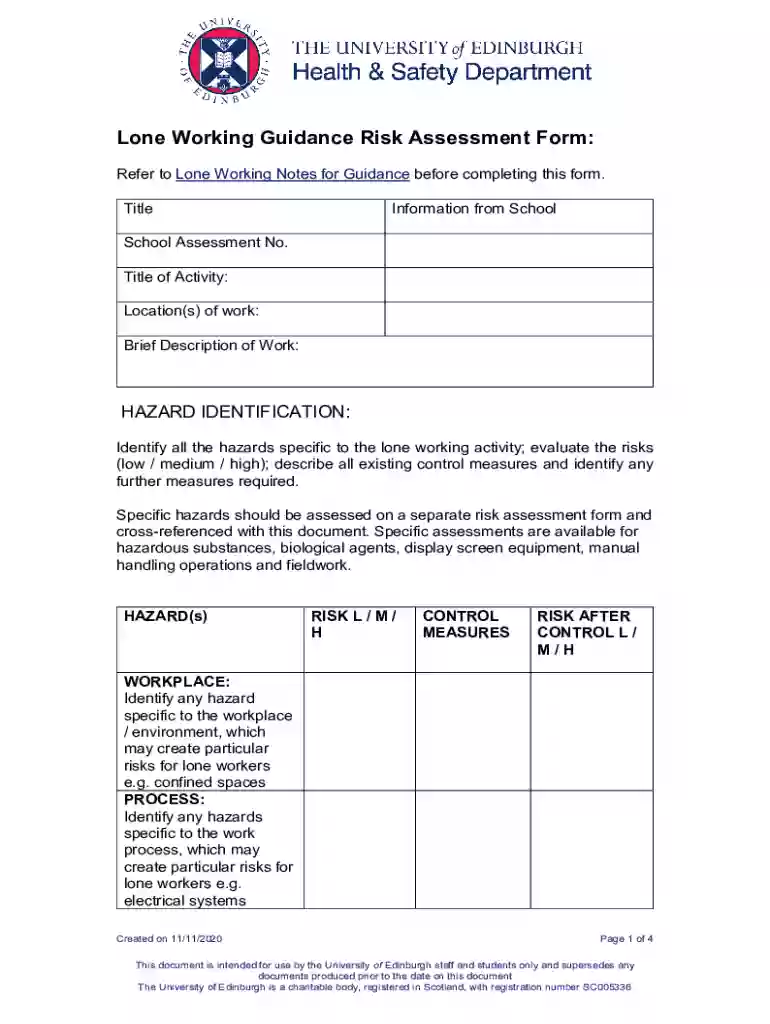
Lone Working Guidance Risk Assessment Form: 2026

Get Form
risk assessment health safety Preview on Page 1

Here's how it works

01. Edit your risk assessment health safety online
Type text, add images, blackout confidential details, add comments, highlights and more.

02. Sign it in a few clicks
Draw your signature, type it, upload its image, or use your mobile device as a signature pad.

03. Share your form with others
Send uk risk assessment guidance via email, link, or fax. You can also download it, export it or print it out.

Definition and Purpose of the Lone Working Guidance Risk Assessment Form

The Lone Working Guidance Risk Assessment Form is a vital document used to identify and manage risks associated with tasks performed independently by individuals, primarily in environments like the University of Edinburgh. This form is crucial for promoting safety by pinpointing potential hazards and implementing control measures to mitigate associated risks. Activities covered by the form often involve scenarios where staff or students work without direct supervision or alongside colleagues, thus necessitating comprehensive risk assessments to ensure individual safety.

Key Elements of the Lone Working Guidance Risk Assessment Form

The form comprises several components designed to capture essential information related to lone working situations:

  • Hazard Identification: Involves recognizing potential dangers associated with the task.
  • Risk Evaluation: Entails assessing the likelihood and impact of identified hazards.
  • Control Measures: Suggests methods to eliminate or reduce risks.
  • Training Requirements: Determines the necessary training to prepare individuals for safely handling lone tasks.
  • Supervision Levels: Establishes the degree of oversight required for specific activities.

These elements collectively help in maintaining a safe working environment for individuals undertaking tasks alone.

Who Typically Uses the Lone Working Guidance Risk Assessment Form

This form is predominantly utilized by:

  • University Personnel: Faculty members, administrative staff, and researchers at institutions like the University of Edinburgh require this form to ensure safety during independent work.
  • Students: Those undertaking projects, research work, or tasks requiring solitude often rely on the form to identify and mitigate risks.
  • Safety Officers: Responsible for overseeing risk assessment procedures and implementation of safety protocols.
  • Supervisors and Managers: They use the form to approve and ensure that individuals are equipped with necessary strategies and tools to handle risks safely.
decoration image ratings of Dochub

Steps to Complete the Lone Working Guidance Risk Assessment Form

Filling out the form involves a systematic approach:

  1. Identify Task and Environment: Clearly define the nature of the work and the environment in which it will take place.
  2. Detail Hazard Identification: Point out potential sources of risk.
  3. Perform Risk Assessment: Evaluate the severity and likelihood of risks involved.
  4. Define Control Measures: Outline procedures to manage or reduce identified risks.
  5. List Training Requirements: Indicate any necessary training for risk mitigation.
  6. Determine Supervision Needs: Specify if supervision is required and to what extent.
  7. Approval and Review: The completed form should be reviewed and approved by designated personnel before commencing tasks.

Legal Use of the Lone Working Guidance Risk Assessment Form

The form is legally significant as it helps workplaces comply with safety regulations and occupational health requirements. By systematically documenting potential hazards and control measures, the form serves as an official record that can demonstrate due diligence in maintaining a safe work environment. It helps fulfill legal obligations pertaining to employee safety and risk management.

State-Specific Rules for the Lone Working Guidance Risk Assessment Form

Rules regarding lone working risk assessments may vary by state within the U.S., particularly in compliance with local occupational safety and health regulations. While the core principles of hazard identification, risk assessment, and control implementation are consistent nationwide, specific reporting formats, approval processes, or supplementary requirements can differ.

Examples of Using the Lone Working Guidance Risk Assessment Form

Imagine a scenario involving a lab technician required to conduct research outside regular hours. Using the form, the technician can identify potential hazards like chemical exposure or equipment malfunction. They would implement safety measures such as wearing protective gear and ensuring communication devices are functional for emergencies. Another example could be fieldwork conducted by a student, where terrain risks or potential wildlife encounters are identified, with risk minimization strategies like emergency protocols documented.

Important Terms Related to the Lone Working Guidance Risk Assessment Form

Understanding specific terms is crucial for correctly filling out the form:

  • Hazard: A potential source of harm.
  • Risk: The likelihood of a hazard causing harm.
  • Control Measure: Steps to mitigate risks.
  • Vulnerability: Specific conditions that make individuals more susceptible to harm.
  • Assessment Frequency: How often the risk assessment should be carried out.

These terms help in accurately documenting and assessing lone working conditions.

Verification and Approval Process for the Lone Working Guidance Risk Assessment Form

Once the form is completed, it must undergo a verification process, typically entailing a review by a safety officer or manager. This process ensures that all identified risks have been addressed adequately with appropriate control measures in place. Furthermore, the form may require periodic review to adapt to any changes in working conditions or task specifics.

See more Lone Working Guidance Risk Assessment Form: versions

We've got more versions of the Lone Working Guidance Risk Assessment Form: form. Select the right Lone Working Guidance Risk Assessment Form: version from the list and start editing it straight away!
Versions Form popularity Fillable & printable
2020 4.8 Satisfied (40 Votes)
2010 4 Satisfied (45 Votes)
be ready to get more

Complete this form in 5 minutes or less

Get form

Got questions?

We have answers to the most popular questions from our customers. If you can't find an answer to your question, please contact us.
Contact us

Log in to your DocHub account and add your risk assessment lone working to our editor using one of its upload methods - from your device, cloud storage, protected URL, or your DocHub folders if you have already processed your document before. Open our editor, click the Sign key in the upper toolbar, and decide on your signing method. You can upload a picture of your handwritten signature, draw it, enter your name, or use a QR code as an alternative.

When you edit your risk assessment health safety pdf with DocHub, you will not need to look for other applications or solutions to sign it. An electronic signature is part of DocHub’s extensive editing toolset, which allows you to apply changes in your form without jumping between platforms. Just complete your form, double-check the correctness of the information and place your electronic signature at the end to make it submission-ready within minutes.

A manager is carrying out a risk assessment among drillers in an underground gold mine. The drillers use pneumatic jackhammers. After some years in this mine several of the drillers developed lung problems, and the owner realizes that safety and health practices need to be improved in this regard.
Basic Risk Assessment Template A description of the procedure, task, or worksite being assessed. Identify the hazards and document them. Identify the risks associated with each activity. Attach photos of the hazards. Determine a risk rating. Document the specific control measures taken to mitigate the risk.
It includes: A description of the procedure, task, or worksite being assessed. Identify the hazards and document them. Identify the risks associated with each activity.

Security and compliance

At DocHub, your data security is our priority. We follow HIPAA, SOC2, GDPR, and other standards, so you can work on your documents with confidence.

Learn more
ccpa2
pci-dss
gdpr-compliance
hipaa
soc-compliance
be ready to get more

Complete this form in 5 minutes or less

Get form

People also ask

You can do it yourself or appoint a competent person to help you. Identify hazards. Assess the risks. Control the risks. Record your findings. Review the controls.
The Health and Safety Executives Five steps to risk assessment. Step 1: Identify the hazards. Step 2: Decide who might be harmed and how. Step 3: Evaluate the risks and decide on precautions. Step 4: Record your findings and implement them. Step 5: Review your risk assessment and update if. necessary.
The risk assessment document is a record of docHub findings from your risk assessment process (that you have just done!). How you write your risk assessment is up to you, but you need to include all the necessary information about the hazards and how to control the risk.
What should lone working risk assessments contain? Your lone working risk assessment should contain the hazards identified, who might be harmed and how, what procedures are already in place to prevent harm and what further action you will take to further reduce risk.
Lone working risk assessments are a basic legal requirement and should be carried out for all employees. If you employ five or more people, you are legally required to write down and keep a record of your risk assessment. It is often kept as part of your Lone Worker Policy.

uk risk assessment school