Veterinary exam forms 2026

Get Form
veterinary exam template Preview on Page 1

Here's how it works

01. Edit your veterinary exam template online
Type text, add images, blackout confidential details, add comments, highlights and more.
02. Sign it in a few clicks
Draw your signature, type it, upload its image, or use your mobile device as a signature pad.
03. Share your form with others
Send veterinary exam form via email, link, or fax. You can also download it, export it or print it out.

How to use or fill out veterinary exam forms with our platform

Form edit decoration
9.5
Ease of Setup
DocHub User Ratings on G2
9.0
Ease of Use
DocHub User Ratings on G2
  1. Click ‘Get Form’ to open the veterinary exam form in the editor.
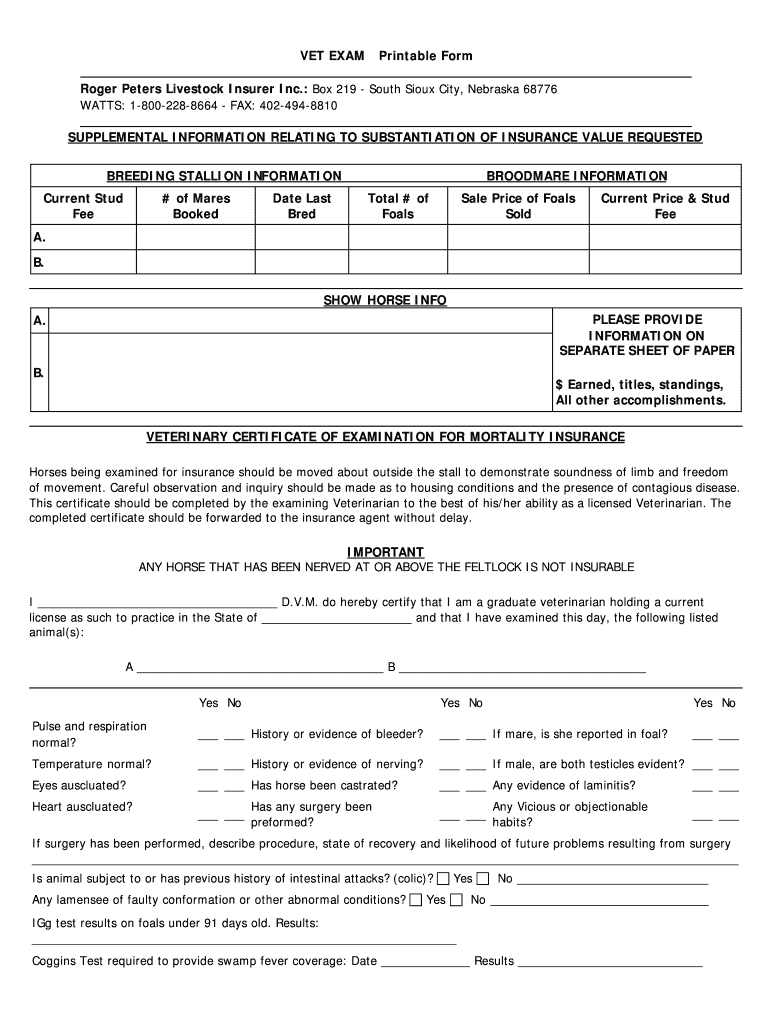
  2. Begin by filling out the Breeding Stallion Information section. Enter details such as Current Stud Fee, Number of Mares Booked, and Date Last Bred.
  3. Next, complete the Broodmare Information section. Provide the Total Number of Foals, Sale Price of Foals Sold, and Current Price & Stud Fee.
  4. For Show Horse Info, if applicable, provide additional information on a separate sheet as instructed.
  5. In the Veterinary Certificate of Examination for Mortality Insurance section, ensure that a licensed veterinarian completes this part accurately. They should certify their findings regarding the horse's health and any relevant medical history.
  6. Finally, make sure to include the Veterinarian's signature, address, office phone number, and date & time before submitting the form.

Start using our platform today to streamline your veterinary exam form completion for free!

be ready to get more

Complete this form in 5 minutes or less

Get form

Got questions?

We have answers to the most popular questions from our customers. If you can't find an answer to your question, please contact us.
Contact us

With DocHub, it’s pretty simple. The platform offers users an add-on called DocHub for Gmail, which you can locate in the Google Workspace Marketplace free of charge. Install it and grant it access to your Google account. Open your email with your veterinary exam forms attached and click on the add-on button in the right-side panel. Log in to your DocHub account, and import the file to our editor, where you can complete it and sign.

If your go-to electronic mail service is Gmail, it is simple to integrate your DocHub editor into your work. Edit your veterinary exam forms with DocHub tools and connect it to your drafts in Gmail. See how straightforward it can be to exchange files and collaborate with a swift PDF editing solution at hand.

(1) Name and address of client and animal. (2) Age, sex, breed, species, and color of the animal. (3) A history or pertinent information as it pertains to each animals medical status. (4) Data, including that obtained by instrumentation, from the physical examination.
2:11 3:31 Search of the skin. What Im looking for is redness hair loss signs of any infection. Anything thatMoreSearch of the skin. What Im looking for is redness hair loss signs of any infection. Anything that would be abnormal. So I usually well start at the neck.
About the journal Full journal titleVeterinary record openAbbreviationVet. Rec. OSN (print)NAISSN (online)2052-6113NLM catalog101653671

Security and compliance

At DocHub, your data security is our priority. We follow HIPAA, SOC2, GDPR, and other standards, so you can work on your documents with confidence.

Learn more
ccpa2
pci-dss
gdpr-compliance
hipaa
soc-compliance
be ready to get more

Complete this form in 5 minutes or less

Get form

People also ask

Your Pets Physical Checkup Listening to your animals lungs and heart. Checking your cat or dogs stance, gait, and weight. Examining your pets eyes for signs of excessive tearing, discharge, redness, cloudiness, or eyelid issues. Checking your companions coat for overall condition, abnormal hair loss, or dandruff.
Your pets medical record is a confidential and legal record that systematically details their entire health history, just like your personal medical record. Its used to provide information, including the assessment, diagnosis, and treatment resulting from all of your pets veterinary visits.
Remember that the SOAP is dynamic for inpatients and that with each day: your S is compared to the last S, your O should focus on the changes in findings, the A should change as diagnoses are made, things resolve or new problems arise, and the P should change as the needs for the patient change.
During a routine wellness examination, your veterinarian will ask you questions about your dogs diet, exercise, thirst, breathing, behavior, habits, elimination patterns (i.e., bowel movements and urination), lifestyle, and general health. Your veterinarian will also perform a physical examination of your dog.
When writing your records, you should use language that is familiar to all veterinarians with abbreviations that are commonly known. You should write medical records in such a way that any veterinarian can read the records and understand what is going on enough to continue with the care and treatment of that patient.

Related links