




01. Edit your call audit template online
Type text, add images, blackout confidential details, add comments, highlights and more.

Type text, add images, blackout confidential details, add comments, highlights and more.

Draw your signature, type it, upload its image, or use your mobile device as a signature pad.

Send free call quality monitoring form via email, link, or fax. You can also download it, export it or print it out.
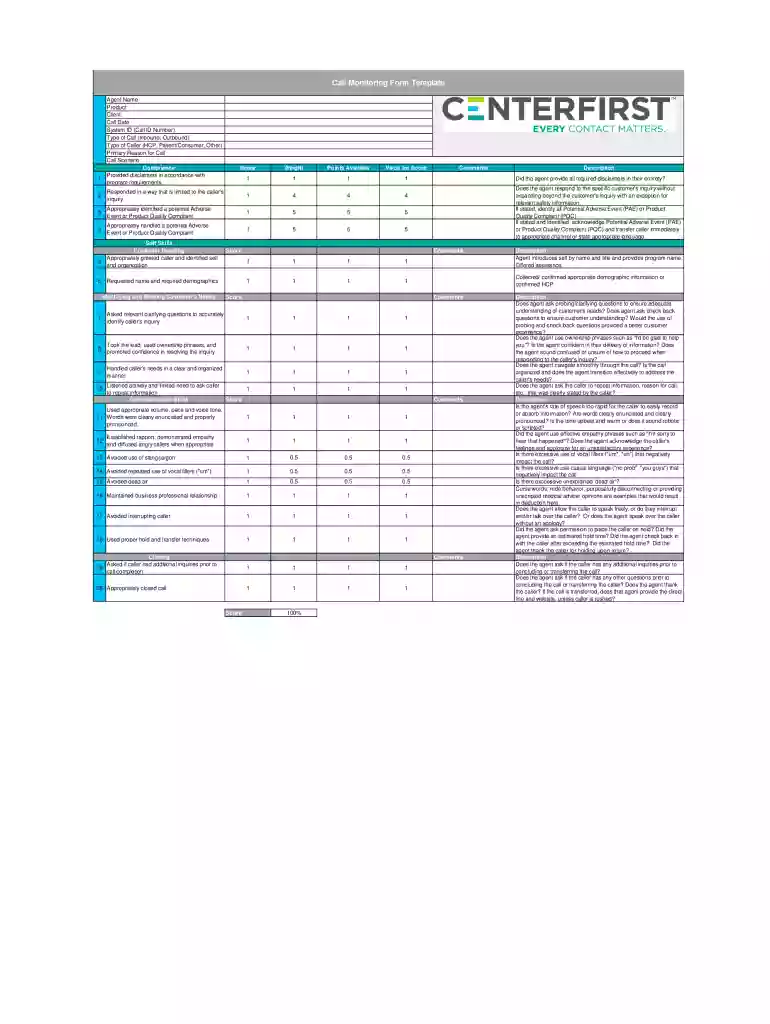
A call monitoring form template is a structured tool used primarily by contact centers and customer service departments to assess agent performance during phone interactions. This template captures various aspects of a call, including agent identification, call details, compliance with company protocols, and effectiveness in communication. By using this form, management can ensure that agents meet operational standards, providing valuable feedback for training and development. This form plays a crucial role in maintaining service quality and consistency across all client interactions.
The call monitoring form template includes several critical components necessary for a comprehensive evaluation:
Agent Identification: The form typically begins with sections where the agent's name, employee ID, and the date and time of the call are recorded. This ensures the evaluation is accurately attributed to the correct interaction.
Call Details: This section involves capturing the call duration, the type of call - inbound or outbound, and a brief description of the customer's issue.
Compliance Checks: It includes predefined criteria to evaluate whether the agent adhered to company protocols and any regulatory requirements during the call.
Scoring Criteria: Quantitative metrics are used to assess agents' skills in communication, problem-solving, and professionalism. Common metrics might include clarity of information, empathy, and adherence to call scripts.
Customer Sentiment Analysis: Some forms also collect feedback on how satisfied the customer appeared to be, either through direct comments or inferred through cues like tone and demeanor.
Utilizing the call monitoring form template effectively involves several crucial steps:
Preparation: Ensure the form is properly aligned with your organization's objectives. Customize sections to fit specific areas of focus such as technical knowledge or policy compliance.
Training: Train evaluators to use the form consistently. This ensures uniform scoring and reduces subjectivity.
Live or Recorded Evaluation: Choose whether evaluations will occur during live calls or by reviewing recorded interactions. This choice may depend on resources and goals.
Feedback Loop: Use the results derived from the form to provide constructive feedback to agents. Highlight strengths and areas of improvement, fostering a culture of continuous development.
Completing a call monitoring form template involves several detailed steps:
Agent and Call Information: Begin by filling out the basics, such as an agent's identification details and call specifics.
Assessment of Call Opening: Evaluate how well the agent introduces themselves and establishes rapport with the caller.
Problem Identification and Resolution: Note how effectively the agent identifies the caller's issue and provides a resolution. This section may also assess product or service knowledge.
Communication Skills Evaluation: Rate the agent's ability to communicate, including their listening skills, tone, and clarity of information conveyed.
Protocol Compliance: Check whether all compliance and procedural aspects of the call were sufficiently met, including necessary disclosures.
Call Closing and Follow-Up: Assess the effectiveness and completeness in closing the interaction, ensuring the caller's needs were fully addressed.
Real-world application scenarios of the call monitoring form template showcase its practical benefits:
Training Programs: During onboarding, call monitoring forms can serve as a foundation for new agents, highlighting key performance areas and expectations.
Performance Reviews: Regular use in performance reviews allows managers to give data-driven feedback, promoting transparency and accountability.
Quality Assurance Audits: Scheduled and random audits using the form ensure consistent service delivery aligns with the company's benchmark standards.
Benchmarking: By analyzing data from multiple forms, management can identify trends and benchmark performance across teams and departments.
We've got more versions of the call audit template form. Select the right call audit template version from the list and start editing it straight away!
| Versions | Form popularity | Fillable & printable |
|---|---|---|
| 2018 | 4.9 Satisfied (46 Votes) |
At DocHub, your data security is our priority. We follow HIPAA, SOC2, GDPR, and other standards, so you can work on your documents with confidence.


