




01. Edit your form online
Type text, add images, blackout confidential details, add comments, highlights and more.

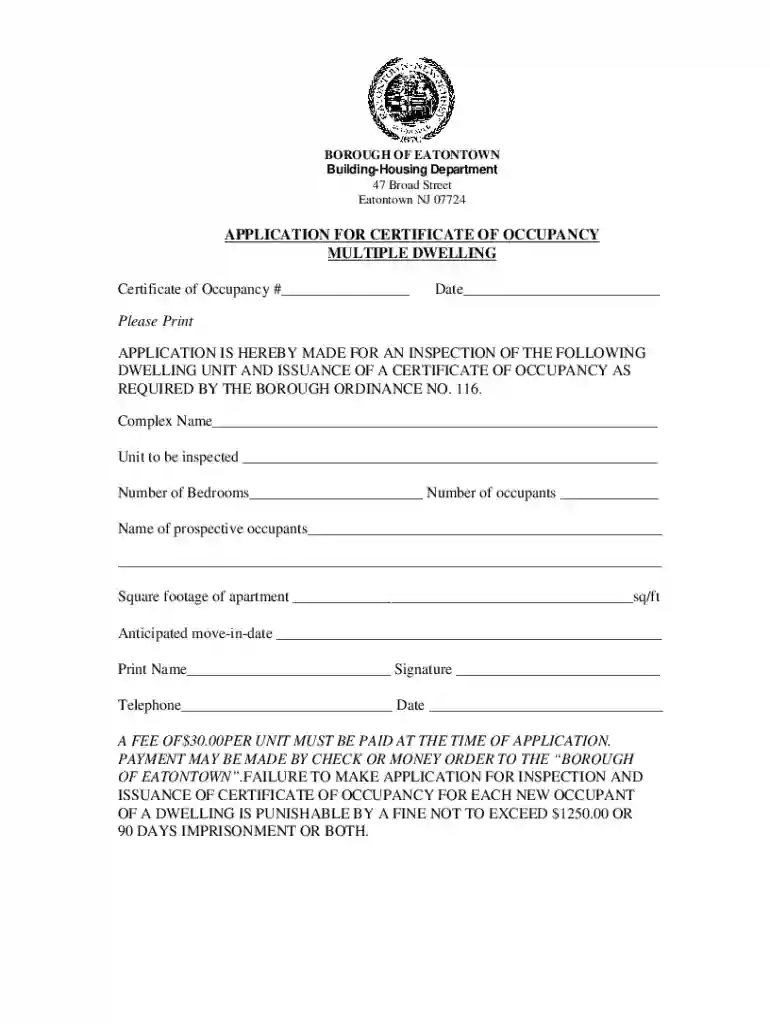
Type text, add images, blackout confidential details, add comments, highlights and more.

Draw your signature, type it, upload its image, or use your mobile device as a signature pad.

Send it via email, link, or fax. You can also download it, export it or print it out.
The Certificate of Occupancy Application for Multi Dwellings is a formal document required by local governments to verify that multi-family residential buildings meet existing safety standards and building codes before they can be legally occupied. This certificate is essential for confirming that the building is safe for habitation and compliant with local zoning laws. It particularly pertains to properties with multiple living units, such as apartment complexes, duplexes, and condominiums.
Completing the Certificate of Occupancy Application involves several steps to ensure accuracy and compliance with local building regulations.
Gather Necessary Information: Include details about the dwelling units, such as the address, building type, number of units, and information about prospective occupants.
Schedule an Inspection: Coordinate with local building inspectors to assess the property. This may involve multiple inspections for aspects like electrical systems, plumbing, and structural integrity.
Ensure Compliance with Safety Codes: Address all safety requirements outlined by the local government, which may include smoke detector checks, fire exits, and general maintenance.
Fill out the Application Form: Input all required information accurately. This includes owner details, intended use, and any prior modifications to the building.
Pay Associated Fees: Submit the form along with any required application fees which may vary by jurisdiction.
Submit the Application: Deliver the completed form alongside the inspection results to the relevant municipal office for processing.
Understanding specific terminology used in the application process is crucial for the successful completion of the certificate application.
This application serves a vital legal function in certifying that a multi-dwelling building can be occupied.
Several elements are crucial to the Certificate of Occupancy Application, ensuring comprehensive compliance.
To complete the Certificate of Occupancy Application, several key documents are often required:
Various scenarios can illustrate the practical applications of this certificate:
Rules for obtaining a Certificate of Occupancy may vary slightly by state, affecting application procedures:
Understanding these state-specific nuances is essential for a smooth application process.
We've got more versions of the Certificate of Occupancy Application for Multi Dwellings form. Select the right Certificate of Occupancy Application for Multi Dwellings version from the list and start editing it straight away!
| Versions | Form popularity | Fillable & printable |
|---|---|---|
| 2025 | 4 Satisfied (34 Votes) | |
| 2025 | 4.8 Satisfied (31 Votes) | |
| 2025 | 4.3 Satisfied (34 Votes) | |
| 2025 | 4.2 Satisfied (34 Votes) | |
| 2025 | 4.6 Satisfied (55 Votes) | |
| 2025 | 4.5 Satisfied (44 Votes) | |
| 2025 | 4.2 Satisfied (37 Votes) | |
| 2025 | 4.7 Satisfied (34 Votes) | |
| 2024 | 4.3 Satisfied (21 Votes) | |
| 2024 | 4.6 Satisfied (51 Votes) | |
| 2024 | 4.5 Satisfied (23 Votes) | |
| 2024 | 4.8 Satisfied (29 Votes) | |
| 2024 | 4.1 Satisfied (28 Votes) | |
| 2024 | 4.9 Satisfied (51 Votes) | |
| 2024 | 4.4 Satisfied (31 Votes) |
If you often work with documents kept in your Google Drive, DocHub is a superb option for you to easily and quickly complete, adjust, and approve them. This editor integrates well with Google apps, so you can export your Certificate of Occupancy Application for Multi Dwellings from your Google Drive to the editor without the need of downloading and re-uploading it. Right-click on your file, select Open With → DocHub PDF Sign and Edit. In our editor, add and assign Signature Fields for all people involved, then click on the Menu button above → Send → choose how you want to share your paperwork.
You can easily edit and complete your Certificate of Occupancy Application for Multi Dwellings on any iOS device. Open an internet browser of your choice, visit the DocHub site, authorize or create a new account, add your file for editing, and make your required changes. Our service is mobile-friendly, so using its features on your smartphone will be a no-brainer, even on the first try.
At DocHub, your data security is our priority. We follow HIPAA, SOC2, GDPR, and other standards, so you can work on your documents with confidence.
A Certificate of Occupancy (C of O) verifies that the use of a building, structure, or land in the District complies with the legal and safety standards in theRead more
The RP-5217-PDF Real Property Transfer Report (RPL Article 9, Section 333) is a one-part, downloadable, barcoded, pdf form used to document the informationRead more
by S Pruss 2008 occupancy of a building [that] describes how a building may be occupied, for example, a two-family home, a parking lot, a 40-unit multiple dwelling, or a store.Read more


