




01. Edit your form online
Type text, add images, blackout confidential details, add comments, highlights and more.

Type text, add images, blackout confidential details, add comments, highlights and more.

Draw your signature, type it, upload its image, or use your mobile device as a signature pad.

Send it via email, link, or fax. You can also download it, export it or print it out.
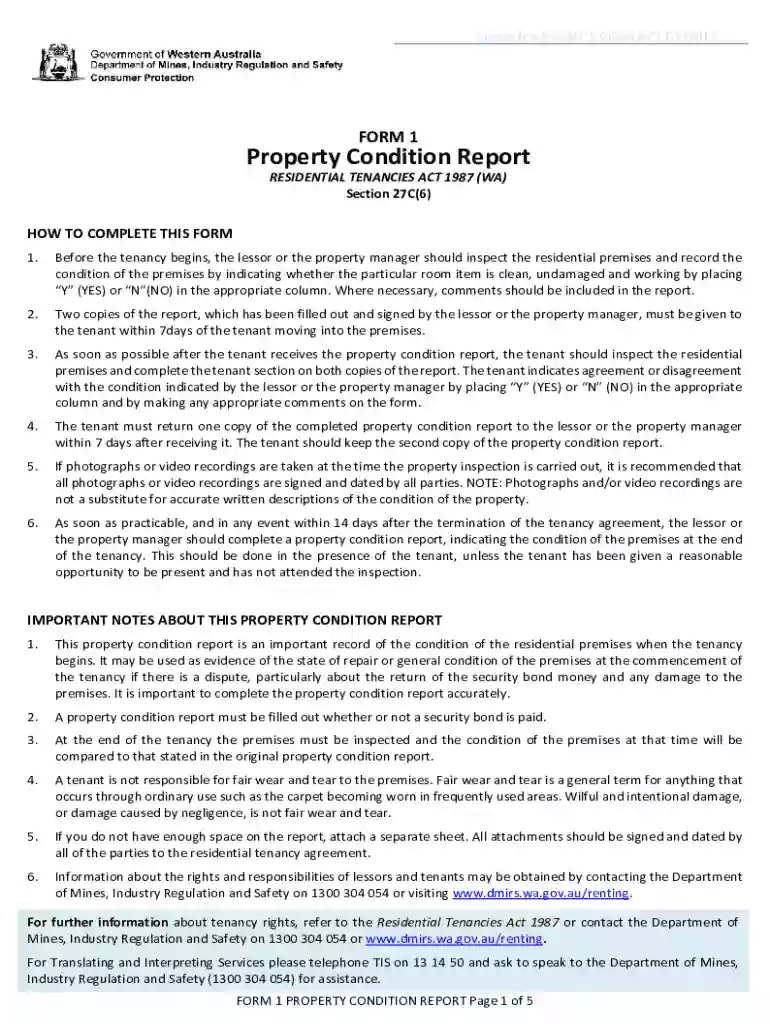
The Form 1 Property Condition Report is a crucial document required under the Residential Tenancies Act 1987 in Western Australia (WA). This report serves multiple purposes. Primarily, it provides a detailed account of the property's condition before a tenant moves in. This helps establish a baseline that both parties can refer to when assessing the property's condition at the end of the tenancy. It is essential for ensuring transparency and reducing disputes over security bond returns. Understanding the definitions and expectations laid out in this form is vital for all parties involved in a rental agreement in WA.
Using the Form 1 Property Condition Report effectively requires a structured approach. First, landlords or property managers must conduct a thorough inspection of the property. Every room and area should be assessed carefully, noting any pre-existing damage or issues. Tenants are then given the opportunity to review the report and note any discrepancies or additional observations. It is crucial that tenants return a signed copy of the report within the stipulated time frame, often within seven days. This countersigns that both parties agree with the documented condition, which is vital for minimizing future disputes.
Completing the Form 1 involves a series of diligent steps:
The Form 1 report includes several key sections that need thorough attention:
Both lessors and tenants use the Form 1 Property Condition Report to establish a mutual understanding of a property's condition at the onset of a tenancy. Lessors, property managers, and landlords utilize this form primarily to prepare documentation that protects their assets. Tenants use this report to ensure they are not held accountable for pre-existing damages upon vacating the premises. It is particularly vital for agents managing multiple properties to systematically document and track the condition of each asset.


The legal significance of the Form 1 Property Condition Report cannot be overstated. Under the Residential Tenancies Act in WA, this report is a legal requirement and helps form part of the contractual agreement between a tenant and landlord. In legal disputes, this document is often referenced to resolve disagreements regarding property conditions and bond return issues. The completion and mutual agreement on this form can serve as legal protection against unfair claims of damage by either party.
Understanding critical terms within the Form 1 is necessary for correct usage:
In practice, use cases can vary:
Each of these examples highlights the importance of accurate and honest documentation in maintaining a healthy landlord-tenant relationship.
We've got more versions of the Form 1 Property Condition Report Renting a home in WA form. Select the right Form 1 Property Condition Report Renting a home in WA version from the list and start editing it straight away!
Sure, and it’s really straightforward! DocHub is a web-based PDF editor with advanced document processing functions that allow you quickly adjust your documents, fill out empty fields and insert new ones for others to fill out, and create electronic signatures in several ways. Add your Form 1 Property Condition Report Renting a home in WA, give information as required, and select how you want to eSign your document - by typing your name, drawing your signature, uploading its picture, or utilizing a QR code.
When you edit your Form 1 Property Condition Report Renting a home in WA with DocHub, you only need a steady web connection and virtually any web browser installed on your device. No need to set up any third-party software or research tutorials. Just open a tab with DocHub, drag and drop your file, and edit it on the spot.
At DocHub, your data security is our priority. We follow HIPAA, SOC2, GDPR, and other standards, so you can work on your documents with confidence.
Overview of Truth in Renting Act. 1. The Lease. 2. Mobile Home Leases Private Residential Leasehold Communities Law. 3. Public Housing Leases.Read more
The owner/management agent and tenant together conduct a move-in/move-out inspection to document the condition of the unit at the time of move-in/move-out.Read more
Feb 23, 2018 If you own a part interest in rental property, you must report your part of the rental income from the property. Rental of property also used asRead more


