




01. Edit your form online
Type text, add images, blackout confidential details, add comments, highlights and more.

Type text, add images, blackout confidential details, add comments, highlights and more.

Draw your signature, type it, upload its image, or use your mobile device as a signature pad.

Send it via email, link, or fax. You can also download it, export it or print it out.
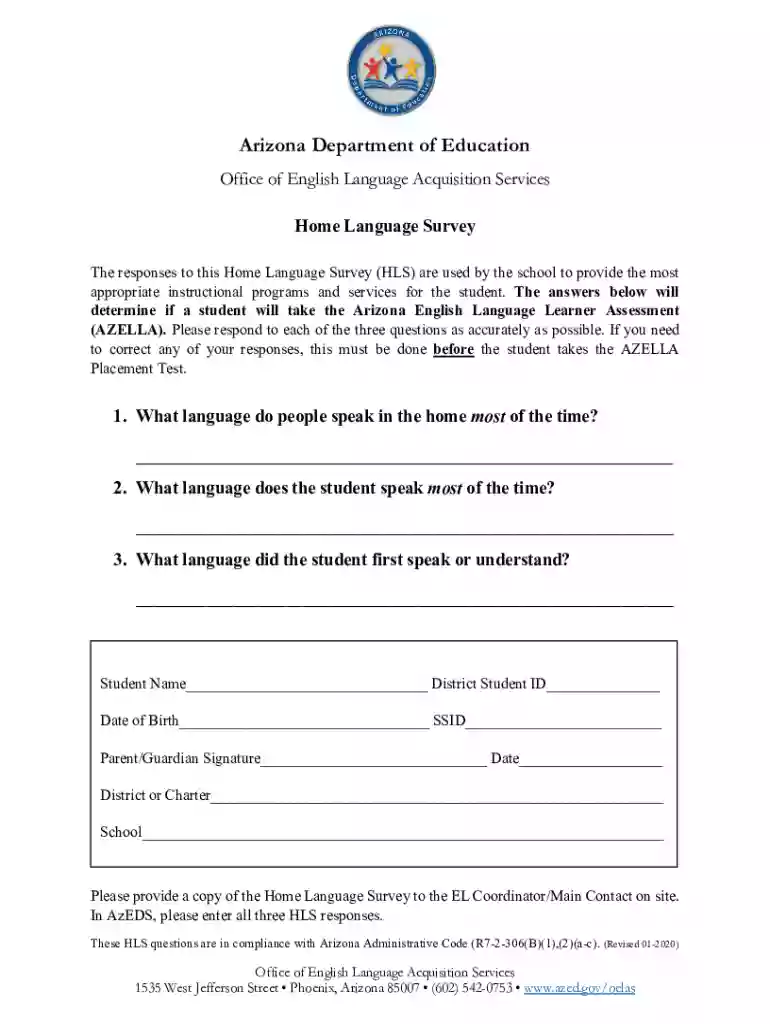
The Home Language Survey (HLS) is an essential tool used by schools to identify the linguistic background of students. Schools employ this survey to glean crucial information about the languages spoken by students and their families. This data is pivotal in crafting instructional programs that cater to the diverse linguistic needs of students. Moreover, the HLS serves as a determinant for students who might require the Arizona English Language Learner Assessment (AZELLA). By understanding the primary languages spoken at home, schools can enhance the educational experience for English Language Learners (ELLs).
To effectively utilize the HLS, educators and school administrators need to follow a systematic approach:
Distribution and Collection: Schools should distribute the HLS to parents and guardians at the point of student enrollment. With the advent of digital solutions, the survey is often shared electronically, ensuring ease of accessibility.
Evaluation of Responses: Once collected, responses should be meticulously evaluated. This evaluation helps in identifying students who might require additional English language support.
Data Utilization: The collated data informs the development of tailored language support programs and instructional strategies. This ensures students receive education aligned with their linguistic abilities.
Completing the HLS involves several straightforward steps:
Provide Student Information: Parents or guardians should begin by filling in the student's details, including name, grade, and school year.
Answer Language Questions: Address questions about the primary language spoken at home, the language the student mainly uses, and the first language understood by the student.
Signature and Date: Parents or guardians are required to sign and date the form, validating the information provided.
Submit the Form: The completed form should be submitted to the school's administration, either electronically or in paper format.
Schools deploy the HLS to:
Identify Linguistic Needs: Understanding the language dynamics of a student's household aids in determining their language learning needs.
Comply with Assessment Requirements: The HLS identifies students who may need to take language assessments such as AZELLA, ensuring regulatory compliance and educational support.
Drive Educational Strategies: Insights from the survey aid in developing informed instructional strategies, enhancing the educational experience for ELLs.
The HLS typically includes:
Student Identification Information: Basic details such as name, date of birth, and enrollment details.
Language Usage Questions: Inquiries about the dominant language spoken at home and by the student.
Parental or Guardian Signature: Ensures authenticity of the responses and formal agreement with the provided information.
The primary users of the HLS include:
School Administrators: For enrollment and assessment placement purposes.
Teachers: To tailor instructional methods and ensure language support aligns with students' needs.
Parents and Guardians: To provide foundational information that supports the student's education.


In states like Arizona, specific rules govern the use of the HLS:
Legal Compliance: Schools must adhere to state mandates regarding language assessments and support.
Language Assessment Requirements: Based on survey responses, students may be required to participate in assessments like AZELLA to evaluate their English proficiency.
Consider the scenario where a student, whose home language is not English, enrolls in a new school:
Through this process, the school ensures that the student receives appropriate language support, fostering an inclusive learning environment.
We've got more versions of the The responses to this Home Language Survey (HLS) are used by the school to provide the most form. Select the right The responses to this Home Language Survey (HLS) are used by the school to provide the most version from the list and start editing it straight away!
At DocHub, your data security is our priority. We follow HIPAA, SOC2, GDPR, and other standards, so you can work on your documents with confidence.
The purpose of the home language survey (HLS) is to determine the primary or home language of the student. This information is essential for schools to provideRead more
Oct 8, 2022 We used Tencent questionnaire to distribute questionnaires to the people of all over the country,including social people, the college students,Read more
by C Goldenberg 2010 Cited by 31 Children whose parents indicated that a language other than English was used in the home were either administered an English language.Read more


