






Definition & Meaning
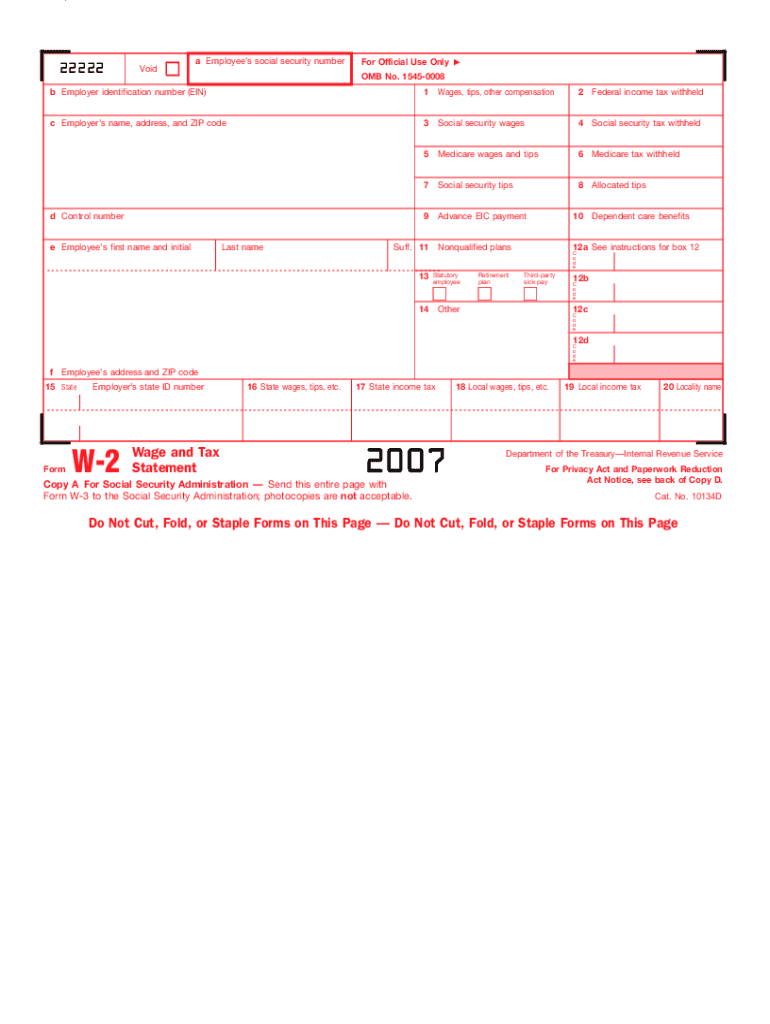
The 2007 W-2 Form, also known as the Wage and Tax Statement, is a document that employers in the United States are required to provide to their employees and the Internal Revenue Service (IRS). This form reports an employee’s annual wages and the amount of taxes withheld from their paycheck. The W-2 Form is crucial for employees to complete their personal tax returns and is an essential component of the United States tax filing system.
Key Elements of the Form
The form contains several critical elements, including:
- Employee’s Social Security Number (SSN) and name
- Employer's Employer Identification Number (EIN)
- Wages, tips, and other compensation
- Total Social Security and Medicare wages and taxes withheld
- Federal, state, and local income tax data
These sections provide comprehensive details necessary for accurate tax reporting and compliance with federal tax laws.
How to Use the 2007 W-2 Form
Employees use the 2007 W-2 Form primarily to prepare their annual tax returns. The information on the form assists in calculating the total amount of tax owed or refunded. Here's how to use it effectively:
- Verify Information: Ensure that personal and employer details are correct as listed.
- Input Data on Tax Returns: Enter the W-2 information into the correct sections of tax forms, such as Form 1040.
- Use for Deductions and Credits: Leverage the data for applicable tax deductions and credits, including the Earned Income Credit (EIC).
- Filing: Attach the W-2 Form to your tax return if filing by mail, or have it accessible for online filing.
Practical Example
A software engineer receives a 2007 W-2 Form from their employer. They use the information on the form to claim an EIC and accurately report federal income tax withheld throughout the year.
How to Obtain the 2007 W-2 Form
To receive a 2007 W-2 Form, employees should follow these steps:
- Request from Employer: The employer is required to send the W-2 Form by January 31 of each year. Contact the employer's HR department if the form has not been received by then.
- Check Online Platforms: Many companies offer electronic access to W-2 Forms through payroll services or company portals.
- Contact IRS if Needed: If the form is not received by mid-February, employees can reach out to the IRS for assistance.
Steps to Complete the 2007 W-2 Form
Employees do not typically complete the W-2 Form, as it is an employer's responsibility. However, understanding the form’s completion process can be beneficial:
- Gather Employee Data: Employers will need accurate personal and payroll information for each employee.
- Fill Appropriate Boxes: Complete each section with precise payroll and tax deduction amounts.
- Distribute Copies: Provide copies of the completed form to each employee and submit to the IRS.
Employer Scenario
A small business in New York employs five people and uses QuickBooks to automate payroll, thus generating and distributing accurate W-2 Forms seamlessly.
Legal Use of the 2007 W-2 Form
The W-2 Form must be used in accordance with IRS guidelines. It is legally binding documentation for both wage reporting and tax withholding.
Key Legal Aspects
- The W-2 is used for filing both federal and state income taxes.
- It must accurately reflect the wages paid and taxes withheld.
- Falsification or manipulation of details on the W-2 Form is a punishable offense.
IRS Guidelines
The IRS provides specific guidelines for the preparation and filing of W-2 Forms:
- Filing Deadline: Employers must file W-2s with the Social Security Administration by January 31.
- Correcting Errors: Use Form W-2c to make corrections to any previously submitted W-2 Forms.
- Electronic Filing: Employers filing 250 or more W-2 Forms must file electronically.
Penalties for Non-Compliance
Failing to comply with W-2 filing requirements can result in penalties:
- Late Filing: Penalties range based on lateness, beginning at $50 per W-2 Form for small delays.
- Fraudulent Information: Substantial fines may be imposed for intentional disregard of filing requirements.
Digital vs. Paper Version
Many employees and employers are transitioning to digital versions for ease of access and efficiency. Both digital and paper forms are acceptable, but electronic forms offer advantages:
- Accessibility: Immediate access through online portals
- Environmental Impact: Reduced paper usage
- Efficiency: Simplifies record-keeping and sharing
Example of Digital Usage
A remote worker based in California accesses their W-2 Form through a cloud-based system, allowing for seamless integration with digital tax filing software like TurboTax.
Filing Deadlines / Important Dates
Critical deadlines associated with the W-2 Form include:
- Form Submission: January 31 to the SSA
- Distribution to Employees: January 31
- Corrections: Submit Form W-2c as soon as errors are identified and corrected
Timely adherence to these deadlines is crucial to avoid penalties and ensure compliance with federal tax regulations.