




01. Edit your mitosis worksheet online
Type text, add images, blackout confidential details, add comments, highlights and more.

Type text, add images, blackout confidential details, add comments, highlights and more.

Draw your signature, type it, upload its image, or use your mobile device as a signature pad.

Send sw science 10 unit 1 mitosis worksheet via email, link, or fax. You can also download it, export it or print it out.
Mitosis is a process of cell division that results in two genetically identical daughter cells from a single parent cell, essential for growth, repair, and asexual reproduction in organisms. Understanding the stages of mitosis is crucial for students studying Grade 10 science, particularly in the context of the SW Science 10 Unit 1 Mitosis Worksheet. This worksheet aids students in visualizing and comprehending the intricate details of mitosis through diagrams and interactive questions.
Mitosis occurs in several distinct stages, which include:
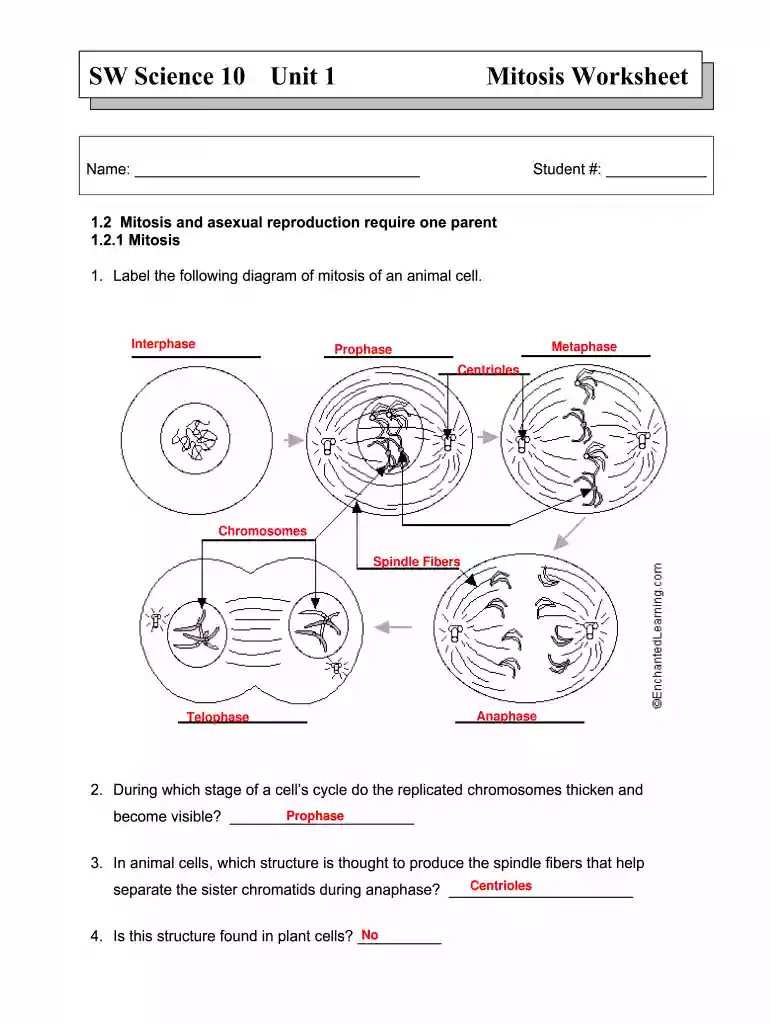
Diagrams in the SW Science 10 Unit 1 Mitosis Worksheet play a pivotal role in enhancing comprehension. Students are required to label these diagrams, which reinforces their understanding of the phases of mitosis and helps visualize the cellular mechanics involved. For instance, labeling structures like spindle fibers and chromosomes during prophase and metaphase allows students to connect theoretical knowledge with visual representation.
The worksheet provides a variety of review questions that are integral to solidifying the information learned. These questions may include:
By answering these questions, students can actively engage with the material, facilitating a deeper understanding of the subject matter and preparing them for assessments.
Mitosis is a form of asexual reproduction, particularly relevant in organisms such as bacteria and certain plants. The worksheet emphasizes this concept to illustrate how organisms can reproduce without the need for gametes. Understanding asexual reproduction through the lens of mitosis allows students to appreciate biological diversity and the mechanisms behind genetic consistency in offspring.
Included in the SW Science 10 Mitosis Worksheet are assessment tools such as quizzes and answer keys, which are valuable for both self-assessment and instructor evaluation. These tools provide immediate feedback, enabling students to identify areas needing further study. For example, students can work through problems associated with the mitosis worksheet's answer key, which offers solutions to complex questions and scenarios related to the content.
Different formats of the mitosis worksheet, such as interactive PDFs and printable versions, accommodate diverse learning preferences. For instance, students who thrive on digital platforms can use interactive features to complete their worksheets online, while those who prefer traditional methods can benefit from printed versions. This variety ensures accessibility for all learning styles while maintaining engagement with the subject matter.
Upon completion of the SW Science 10 Unit 1 Mitosis Worksheet, students will:
By addressing these outcomes, the worksheet becomes an essential resource in the educational toolkit for understanding cellular processes, ultimately fostering a comprehensive grasp of fundamental biological principles.
At DocHub, your data security is our priority. We follow HIPAA, SOC2, GDPR, and other standards, so you can work on your documents with confidence.
Apr 26, 2024 In class: Worksheet due at the end of class. Early Alerts: Full Term. #1: September 10th 11th. #2: October 10th 11th. NFC Course PolicyRead more
ABSTRACT. This manual is designed to provide teachers with practical information to assist them as they implement the Science 10.Read more


