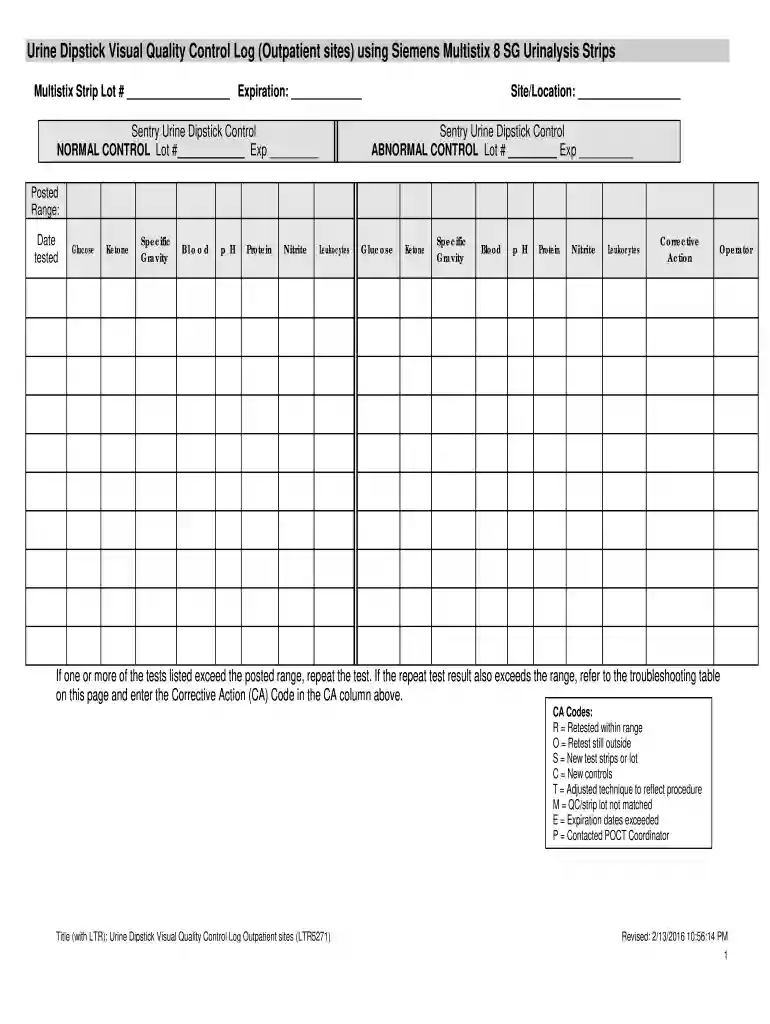
Urinalysis quality control log 2026

Get Form
urinalysis quality control log Preview on Page 1

Here's how it works

01. Edit your urinalysis quality control log online
Type text, add images, blackout confidential details, add comments, highlights and more.

02. Sign it in a few clicks
Draw your signature, type it, upload its image, or use your mobile device as a signature pad.

03. Share your form with others
Send urinalysis log sheet via email, link, or fax. You can also download it, export it or print it out.

Definition and Purpose of the Urinalysis Quality Control Log

The urinalysis quality control log is a critical document designed to ensure the reliability and consistency of urine testing results within medical facilities. This log is essential for documenting various components involved in urinalysis testing, including:

  • Lot Numbers: Each batch of testing strips or materials comes with a specific lot number that must be recorded. This enables traceability in case of quality issues.
  • Expiration Dates: It is vital to maintain the integrity of test results by ensuring that testing materials are within their expiration dates.
  • Test Results: Documentation of the results for various parameters such as glucose, ketones, and specific gravity. Recording these values allows for a methodical review of outcomes and enhances quality assessment.
  • Corrective Actions: In cases where test results fall outside the expected range, the log should indicate corrective actions taken, ensuring that issues are addressed promptly.

Utilizing a quality control log not only promotes compliance with governing health standards but also enhances the accuracy and reliability of urinalysis tests performed at outpatient sites.

Key Components of the Urinalysis Quality Control Log

When constructing an effective urinalysis quality control log, several key components must be included to ensure comprehensive documentation:

  • Operator Identification: This section captures the details of the individual performing the urinalysis, including name and credentials. This is crucial for accountability and traceability.
  • Testing Environment: Documenting conditions such as temperature and humidity can affect the quality of urinalysis results and should be noted to ensure reproducibility.
  • Control Tests: Regularly scheduled control testing is essential to ensure that the dipstick tests are functioning correctly. The log should include information on control test runs, including results and any follow-up actions taken.
  • Frequency of Testing: Establishing a schedule for regular quality control checks helps in maintaining standards and identifying patterns over time.
  • Review and Sign-off: Having a designated supervisor or manager review the log ensures that all entries are validated and approved, fostering a culture of quality and accountability.

These components aid laboratories in meeting regulatory guidelines while maintaining the accuracy of their urinalysis processes.

Steps to Maintain the Urinalysis Quality Control Log Effectively

Maintaining a urinalysis quality control log necessitates a systematic approach for accuracy and consistency. Here are effective steps to ensure diligent management:

  1. Daily Entry: Assign responsibility for daily entries to ensure that all required data is logged promptly. This should include test results, lot numbers, and operator details.
  2. Weekly Review: Implement a weekly review process whereby a designated team member checks the log for completeness and accuracy. This review should include cross-referencing with original documents.
  3. Monthly Assessment: Conduct a comprehensive monthly assessment of the quality control data. Analyze trends in results, identify recurring issues, and implement necessary changes to protocols.
  4. Staff Training: Ensure that all personnel involved in urinalysis testing understand the importance of the quality control log and are trained in how to complete it accurately.
  5. Corrective Action Documentation: Whenever an anomaly occurs, it is vital to log corrective actions taken, including investigations and follow-ups. This not only addresses immediate issues but also helps in preventing future occurrences.

By adhering to these steps, facilities can ensure the integrity of their urinalysis processes and maintain high standards of patient care.

Examples of Urinalysis Quality Control Scenarios

Understanding practical scenarios aids in comprehending the importance of a quality control log for urinalysis. Here are several key examples illustrating its application:

  • Scenario of Lot Number Tracking: Suppose a particular batch of testing strips consistently produces erroneous results for glucose levels. By documenting the lot number in the quality control log, the facility can identify and report the issue to the manufacturer, ensuring that patient safety is prioritized.
  • Corrective Actions: In instances where test results deviate from established ranges, such as an unexpectedly high specific gravity reading, the log must reflect the follow-up actions taken, like recalibrating the equipment or investigating potential user error.
  • Staff Accountability: During an audit, quality control logs serve as a mechanism for accountability. Should any issues arise regarding test accuracy, an audit trail can reveal the operator responsible, the conditions under which testing occurred, and the steps taken to resolve any discrepancies.

These scenarios highlight the practical significance of maintaining a detailed urinalysis quality control log for ensuring compliance and improving patient outcomes.

Compliance and Regulations Surrounding the Urinalysis Quality Control Log

Adhering to compliance standards is critical when managing a urinalysis quality control log. Various health regulations dictate the procedures and documentation required:

  • CLIA Regulations: The Clinical Laboratory Improvement Amendments set guidelines for laboratory testing, including urinalysis. Compliance with these regulations is mandatory for facilities to operate legally.
  • Accreditation Standards: Laboratories seeking accreditation through organizations like the College of American Pathologists must maintain rigorous documentation, which includes the quality control log for urinalysis.
  • State Regulations: Specific states may have additional regulations regarding laboratory practices. Familiarizing oneself with local guidelines is essential for compliance.

Maintaining thorough quality control logs not only aligns with regulatory requirements but also reinforces a facility's commitment to high-quality patient care. Regular audits and training can help to uphold these standards.

be ready to get more

Complete this form in 5 minutes or less

Get form

Got questions?

We have answers to the most popular questions from our customers. If you can't find an answer to your question, please contact us.
Contact us
A Quality Control Log is a document used to record and track the quality control measures performed in a medical laboratory. It serves as a record of the tests conducted, the results obtained, and any corrective actions taken.
How do I read my test results? Colour and Appearance: Normal is pale yellow. Specific Gravity: Measures concentration. pH Level: Indicates acidity. Protein: High levels might suggest kidney issues. Glucose: Presence could indicate diabetes or high blood sugar.
Here is a list of Quality Record examples: Inspection results. Traceability records. Product realization plans. Quality Objective charts. Customer communication email. Management review results. Product performance data. Process performance data.
A tool to help you itemize, document, and track items reported through quality management activities. 728.
Internal quality control (IQC) of a URST typically involves the measurement of control materials once per run or over a time interval. As in precision evaluation, test results from the control materials are compared with the expected values for the material; QC is assured when the difference is not more than one grade.

Security and compliance

At DocHub, your data security is our priority. We follow HIPAA, SOC2, GDPR, and other standards, so you can work on your documents with confidence.

Learn more

People also ask

Quality control is the process that defines how well the solution for a specific problem is known. Well log quality control is a set of methods that identifies and analyses data deviations from established standards and allows the design of a remedy.

Related links