







Definition and Meaning
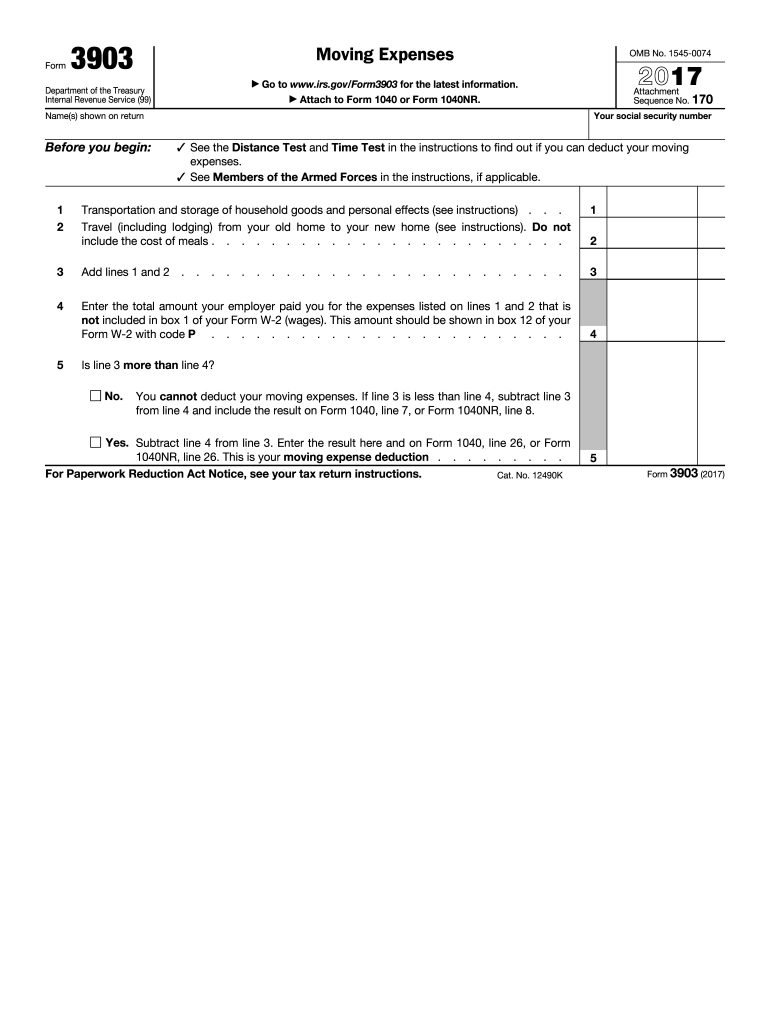
The "3 form" is a tax document issued by the Internal Revenue Service (IRS) used by individuals to claim deductions for certain moving expenses. This form is part of the United States federal income tax returns. Taxpayers can use Form 3903 to deduct reasonable costs associated with moving themselves and their household goods and personal effects to a new home. This deduction applies only if the move was related to starting work in a new location and if specific criteria, such as a distance test and a time test, are met.
Eligibility Criteria
To be eligible to use Form 3903 for moving expense deductions, taxpayers must meet the distance and time tests.
- Distance Test: The new workplace must be at least 50 miles farther from the taxpayer's old home than their old workplace was.
- Time Test: The taxpayer must work full-time for at least 39 weeks during the first 12 months after arriving in the general area of the new job location.
These tests ensure the move is closely related to work at a new job location. There are exceptions for members of the Armed Forces moving due to a permanent change of station.


Key Elements of the 3 Form
The form contains sections to enter specific moving expenses which are deductible under IRS rules. These include:
- Transportation and Storage: Costs of moving household goods and personal effects from the old home to the new home.
- Travel Expenses: Reasonable expenses for one trip, including lodging but excluding meals, for the taxpayer and their family.
Each section must be filled out accurately to ensure no issues with the deduction claim.
Steps to Complete the 3 Form
- Gather Information: Collect records of all moving-related expenses such as receipts and bills.
- Meet Eligibility Requirements: Ensure you qualify under the distance and time tests.
- Fill Out the Form: Enter your moving expenses in the respective sections of Form 3903.
- Enter costs related to transportation and storage.
- Include travel expenses like lodging during the trip.
- Attach to Your Tax Return: File Form 3903 with your IRS tax return to claim the deduction.
Examples of Using the 3 Form
Consider Jane, a software engineer who relocated from Miami to San Francisco for a new job. Her company's office is 200 miles farther from her previous location. Jane kept all receipts of her expenses during the move and worked full-time for ten months in San Francisco. She would qualify to use Form 3903 to deduct her qualifying moving expenses.
IRS Guidelines
The IRS provides specific guidelines on what expenses can be deducted using Form 3903:
- Only direct moving expenses are deductible, which include costs of packing, shipping, and storing household goods.
- Travel costs must be reasonable and necessary.
- Meals during the move are not deductible.
Taxpayers must adhere to IRS guidelines to avoid penalties and ensure accurate deductions.
Who Typically Uses the 3 Form
Individuals relocating for a new job generally use the 3 form. This typically includes:
- Employees who are starting a new job
- Employees transferred by their employers to a different geographical location
- Members of the military who are making a permanent change of station

State-Specific Rules for the 3 Form
While Form 3903 is a federal tax document, it's important to note that state tax laws vary. Some states might have additional requirements or do not allow moving expense deductions at the state level. Taxpayers should check with their state's tax authority for specific rules and regulations. For example, in California, moving expenses are not deductible on state tax returns despite being eligible for federal deduction.
Required Documents
When filling out Form 3903, the following documents are essential:
- Moving bills and invoices from the moving company or service providers
- Travel receipts including lodging
- Employment offer letter showing the new job location
- Banking statements to verify claimed expenses
These documents substantiate the deductions claimed, minimizing the risk of audits or inquiries from the IRS.




