




01. Edit your 150 air mile radius log sheet online
Type text, add images, blackout confidential details, add comments, highlights and more.

Type text, add images, blackout confidential details, add comments, highlights and more.

Draw your signature, type it, upload its image, or use your mobile device as a signature pad.

Send 150 air mile exemption log book via email, link, or fax. You can also download it, export it or print it out.
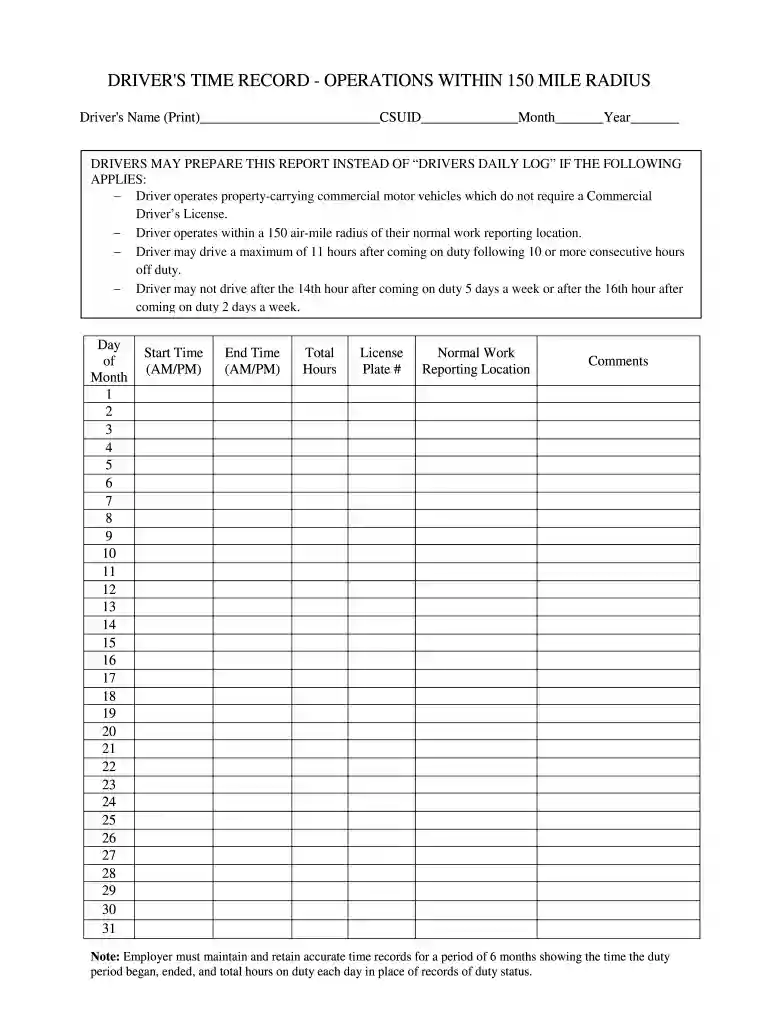
The 150 air mile radius log sheet is designed for drivers operating within a 150 air mile radius who do not require a Commercial Driver’s License (CDL). This log sheet allows qualified drivers to maintain a simplified record of their hours and routes, significantly easing the documentation burden while adhering to Federal Motor Carrier Safety Administration (FMCSA) regulations. It is essential for employers to recognize the stipulations surrounding this exemption to ensure compliance and avoid penalties.
Understanding the 150 air mile radius exemption is crucial for both drivers and employers. This exemption is applicable to drivers who:
These criteria enable drivers to use the log sheet instead of a traditional daily log, making it easier to track working hours. Employers have the responsibility to maintain accurate records of operation, which includes saving the logs for a minimum of six months to comply with FMCSA regulations.
A fully compliant 150 air mile radius log sheet includes several essential elements:
Maintaining detailed records helps drivers adhere to regulatory requirements and can be beneficial if an audit occurs.
Completing the 150 air mile radius log sheet is straightforward and should be done daily. Here's a step-by-step guide:
Accuracy is critical while filling out the log sheet, as incorrect entries can lead to non-compliance with FMCSA rules.
Employers must ensure that their drivers accurately fill out the 150 air mile radius log sheet. Here are some important considerations for maintaining compliance:
By maintaining robust procedures around the 150 air mile radius log sheet, employers can minimize operational risks and focus on their core business activities.
With advancing technology, many drivers opt for digital solutions to manage their log sheets, offering significant advantages:
Transitioning to digital formats can streamline operations while ensuring compliance and enhancing the efficiency of record keeping.
There are various situations where the 150 air mile radius log sheet is applicable:
Understanding these scenarios can help both drivers and employers maximize the utility of the 150 air mile radius log sheet.
Ensuring proper usage of the 150 air mile radius log sheet is about more than just compliance; it fosters accountability and efficient management of resources in the transportation sector. As regulations evolve and business needs change, staying informed about updates to FMCSA guidelines and best practices in record keeping will remain essential for safe and productive operations.
At DocHub, your data security is our priority. We follow HIPAA, SOC2, GDPR, and other standards, so you can work on your documents with confidence.
- Driver operates within a 150 air-mile radius of their normal work reporting location. - Driver may drive a maximum of 11 hours after coming on dutyRead more
* Operates within 100 air-mile radius for CDL or 150 mile radius for non CDL drivers. * Returns to headquarters and is released from work within 12Read more
Non-CDL 150 Air-Mile Radius Provision. Drivers are exempt from maintaining the daily log requirements of Section 395.8 if ALL of the following apply: TheRead more


