







Definition & Meaning
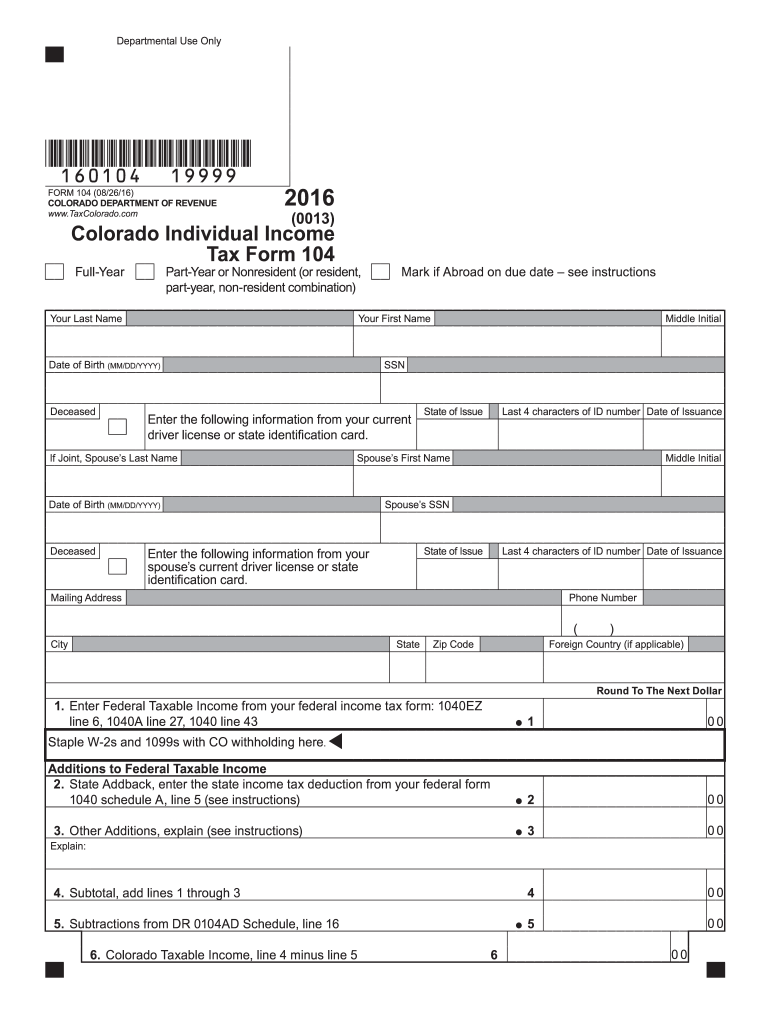
The Form 104 for the year 2016 is designated as the Colorado Individual Income Tax Return. It serves as a vehicle for reporting various tax-related financial details, including income, deductions, and credits, for a given tax year. This form is relevant for Colorado taxpayers who are classified as full-year residents, part-year residents, or non-residents. By submitting this, taxpayers can determine the amount of tax owed or the refund due. The form's function is to consolidate state income tax affairs within Colorado's legal framework, reflecting any federal taxable income adjustments applicable to state tax liabilities.
Steps to Complete the Form
-
Personal Information: Begin by filling out personal details such as your name, address, and Social Security Number. Ensure accuracy to avoid processing delays.
-
Income Reporting: Enter your federal taxable income as reported on your federal return. Adjust it for any Colorado-specific modifications.
-
Deductions and Credits: Detail any applicable deductions and credits. This includes standard deductions, contributions to state-approved organizations, or other state-specific credits.
-
Tax Calculation: Compute your state income tax liability using Colorado's tax rate schedules. Ensure that pre-paid taxes such as withholding and estimated tax payments are subtracted.
-
Finalizing Payment: If additional taxes are due, calculate and enter the payable amount on the form. Conversely, identify the refund amount if taxes paid exceed the total liability.
-
Signature and Submission: After completion, validate with your signature. Carefully review and submit the form via your chosen method: online, mail, or in-person, by the specified deadline.
Who Typically Uses the Form
The Colorado Individual Income Tax Form 104 is primarily used by:
- Full-Year Residents: Individuals residing in Colorado for the entire tax year are obligated to file this form to settle their state tax obligations.
- Part-Year Residents & Non-Residents: Those who have lived in Colorado for only a portion of the year or have earned income within the state must also file to properly allocate tax responsibilities for income attributable to Colorado.
Utilization of this form extends to a variety of taxpayer scenarios, ensuring compliance across different residency statuses.


Important Terms Related to Form
- Federal Taxable Income: The income figure determined on the federal level and used as a baseline for state tax reporting.
- Credits and Deductions: Allowances authorized by the state to reduce taxable income or tax liability.
- Withholding: Pre-paid taxes deducted from earnings that contribute to settling tax obligations.
- Amendments: Process of making corrections to previously filed forms, using an amended version if necessary.
Required Documents
Preparation to file Form 104 requires gathering the following documents:
- W-2s and 1099 Forms: Reflect wage and non-wage income earned throughout the year.
- Federal Tax Return: Provides federal taxable income figures and additional details necessary for state calculation.
- Records of Miscellaneous Income: Includes interest, dividends, and other financial gains.
- Receipts for State Deductions: Documentation for charitable contributions or expenses eligible for state-specific deductions.
Ensure all data is accurate to facilitate a smooth filing process.
Legal Use of the Form
Form 104 is a legally recognized document used for accurate reporting of state income taxes in Colorado. It should adhere to the statutory guidelines as outlined by the Colorado Department of Revenue. Incorrect or intentional misinformation on the form can lead to penalties, emphasizing the importance of truthful and precise data representation.
Filing Deadlines / Important Dates
- April 15: Traditionally, Form 104 and related tax documents are due by this date each year. If it falls on a weekend or holiday, the deadline extends to the next business day.
- Extensions: Should additional time be required, apply for an extension before the deadline to avoid penalties, though all estimated taxes must still be paid by the original deadline to prevent accruing interest.
Penalties for Non-Compliance
Failing to file Form 104 on time or providing inaccurate information can result in penalties, interest charges, and additional scrutiny by state authorities. Ensuring complete and timely submission along with proper documentation helps avoid these repercussions. Compliance with the filing requirements supports tax transparency and adherence to the state’s legal obligations.
Form Submission Methods (Online / Mail / In-Person)
- Online Filing: Offers a convenient, efficient alternative via the Colorado Department of Revenue's official website.
- Mail: Traditional paper forms can be sent to the appropriate address provided on the form.
- In-Person: Submission directly at a Colorado Department of Revenue office for those preferring a personal handover and feedback.
Choosing the method that best fits your circumstances can help streamline the filing process and allow for more effective management of tax responsibilities.




