






Definition & Meaning
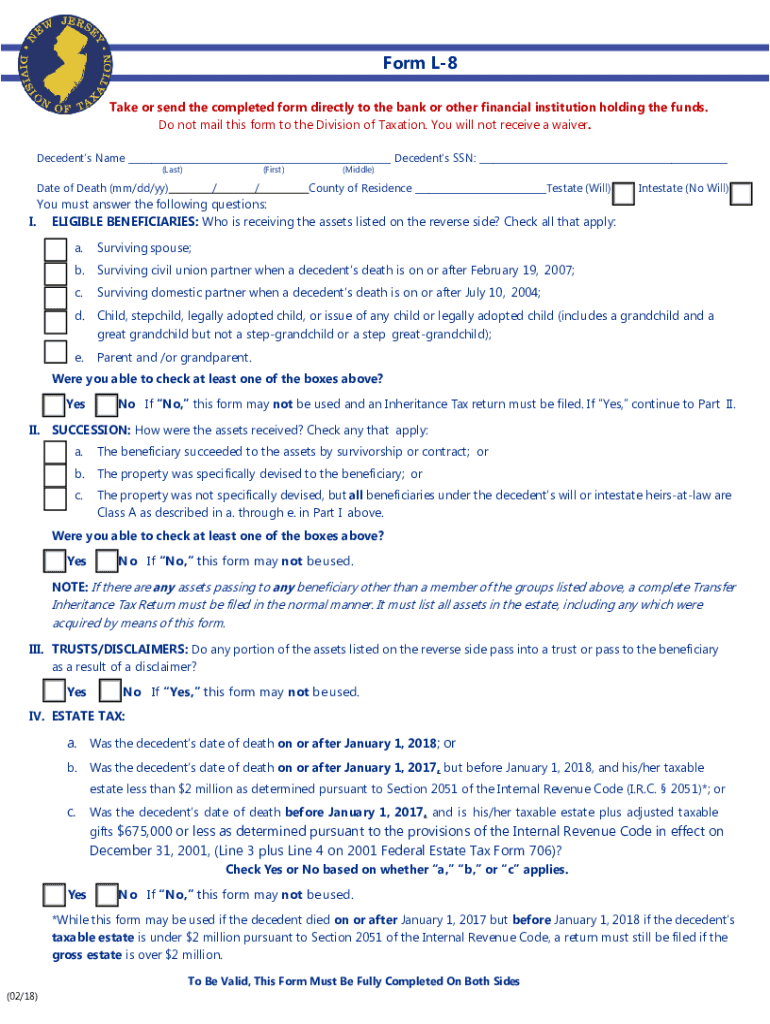
Form L-8 is a legal document utilized in New Jersey for facilitating the release of non-real estate assets owned by a deceased individual. These assets include bank accounts, stocks, brokerage accounts, and investment bonds. This form primarily serves as an affidavit completed by eligible beneficiaries such as executors, administrators, or specific joint tenants. It is essential for outlining and documenting the succession method, as well as addressing estate tax considerations that might arise in the absence of a will. The form is exclusive to non-real estate assets since real estate requires a separate document, the L-9.
Key Components of Form L-8
- Asset Details: A declaration of the deceased's non-real estate assets.
- Beneficiary Information: Details about the individuals entitled to the assets.
- Estate Tax Responsibility: Assessment of any due estate taxes, clarifying the tax waiver status.
How to Use the L-8 Form
When handling a deceased person’s estate in New Jersey, Form L-8 expedites asset transfer without court intervention.
- Determine Eligibility: Verify if you are eligible to file as an executor or next of kin.
- Gather Information: Collect necessary data, including details of the deceased, asset information, and your credentials as an executor or administrator.
- Fill the Form: Follow the instructions, ensuring all required information is accurately filled out.
- Submit the Form: Present the completed form to the financial institutions holding the assets.
Steps to Complete the L-8 Form
- Preparation:
- Identify all non-real estate assets.
- Gather certificates or statements proving ownership.
- Personal Information:
- Enter the deceased’s personal details, including name, date of death, and Social Security Number.
- Provide your details as the completing agent.
- Asset Declaration:
- List each non-real estate asset separately.
- Include account numbers and estimated values.
- Certification:
- Sign and date the form under penalty of perjury.
- Have the form notarized if required by the institution.
Eligibility Criteria
To effectively utilize Form L-8, certain criteria must be met:
- Residency: The deceased must have been a New Jersey resident.
- Relationship: Applicants must be closely related to the deceased, such as an executor, administrator, or executor-appointed agent.
- Asset Type: Only applies to non-real-estate assets.
Exceptions
- Non-Joint Assets: Cannot be used if assets were held in joint tenancy.
- Estate Tax Waiver: May not be applicable if previous estate tax returns have been filed.


State-Specific Rules for the L-8 Form
While the L-8 form is specific to New Jersey, there are nuances involved:
- Estate Tax Exemption: New Jersey demands special attention to estate tax, which may differ from federal requirements.
- Waiver Applications: An estate tax waiver may be needed if set thresholds are surpassed.
Differences Across States
- Asset Thresholds: Various states have different minimum asset requirements for needing an affidavit.
- Form Titles: Similar forms might exist under different nomenclature in other jurisdictions.
Filing Deadlines / Important Dates
Timeliness is crucial in completing the L-8 Form:
- Filing Deadline: Typically tied to estate planning timelines, but no specific deadline imposed.
- Bank Policy: Each financial institution may impose its guidelines regarding the timing of submissions.
Late Submissions
- Financial institutions might delay asset release upon late submission, emphasizing the importance of prompt filing.
Required Documents
Essential documentation supports L-8 Form submission:
- Death Certificate: An official document confirming the individual's death.
- Asset Documents: Account statements or certificates validating asset ownership.
- Beneficiary Identification: Valid ID proof of the executor or administrator.
Additional Documentation
- Tax Documents: Previous estate tax filings if applicable.
- Legal Authorizations: Power of Attorney or executor certification may be necessary.
Form Submission Methods (Online / Mail / In-Person)
While the method depends largely on the financial institution's policies, you have several options:
- Online Submission: Some institutions may offer portals for secure digital document exchange.
- Mail: Postal submission with registered mail for confirmation.
- In-Person: Direct handover at branches, ensuring immediate acknowledgement.
Recommendations
- Confirm with each institution for their preferred method.
- Consider expedited services to avoid processing delays.
Key Takeaways
The L-8 Form proves invaluable for beneficiaries of New Jersey residents, offering a streamlined process for accessing non-real-estate assets. By fully understanding its structure, eligibility requirements, and submission process, beneficiaries can ensure the efficient transfer of assets without unnecessary legal hurdles.