




01. Edit your aha form template free online
Type text, add images, blackout confidential details, add comments, highlights and more.

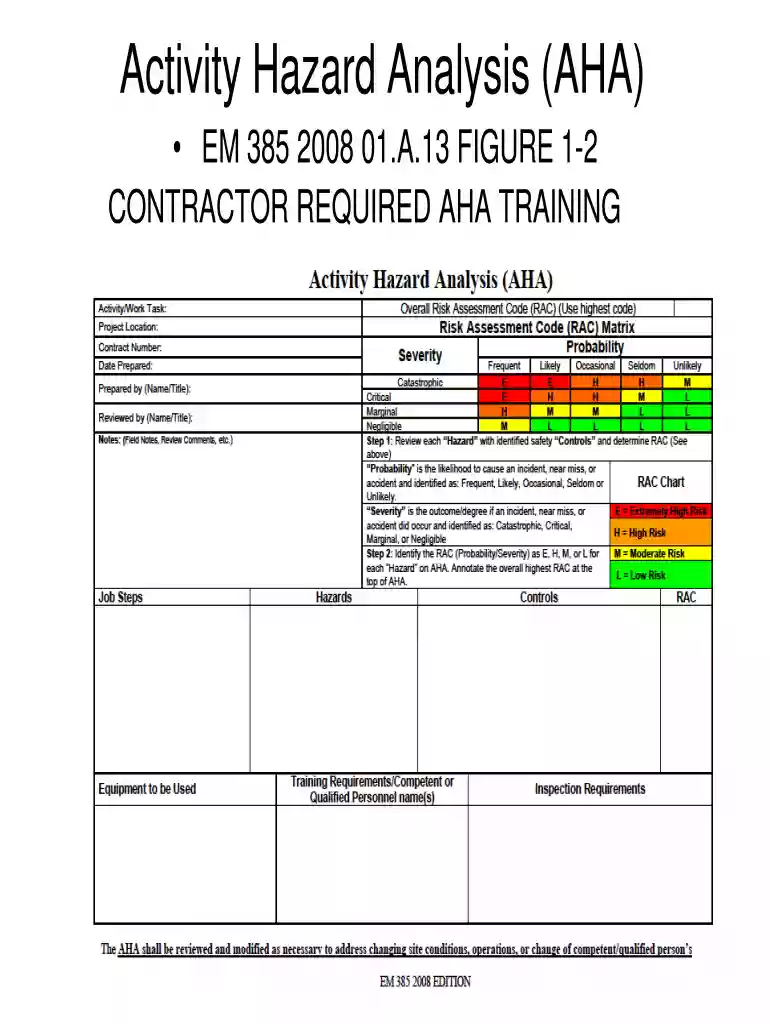
Type text, add images, blackout confidential details, add comments, highlights and more.

Draw your signature, type it, upload its image, or use your mobile device as a signature pad.

Send activity hazard analysis template excel via email, link, or fax. You can also download it, export it or print it out.
An Activity Hazard Analysis (AHA) template in Excel is an essential tool used to identify and manage risks associated with specific work activities in construction and other industries. This template allows organizations to systematically evaluate tasks, identify potential hazards, and implement control measures efficiently. Utilizing a spreadsheet format facilitates data manipulation, sharing, and real-time collaboration, aligning well with safety management practices.
The AHA template typically includes several critical components that guide users through the hazard analysis process:
Creating a site-specific AHA involves several steps to ensure thorough risk assessment:
Using the Excel format for the AHA template offers unique advantages:
The AHA should not be a static document. Continuous updates are vital to adapt to changing site conditions, personnel variances, and evolving regulations. Regular reviews of the AHA allow teams to remain proactive in identifying new hazards or adjusting existing control measures as necessary.
Various industries implement AHA templates to minimize risks effectively. For instance:
Utilizing an AHA template in Excel simplifies the complexity of hazard analysis, promoting a culture of safety within any organization. Engagement in this proactive risk assessment process equips teams to recognize hazards and adopt strategies that foster workplace safety and compliance with regulatory requirements.
We've got more versions of the aha form template free form. Select the right aha form template free version from the list and start editing it straight away!
| Versions | Form popularity | Fillable & printable |
|---|---|---|
| 2008 | 4.8 Satisfied (123 Votes) |
Sure, a typed name is accepted as a valid electronic signature when you add it to your document using a compliant solution like DocHub. Simply upload your activity hazard analysis template to our editor, click Sign in the top tool pane → Create your signature → Type your name in the proper tab, and decide how it will appear on your document.
If you store your paperwork in Google Drive, there is no need to download your aha template on the computer and upload it back to our editor. A significantly simpler way is to install a browser extension developed by DocHub to simplify this flow. The extension allows editing PDFs in your web browser. Alternatively, you can integrate your DocHub and Gmail accounts for more efficient editing.
At DocHub, your data security is our priority. We follow HIPAA, SOC2, GDPR, and other standards, so you can work on your documents with confidence.




This draft guidance, when finalized, will represent the current thinking of the Food and Drug. Administrations (FDA or we) on this topic.Read more
Hazard Analysis. A, B, D, F, H, J, L, N, P, R, T. 1, #, System, Hazard Description, Risk before Mitigation Measures, Risk Elimination or Mitigation MeasuresRead more
No information is available for this page.


