
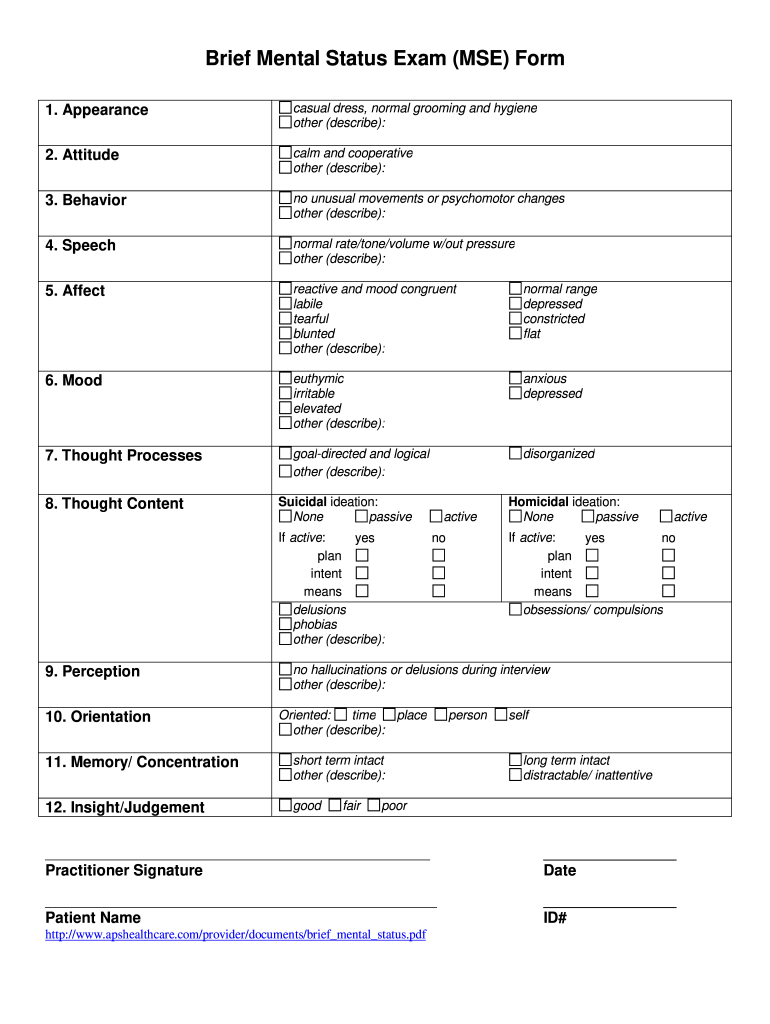







Definition and Meaning of the Mental Status Exam
The mental status exam (MSE) is a structured assessment used by healthcare professionals to evaluate an individual's mental state. It encompasses various aspects, including appearance, behavior, mood, and cognitive functioning. The MSE provides essential insights for diagnosing mental health conditions and planning treatment. Understanding the components involved in a mental status exam template is crucial for effectively assessing a patient's mental health.
Key Components of the Mental Status Exam
- Appearance: Observations about the patient's grooming, attire, and general physical presentation.
- Behavior: Analysis of the patient's interaction style, demeanor, and any noticeable behaviors, such as restlessness or eye contact.
- Speech: Evaluation of the patient's speech patterns, including rate, volume, and coherence.
- Mood and Affect: Assessment of the patient's emotional state and how congruent their emotional expression is with their thoughts.
- Thought Process and Content: Examination of the patient’s thought organization, clarity, and the presence of delusions or obsessions.
- Perception: Exploration of the patient’s sensory perceptions, including any hallucinations.
- Cognition and Insight: Assessment of orientation (to time, place, person), memory, and the patient’s understanding of their mental state and illness.
How to Use the Mental Status Exam Template
Using a mental status exam template effectively involves several steps that guide practitioners in gathering comprehensive information. Adhering to a structured format ensures consistency and thoroughness in evaluations.
Structured Approach to the MSE
- Preparation: Gather all necessary documentation and create a comfortable environment for the patient to facilitate open communication.
- Using the Template: Begin by following the sections outlined in the template, which include appearance, behavior, and cognitive domains.
- Document Observations: Record observations in real-time while interacting with the patient. Accurate documentation is vital for future reference and treatment planning.
- Review Findings: At the end of the assessment, review the documented information to ensure all relevant details are captured and coherent.
Benefits of Structured Templates
- Promotes comprehensive assessments.
- Enhances accuracy in documenting mental state.
- Facilitates better communication among healthcare providers regarding patient status.
Steps to Complete the Mental Status Exam Template
Completing a mental status exam template requires an organized process that ensures no critical elements are overlooked. Each step builds on the previous one, guiding the healthcare professional through the assessment.
- Introduce the Examination: Begin by explaining the purpose of the MSE to the patient to foster trust and cooperation.
- Collect Demographic Information: Fill in basic information such as the patient's name, age, and reason for the visit.
- Assess Each Section of the Template:
- Complete sections on appearance and behavior by jotting down specific observations.
- Evaluate speech and mood, taking note of any distinctive or erratic patterns.
- Investigate thought processes and perception, documenting any abnormal findings clearly and concisely.
- Summarize Findings: Conclude with an overall impression of the patient's mental status, highlighting any concerns or areas requiring further exploration.
Detailed Example of the MSE Process
For instance, if a patient appears disheveled and expresses hopelessness, this should be noted explicitly in the appropriate sections of the template. The healthcare professional should be precise, as this documentation is critical for understanding the patient's condition later.
Important Terms Related to the Mental Status Exam Template
Familiarity with specific terminology aids in accurately completing a mental status exam template and enhances communication among professionals.
- Affective/Facial Expression: Refers to the patient's emotional expressions visible in their demeanor.
- Disorientation: A state where a patient is confused about their surroundings, time, or identity.
- Insight: The patient’s recognition of their psychological condition and the implications it has on their life.
- Judgment: The ability of the patient to make sound decisions regarding daily activities and safety.
Recognizing these terms can prevent misunderstandings and ensure clarity in assessments and documentation.
Legal Use and Compliance of the Mental Status Exam Template
The mental status exam serves as a critical document in the realm of mental health, and understanding its legal implications is essential.
Legal Considerations
- Confidentiality: Ensure that patients' privacy is maintained throughout the documentation and assessment process.
- Consistency with Standards: Adhere to regulatory criteria, including those set forth by the American Psychiatric Association and related authorities.
- Documentation Integrity: Accurate and truthful documentation is crucial, as it can influence treatment decisions and legal ramifications.
Importance of Proper Legal Use
Legal compliance safeguards patient rights and helps practitioners maintain ethical standards in their assessments.
Examples of Using the Mental Status Exam Template
Illustrative examples can significantly enhance the understanding of the mental status exam and its practical applications.
Case Study 1: General Assessment
A young adult presents for a routine MSE due to anxiety. The clinician notes:
- Appearance: Disheveled, wearing unkempt clothes.
- Behavior: Restless movements, avoiding eye contact.
- Mood: Reported feelings of sadness; affect is flat.
Case Study 2: Crisis Intervention
An individual in an acute crisis is assessed. Observations include:
- Speech: Pressured speech that is difficult to interrupt.
- Thought Content: Expresses paranoid ideations indicating a possible underlying disorder.
- Insight: Limited – the individual does not recognize the impact of their mental health on behavior.
These scenarios demonstrate how the template aids in capturing crucial information that informs diagnosis and treatment plans.




