




01. Edit your liquor order sheet online
Type text, add images, blackout confidential details, add comments, highlights and more.

Type text, add images, blackout confidential details, add comments, highlights and more.

Draw your signature, type it, upload its image, or use your mobile device as a signature pad.

Send liquor order form via email, link, or fax. You can also download it, export it or print it out.
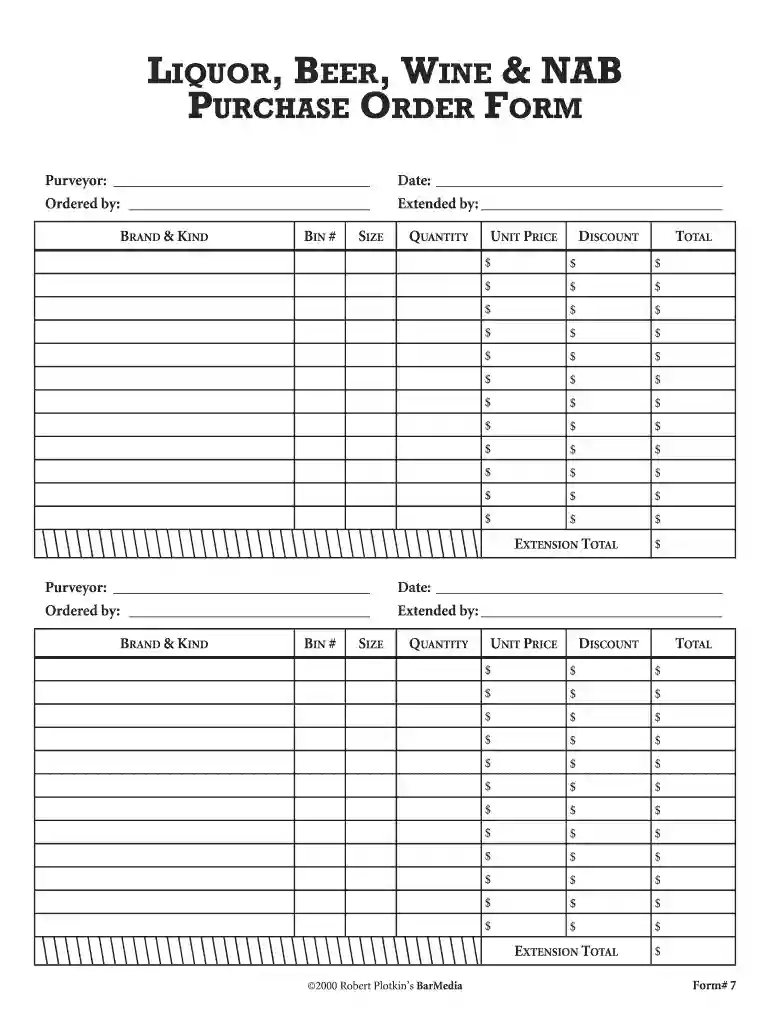
A liquor order sheet template is a critical document used by businesses within the beverage industry, specifically for ordering alcoholic beverages such as liquor, beer, and wine. Such templates streamline the ordering process, ensuring all necessary information is captured efficiently, minimizing errors, and enhancing operational workflow.
The liquor order sheet template is designed to gather essential details methodically.
Purveyor Information: Essential details about the supplier, including name, contact information, and address. This information is crucial for follow-ups or resolve any issues regarding the order.
Ordered Items: This section details what is being ordered, including:
Total Costs: A calculated summary reflecting:
Order Date and Delivery Instructions: Important for tracking and ensuring that the order arrives on time at the specified location.
Utilizing the liquor order sheet template effectively involves a few strategic steps:
Select the Appropriate Template: Choose a liquor order sheet that fits your business's needs, often available as a printable PDF or an editable Excel file.
Fill in Purveyor Information: Enter the supplier's details accurately to ensure that the order is processed without delays.
List Ordered Items: Populate this section with the items needed, taking care to include the specifics like brand, size, quantity, and pricing.
Calculate Total Costs: Use the template’s built-in formulas, if applicable, or ensure that manual calculations are accurate.
Review Before Submission: Ensure all details are correct to avoid issues with fulfillment.
Submit the Order: Send the completed sheet to the supplier via your preferred method (email, fax, or direct delivery).
The primary benefits of using a liquor order sheet template include:
Efficiency: Speeds up the ordering process by having a structured format that is easy to fill out and follow.
Accuracy: Reduces the likelihood of errors in quantities or pricing, which can lead to unnecessary costs or delivery delays.
Record Keeping: Offers a written record of orders that can be helpful for both parties to clarify any discrepancies or manage inventory effectively.
Legal Compliance: Ensures that the ordering process adheres to regulations governing alcoholic beverages, which can vary by state.
Several entities find the liquor order sheet template beneficial:
Bars and Restaurants: Necessary for managing inventory and reordering stock regularly.
Liquor Stores: Assists in maintaining accurate inventories and timely replenishments.
Caterers: Often require specific quantities of various beverages for events, making this tool essential for planning.
Distributors: Facilitate the ordering process for their clients in a structured manner.


Familiarizing oneself with relevant terminology aids in understanding the document's purpose and optimal execution:
SKU (Stock Keeping Unit): A unique identifier for each product, essential for inventory tracking.
Net Price: The cost of products excluding any tax or additional fees.
Lead Time: The amount of time between placing an order and receiving the items, critical for planning inventory levels.
Minimum Order Requirements: Specific conditions placed by suppliers regarding the least amount of product that can be ordered.
This information-rich overview ensures that users comprehend the significance and practical application of a liquor order sheet template, which is indispensable in the beverage industry.
Yes, a typed name is recognized as a legitimate electronic signature when you add it to your paperwork using a compliant solution like DocHub. Simply import your liquor order sheet template to our editor, click Sign in the top tool pane → Create your signature → Type your name in the proper tab, and choose how it will look on your document.
You can get and modify your alcohol inventory template online by using DocHub. Its simple yet feature-rich design allows you to begin productive work right after you sign up your account. Create your profile and add your document, then our interface will guide you via our stress-free form completion experience.
At DocHub, your data security is our priority. We follow HIPAA, SOC2, GDPR, and other standards, so you can work on your documents with confidence.
Select from one of the following: General, Alcohol, Tobacco, Firearms Ammunition, Reserved, Alcohol - Miscellaneous, Revenue, Records, Reports Statistics.Read more
Apr 20, 2025 Download and customize our bar inventory template for Excel or Google Sheets to track stock on hand, manage ordering, and optimize yourRead more
Sep 13, 2020 Multiple Sheets: Multiple sheet final site plans may be used. All sheets shall be numbered and referenced to an index, and all requiredRead more


