Business financial statement template 2026

Get Form
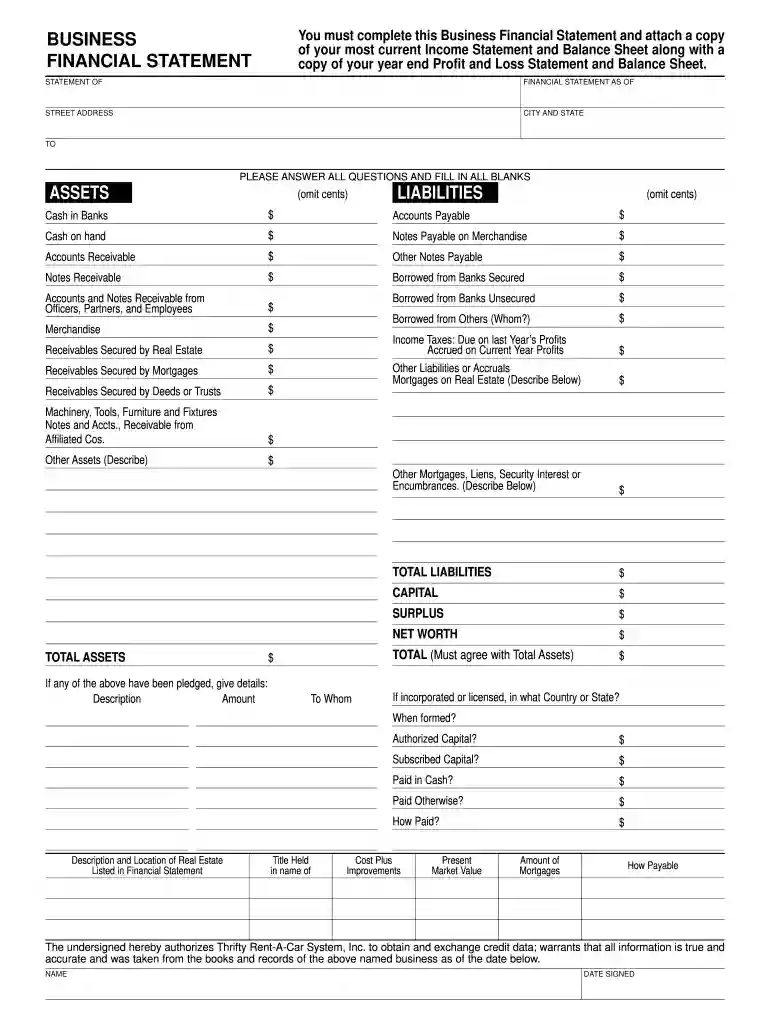
blank business financial statement Preview on Page 1

Here's how it works

01. Edit your blank business financial statement online
Type text, add images, blackout confidential details, add comments, highlights and more.

02. Sign it in a few clicks
Draw your signature, type it, upload its image, or use your mobile device as a signature pad.

03. Share your form with others
Send business financial statement template via email, link, or fax. You can also download it, export it or print it out.

Definition and Meaning of the Business Financial Statement Template

A business financial statement template serves as a structured format designed to capture the financial health of a business. It consolidates critical data regarding a company's financial position, typically summarizing key areas such as income, expenses, assets, and liabilities. This template can be used across various business types, including sole proprietorships, partnerships, and corporations, to provide stakeholders with an overview of financial performance. Understanding these financial statements is crucial for both internal management and external parties, such as investors and lenders, as they rely on accurate financial reporting to make informed decisions.

Key Components of a Business Financial Statement

  • Assets: This section outlines what the business owns, including cash, receivables, inventory, and property.
  • Liabilities: Here, the business records its obligations, such as loans, accounts payable, and accrued expenses.
  • Equity: This component represents the owner’s stake in the business, calculated as total assets minus total liabilities.
  • Income Statement: A summary of revenues and expenses over a specific period, providing insights into profitability.
  • Balance Sheet: A snapshot of the business's financial condition at a specific point in time, detailing assets, liabilities, and equity.

Steps to Complete the Business Financial Statement Template

Filling out a business financial statement template can seem daunting, but following a structured approach simplifies the process. Here are the essential steps involved:

  1. Gather Financial Records: Collect all relevant financial documents, including invoices, bank statements, receipts, and existing financial reports.
  2. Fill Out Basic Information: Input your business name, address, and other identifying details at the top of the template.
  3. Complete the Assets Section: List all current and fixed assets. Ensure to quantify the value of each item based on recent appraisals or accounting records.
  4. Document Liabilities: Include all outstanding debts and obligations. Group these by current and long-term liabilities for clarity.
  5. Calculate Owner’s Equity: By subtracting total liabilities from total assets, you can determine the equity position of the business.
  6. Prepare the Income Statement: Record your revenues and expenses, noting significant line items that impact your profitability.
  7. Review and Validate Data: Before finalizing the document, cross-check all figures for accuracy and ensure they align with your accounting records.

Important Terms Related to Business Financial Statements

Understanding the terminology associated with business financial statements is essential for effective communication and analysis. Here are some key terms to be familiar with:

  • Fiscal Year: The twelve-month period used for accounting purposes, which may or may not correspond with the calendar year.
  • Depreciation: A method of allocating the cost of tangible assets over their useful lives, affecting both income and asset valuations.
  • Liquidity: A measure of how easily assets can be converted into cash to meet short-term obligations.
  • Profit Margin: The ratio of profit to revenue, indicating how effectively a company controls its costs and expenses.
  • Account Receivable: Money owed to a company by customers for goods or services delivered but not yet paid for.

Examples of Using the Business Financial Statement Template

Utilizing a business financial statement template can vary significantly based on business types and needs. Here are examples to illustrate practical applications:

  • For Loan Applications: Businesses seeking financing can present a well-structured financial statement to demonstrate their creditworthiness to lenders. It serves as a critical component of the loan application process.
  • For Internal Review: Company managers may use the template to regularly assess financial health and inform strategic planning, allowing for data-driven decisions regarding budgets and resource allocations.
  • For Investor Relations: Startups and growth-stage companies can use the template to provide potential investors with an overview of financial performance, showcasing revenue growth, profitability, and the overall business model.

Legal Use of the Business Financial Statement Template

Using a business financial statement template is essential for compliance with various legal and regulatory requirements. Adhering to these guidelines ensures that your financial reporting meets established standards and protects your business from potential audits or penalties.

Compliance with Accounting Standards

  • Generally Accepted Accounting Principles (GAAP): Most businesses in the United States are required to prepare financial statements in compliance with GAAP, which governs the standards for financial reporting.
  • Securities and Exchange Commission (SEC) Regulations: Companies required to file with the SEC must ensure their financial statements comply with federal regulations to provide transparency and accuracy to investors.

Additionally, businesses must also consider any state-specific regulations that may affect their financial reporting obligations. Understanding these requirements is crucial for avoiding non-compliance penalties and establishing credibility with stakeholders.

be ready to get more

Complete this form in 5 minutes or less

Get form

Security and compliance

At DocHub, your data security is our priority. We follow HIPAA, SOC2, GDPR, and other standards, so you can work on your documents with confidence.
Learn more
ccpa2
pci-dss
gdpr-compliance
hipaa
soc-compliance