




01. Edit your behavior observation form online
Type text, add images, blackout confidential details, add comments, highlights and more.

Type text, add images, blackout confidential details, add comments, highlights and more.

Draw your signature, type it, upload its image, or use your mobile device as a signature pad.

Send student behavior observation form pdf via email, link, or fax. You can also download it, export it or print it out.
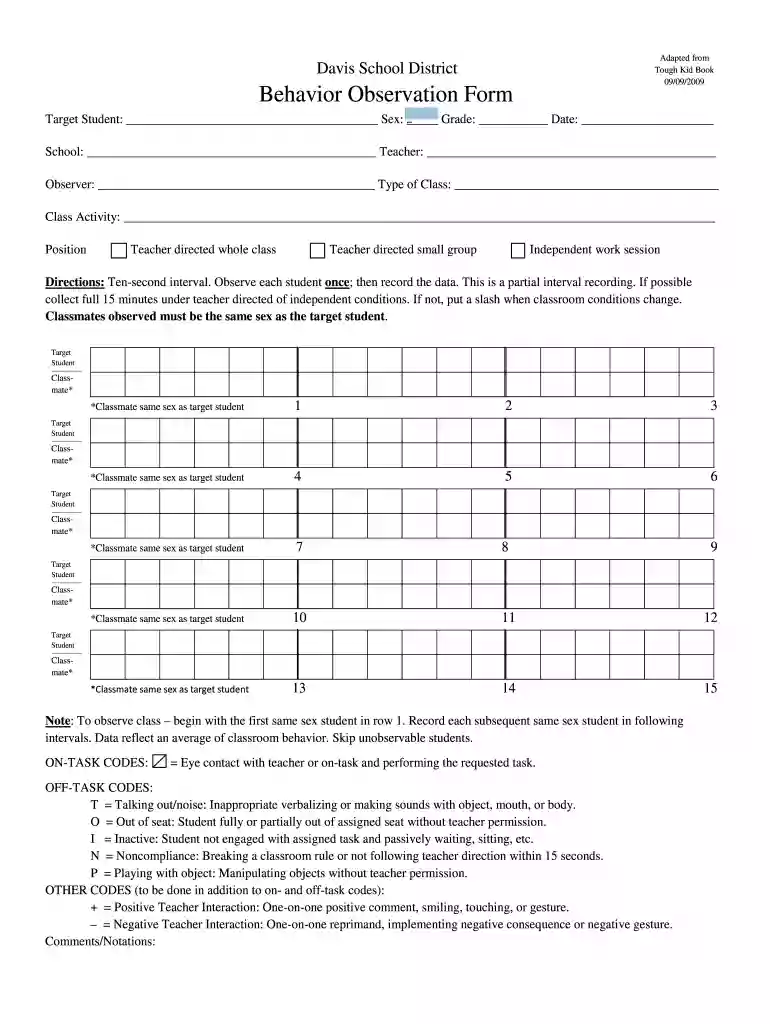
The Behavior Observation Checklist PDF is a structured tool designed for educators and behavioral specialists to systematically document and evaluate student behavior in various settings. This checklist aids in recording specific behaviors, analyzing patterns, and identifying areas for intervention.
Target Student Identification: This section includes fields for the observer to note the name, age, and grade of the student being observed. Establishing a clear identification allows for tailored observations that consider the student’s unique context.
Observation Context: This prompts the observer to describe the setting and circumstances in which the behavior is occurring, such as the classroom, cafeteria, or during recess. Understanding the environment provides insight into potential triggers or supports.
Behavioral Categories: The checklist should outline various types of behaviors to be observed. Common categories include:
On-Task versus Off-Task: Observers can use checkboxes or a coding system to mark whether the student is on-task or off-task during specific intervals. This binary coding provides a clear and concise way to quantify behaviors.
Frequency Counting: Some checklists may include a section for counting the frequency of specific behaviors, allowing educators to track the occurrence of both positive and negative behaviors over time.
Teacher Interactions: This section captures the responses from teachers or staff when observing particular behaviors. Noting how interactions influence behavior can help in identifying effective strategies or necessary adjustments.
Intervention Notes: Observers can document any interventions used during the observation, such as verbal reminders, guided support, or behavior-specific praise. This helps create a comprehensive record of actions taken in response to observed behaviors.
Observation Time Frame: A designated area for noting the time and date of observations aids in identifying trends over time. For example, regular observations over weeks or months can help determine if certain behaviors are improving, deteriorating, or remaining consistent.
Summarizing Observations: At the end of the checklist, there should be a section dedicated to summarizing overall observations, identifying patterns, and suggesting possible next steps. This synthesis is crucial for developing personalized behavior intervention plans tailored to the individual needs of the student.
Printable Behavior Observation Forms: Having the checklist in PDF format ensures that it can be easily printed or shared electronically, allowing for versatile use in various educational settings.
Easy Access and Edits: With platforms like DocHub, users can not only access but also edit the checklist as needed, ensuring that it remains a living document that reflects ongoing observations and strategies for improvement.
Classroom Behavior Tracking: In a kindergarten classroom, a teacher might use the behavior observation checklist to monitor student engagement during a group activity, documenting instances of off-task behavior and successful peer interactions.
Behavioral Interventions: A behavioral specialist may utilize this checklist during a one-on-one session to track a student’s response to specific interventions, noting when they remain on-task and when they require redirection.
Behavior Observation Form Templates: Various templates are available for download to suit different school environments, ensuring that educators can select the most relevant form for their needs.
Comparison with Other Tools: Other forms such as the systematic behavior observation form offer additional structures for collecting data, and may include different coding and categorization systems suited to specific behaviors being targeted.
Using a Behavior Observation Checklist PDF is instrumental in the systematic analysis of student behaviors, supporting educators in making informed decisions that positively impact classroom dynamics and individual student success.
We've got more versions of the behavior observation form form. Select the right behavior observation form version from the list and start editing it straight away!
| Versions | Form popularity | Fillable & printable |
|---|---|---|
| 2009 | 4.8 Satisfied (140 Votes) |
Upload your classroom behavior observation form to DocHub (after you’ve created an account for this). If you need to fill out fields in it, use proper tools from the top pane. For example, add Signature Fields, assign each to specific person, and click on Sign → Request signatures from others. Personalize your message for your recipients and click Send Request. You can also send your paperwork by fax or as a Signing link instead of using email (you’ll locate these options by navigating to the Menu → Send)
When you go for analog methods of completing your behavioral observation form, you can easily download your file for printing. Search DocHub’s Forms & Templates catalog to get the exact document template you need and open it for editing or download it on your gadget in the format of your choice. It is easy to complete your form electronically and place your handwritten signature on it after printing or eSign your document with DocHub.
At DocHub, your data security is our priority. We follow HIPAA, SOC2, GDPR, and other standards, so you can work on your documents with confidence.
25. emotion inappropriate for situation. 26. emotional swings. 27. flat, unvarying mood. 28. euphoric, elated(happy) mood. 29. angry, hostile mood.Read more
OBSERVED BEHAVIOR CHECKLIST. Directions: Supervisor or Manager, please document your observations of the employees behavior and indications on this form.Read more
Behavioural Observations. Note behavioral observations of the clients presentation of self. The coach/practitioner should assess the clients overall mentalRead more


